Author

admin

Browsing

The biotech sector is entering 2026 with a positive outlook, characterized by reasonable valuations, robust oncology momentum and supportive policy tailwinds. This combination is setting the stage for a continued recovery, driven in part by the integration of artificial intelligence (AI).

However, this sectoral resurgence must navigate a tug-of-war between supportive stimulus and structural risks, which have the potential to challenge the pace of recovery.

Biotech sector rebounding after US uncertainty

According to Song, biotech has rebounded since its lows in April of this year.

Company valuations are trading at a 15 percent discount to broader markets on forward price-to-earnings, with secular demand intact for oncology, obesity and chronic diseases. In Song’s view, the biotech industry’s rebound stems from reduced uncertainty under the administration of US President Donald Trump.

Song added that valuations across healthcare are reasonable, noting rotational flows from cooling AI hype.

“I can’t deny that there have been some rotational effects that not just biotech has benefited (from), but healthcare in general,’ he commented. “While AI is an important driver in healthcare, to our view, it certainly is not priced in to the largest extent in many pockets of healthcare.”

Key biotech sector catalysts in 2026

Song sees healthcare’s recovery extending into 2026, with oncology remaining the primary growth engine.

He characterized the current sector resurgence as a durable structural shift being fueled by key developments that present tangible investment opportunities, including anticipated positive clinical trial outcomes, such as those for Revolution Medicines’ (NASDAQ:RVMD) pancreatic cancer drug.

“They have a lead drug that blocks an important pathway called RAS … and they could have a potential breakthrough in pancreatic cancer. They’re running a Phase III trial to demonstrate a potential survival benefit. There could be meaningful progress there,” Song noted. A data readout is expected next year.

Outside oncology, Song flagged high-profile biotech catalysts that could broaden the sector’s 2026 rally.

“Non-peptide oral GLP-1s … are clearly going to be an important data set readout and launch that could occur next year,” he explained, citing Eli Lilly’s (NYSE:LLY) orforglipron, a daily pill that hit Phase III success for type 2 diabetes and obesity in 2025. Approval is expected in 2026, and he believes it could be a potential game changer in obesity and chronic disease treatments, an area dominated by biotech innovators.

Song also sees validation ahead for platform technologies.

A dual-track recovery for biotech

While macro analysts see a broad cyclical recovery in 2026, Song predicts that the market will be defined by a dual-track recovery: a diagnostics-led initial public offering (IPO) surge, and a biopharma M&A environment focused on companies with the clinical validation required to alter the current standard of care.

Renaissance Capital predicts a faster pace for biotech IPOs, with a strong pipeline of companies such as Aktis Oncology, a radiopharma diagnostics firm targeting solid tumors, ready to list for US$100 million.

Additionally, AlphaSense forecasts steady M&A flow as companies rebuild their pipelines in the new year, a trend that Song sees as a structural necessity rather than a simple trend. “It’s an important pillar where Big Pharma needs to replenish their pipelines, and they can’t all do it internally,” he explained.

Consequently, he believes the primary “hunting ground” for these deals is mid-cap territory, where acquiring one or two proven drugs can effectively move the needle for a large pharmaceutical giant.

AI in the biotech sector

Song maintained that AI has not reached full valuation in the sector, and its role is expected to grow, with significant future productivity gains predicted in biopharma, drug discovery, clinical development and healthcare delivery.

“We’ve done some preliminary work that that that suggests there could be … productivity gains in areas like biopharmaceuticals and drug discovery and clinical development,” Song explained, adding that these are long-term projections. He sees a more immediate economic impact in how care is managed.

“Since healthcare is a large part of the US and global economy, and growing quickly in terms of healthcare costs, there are also opportunities for efficiency gains, which could lead to margin and consumer gains,” he noted. This revolution in delivery is already a key focus for his firm’s Tema Oncology ETF (NASDAQ:CANC).

However, life science market analyst Anastasia Bystritskaya warned that valuation and productivity are not synonymous, as high-performing models do not automatically become revenue-producing products. For investors, the real inflection point is operational integration rather than operating as a standalone prototype.

Drive for efficiency is expected to take a practical form in 2026 through what Sergey Jakimov, managing partner at longevity and biotech venture capital firm LongeVC, described as the “doctor in your hand.”

This AI companion manages routine, low-complexity tasks between clinic visits.

LongeVC anticipates that this shift to a regulated digital workflow will allow AI to identify meaningful clinical signals continuously without overburdening primary care teams.

This democratization of discovery creates a new competitive landscape for the hunting ground Song described; if AI-enabled teams can dissect complex pathways without a billion-dollar balance sheet, the traditional R&D model of Big Pharma faces a permanent disruption. In this new era, the innovation gap could be filled by agile players who use technology to act with the scale of a giant, but the speed of a startup.

Investor takeaway

Despite sector momentum, headwinds remain, particularly regarding the stability of clinical research funding.

A November report in JAMA Internal Medicine reveals that 383 clinical trials recently had their grants terminated, disrupting progress for over 74,000 participants. Dr. Gary K. Zammit, founder of Clinilabs, warned these reductions in National Institutes of Health funding risk slowing future commercial development of innovative therapies.

Macroeconomic headwinds, including rising tariffs and early labor market weakness, also present a material challenge.

Ultimately, the 2026 biotech outlook balances promising catalysts with the need for strategic capital deployment and a focus on clinically validated platform technologies, ensuring a durable expansion for the sector.

Securities Disclosure: I, Meagen Seatter, hold no direct investment interest in any company mentioned in this article.

This post appeared first on investingnews.com

President Trump has faced unprecedented lawfare, including four indictments, two impeachments and countless lawsuits aimed at keeping him from power, confiscating his wealth and even putting him in prison for life. The most stark example? The FBI’s August 2022 raid of his Mar-a-Lago property. This week, we learned that even FBI agents did not believe there was probable cause for the sham raid.

The Fourth Amendment is fundamental to our Republic. The government cannot search or seize one’s home, office, papers or person without probable cause. Usually, authorities must obtain a search warrant prior to searching or seizing.

When the raid on Mar-a-Lago became public, lawfare opponents were horrified, for we had crossed the Rubicon. FBI agents rummaged through Trump’s personal effects and took his passport. They staged photos of folders supposedly containing classified information haphazardly strewn about and the Justice Department under then-President Biden released them to the media to cast Trump in a negative light.

The material in question consisted of records that Trump was allowed to maintain under the Presidential Records Act. A battle started between Trump and the National Archives, which wanted some of the documents. Biden’s White House Deputy Counsel Jonathan Su waived executive privilege, allowing the Biden Justice Department to begin an investigation. The Justice Department obtained a warrant to search for and seize the records, and Trump was indicted for allegedly unlawful retention of classified materials the following year.

The entire process was corrupt. First, the records were under Secret Service protection. Former presidents receive federal funds for secure office space so that they can maintain classified records. Former presidents, prior to Biden’s disgraceful decision to lock out Trump, were entitled to receive classified intelligence briefings. Trump allowed government officials to come to Mar-a-Lago to view the records and was opposed only to turning them over.

Second, the motive for the return of the records had nothing to do with security concerns. Trump had many records concerning Operation Crossfire Hurricane, the official name for the Obama-Clinton Russian Collusion Hoax. The 2016 campaign of Hillary Clinton cooked up the claim that Trump colluded with Russia to hack Clinton’s emails. Trump sued Clinton and the Democratic National Committee based on the Russia investigation.

Third, the warrant was a sham because the magistrate was not neutral and detached. Magistrate Judge Bruce Rinehart of the Southern District of Florida signed the warrant. Just six weeks earlier, Rinehart had recused himself from the Trump/Clinton lawsuit. The reason was obvious: Rinehart, while a civilian in 2017, had written a Facebook post viciously bashing Trump. The Biden Justice Department ran to a blatantly biased judge in order to procure the warrant.

This week, through documents released by Senate Judiciary Committee Chairman Chuck Grassley, we learned that even agents in the FBI’s Washington Field Office did not think that probable cause existed for the raid. The involvement of the Washington Field Office itself is scandalous. The alleged crime occurred in the Southern District of Florida. Yet, Biden special counsel Jack Smith used a D.C. grand jury to obtain subpoenas. D.C. voted for Trump’s opponents at a clip of 90% or more during the last three elections. Smith also went to shamelessly leftist D.C. Chief District Judges Beryl Howell and James Boasberg to obtain favorable rulings. Smith only indicted Trump in the Southern District of Florida because he feared that a D.C. conviction would get reversed over improper venue.

Florida District Judge Aileen Cannon invalidated Smith’s appointment on constitutional grounds. Then, Trump won a decisive electoral victory last November, and Smith ended his ignominious witch hunt, fleeing back to Europe.

The lawfare waged against Trump, his aides, his supporters, and even members of Congress, most blatant during Operation Arctic Frost, where nearly a dozen senators had their phone records seized, threatened to destroy the Republic. The lawfare perpetrators failed, however, and it is time for legal accountability in the form of an indictment for conspiracy against rights pursuant to 18 U.S.C. § 241.

The government searched a former president’s home without probable cause to seize records in order to protect a corrupt former presidential candidate and to end the future political prospects of Trump. And the government procured the search warrant from a biased judicial disgrace who had no business anywhere near any case involving Trump. What occurred is a stain on the judiciary and the nation. Justice must, and will, come.

This post appeared first on FOX NEWS

The Department of Justice on Tuesday released nearly 30,000 pages of documents related to disgraced late financier Jeffrey Epstein. This is the latest batch of documents to be released since the DOJ began publishing files on Dec. 19.

The files include a number of revelations, including a psychological assessments from Epstein’s time in prison, a fake passport and his cellmate’s testimony about witnessing the financier’s first apparent suicide attempt. The newly released pages also include a claim made by an unidentified Epstein accuser who said that former President Bill Clinton’s name was used as a way to deter her from coming forward.

Here are some of the top takeaways.

Prison psychology report shows Epstein was deemed ‘low risk’ for suicide days before his death

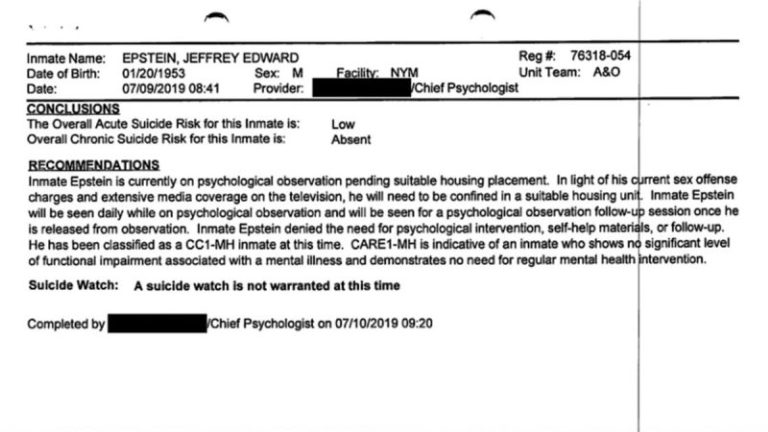
A Bureau of Prisons psychological assessment released Tuesday by the DOJ showed Epstein was considered to be at ‘low’ acute suicide risk and showed no signs of suicidal ideation just days before his death, according to internal prison records.

The suicide risk assessment, conducted on July 9, 2019, states Epstein was placed on precautionary psychological observation due to the high-profile nature of his case and not because he expressed intent to self-harm.

‘Inmate Epstein adamantly denied any suicidal ideation, intention or plan,’ the chief psychologist wrote in the assessment.

The psychologist noted Epstein appeared ‘polite, calm, and cooperative’ during the evaluation, with ‘organized and coherent’ thoughts and no signs of acute psychological distress. Additionally, the psychologist documented Epstein saying that ‘being alive is fun,’ describing himself as a banker with a ‘big business,’ and expressing confidence in his legal defense.

The report concluded that ‘the Overall Acute Suicide Risk for this Inmate is: Low,’ and, ‘A suicide watch is not warranted at this time.’

Newly shared Bureau of Prisons records shed fresh light on what Epstein’s cellmate, Nicholas Tartaglione, says he witnessed during the disgraced financier’s first apparent suicide attempt while in federal custody.

‘I was asleep with headphones on when I felt something hit my legs,’ Tartaglione said, according to the memo.

‘I turned on the light and saw Epstein on the floor with something around his neck,’ he told investigators, adding that Epstein appeared unresponsive.

The records state Tartaglione immediately called for help after discovering Epstein on the ground. Correctional officers responded, and Epstein was taken for medical evaluation. Officials later described the incident as an apparent suicide attempt.

The documents also note that Epstein later accused Tartaglione of trying to kill him, a claim Tartaglione flatly denied.

‘That allegation is completely false,’ Tartaglione told investigators. Additionally, Bureau of Prisons officials said there was no evidence to support Epstein’s claim.

Epstein was later removed from the cell and placed under closer observation before his death weeks later in what was ruled a suicide.

Tartaglione was sentenced to four consecutive life sentences in 2024 for killing four people, according to prior reporting from Fox News Digital.

Epstein accuser said Clinton’s name was used to deter her from coming forward

A woman who accused Epstein of sexual misconduct said she was warned that his ties to former President Bill Clinton could prevent her from working if she spoke out, according to a sworn attorney-released statement in Tuesday’s DOJ document dump.

In the statement, dated August 27, 2019, the woman identified as Jane Doe alleged that after fleeing an encounter with Epstein at his Manhattan mansion, another woman cautioned her that Epstein ‘knew a lot of powerful people, including Bill Clinton,’ and that refusing him could end her career in the modeling industry.

The accuser said she believed the reference to influential figures was meant to intimidate her and discourage her from coming forward.

The statement does not allege that Clinton participated in or had knowledge of the alleged encounter. Clinton has previously denied wrongdoing in connection with Epstein.

Jeffrey Epstein’s fake passport revealed

The latest documents also include a fake passport that Epstein apparently used in the 1980s. The passport appeared to be issued from Austria, with Epstein going by the name ‘Marius Robert Fortelni.’ It listed Saudi Arabia as his place of residence. 

In a 2019 letter to a federal judge over his detention on sex trafficking charges, Epstein’s lawyers justified his use of a false identity. 

‘Eighth, as for the Austrian passport the government trumpets, it expired 32 years ago,’ his attorneys said in the letter. ‘And the government offers nothing to suggest — and certainly no evidence — that Epstein ever used it.’ 

‘In any case, Epstein – an affluent member of the Jewish faith – acquired the passport in the 1980s, when hijackings were prevalent, in connection to Middle East travel,’ the letter continued. ‘The passport was for personal protection in the event of travel to dangerous areas, only to be presented to potential kidnappers, hijackers or terrorists should violent episodes occur.’

Epstein requested ‘razor to shave,’ complained of lack of water weeks before death, document shows

Documents indicate that Epstein requested a razor to shave while in federal custody just weeks before his death, while also raising a series of complaints about his detention conditions.

In a July 30, 2019 internal communication labeled ‘Inmate Epstein,’ Epstein asked for a razor and requested access to water during attorney conferences, saying the available machine ‘does not have water’ and that he was becoming dehydrated, according to the document.

The same email notes Epstein claimed he did not receive all of his prescribed medications after being placed on psychological observation, and said he had not slept well in 21 days due to the absence of his CPAP machine. Epstein also complained about noise in the Special Housing Unit, warning he could suffer ‘psychological trauma’ from the conditions.

Fox News’ Bill Mears contributed to this report.

This post appeared first on FOX NEWS

President Donald Trump’s newly appointed envoy to Greenland said Tuesday the administration wants to open a dialogue with residents of the territory, stressing the U.S. is not seeking to ‘conquer’ the island.

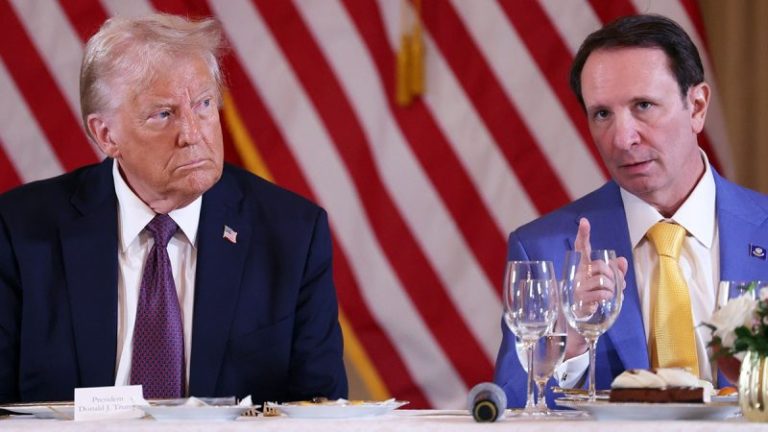
During an appearance on Fox News’ ‘The Will Cain Show,’ Louisiana Gov. Jeff Landry, who was tapped as special envoy to Greenland by Trump on Sunday, said discussions must be had with Greenlanders to understand what they want moving forward.

‘What are they looking for? What opportunities have they not gotten? Why haven’t they gotten the protection that they actually deserve?’ Landry said.

Landry added that the U.S. ‘has always been a welcoming party,’ and that the Trump administration is not going to ‘go in there trying to conquer anybody’ or ‘take over anybody’s country.’

Landry’s comments came after Danish leaders sharply criticized Trump after he announced the appointment of the new special envoy to Greenland, a territory controlled by Denmark.

‘We have said it before. Now, we say it again. National borders and the sovereignty of states are rooted in international law,’ Danish Prime Minister Mette Frederiksen and Greenlandic Prime Minister Jens-Frederik Nielsen said in a joint statement Monday. ‘They are fundamental principles. You cannot annex another country. Not even with an argument about international security.’

Trump wrote on Truth Social Monday that Landry ‘understands how essential Greenland is to our National Security, and will strongly advance our Country’s Interests for the Safety, Security, and Survival of our Allies, and indeed, the World.’

On Tuesday, Danish Foreign Minister Lars Løkke Rasmussen called Trump’s comments ‘completely unacceptable,’ adding that he would summon the U.S. ambassador.

The Danish kingdom, he wrote on Facebook, is ‘sovereign and cannot accept that others question it.’

Trump has previously expressed ambitions for the U.S. to acquire Greenland, posting on Truth Social in December 2024 that ‘ownership and control of Greenland is an absolute necessity’ for national security purposes.

In another post from January 2025, Trump said Greenland is an ‘incredible place,’ and its people will ‘benefit tremendously if, and when, it becomes part of our Nation,’ before declaring, ‘MAKE GREENLAND GREAT AGAIN!’

Fox News Digital has reached out to the White House for comment.

Fox News Digital’s Alex Nitzberg and The Associated Press contributed to this report.

This post appeared first on FOX NEWS

As the year closes, Republicans are looking to the past for another dance with a partisan exercise that tested the party’s unity and delivered President Donald Trump his crowning legislative achievement of the year.

Budget reconciliation is how congressional Republicans rammed through Trump’s ‘big, beautiful bill,’ earlier this year. But it’s a time-consuming, labor-intensive process that laid bare intra-party divisions and nearly exploded before liftoff.

Still, some Republicans want to take another stab at reconciliation, which allows a party in power to advance legislation with just a simple majority in the Senate as long as it adheres to strict, budgetary parameters.

‘We can do two more reconciliation bills without a single Democratic vote,’ Sen. John Kennedy, R-La., told Fox News Digital. ‘Doesn’t mean we wouldn’t welcome Democratic votes, but we can do them without a single Democratic vote.’

Turning once again to reconciliation would help Senate Republicans, in particular, address one of Trump’s desires to kill the 60-vote filibuster threshold in the upper chamber without changing the precedent that Democrats, for years, have threatened to do.

But they need a plan, first.

That would come from Senate Budget Committee Chair Lindsey Graham, R-S.C., the de facto maestro of the reconciliation process. His committee was responsible for drafting the budget resolution that unlocked the process in the upper chamber earlier this year, and he is reportedly eying drafting another resolution in the new year.

‘It would be political malpractice not to do another reconciliation,’ Graham told Semafor.

But many Republicans acknowledged just how difficult reconciliation is, especially after the latest exercise that dominated much of Congress’ attention for the first half of the year.

Senate Majority Leader John Thune, R-S.D., told Fox News Digital that ‘it’s always hard, but it’s an option, and one that we’re not ruling in or ruling out.’

‘I would say you have to have a reason to do it, you know,’ Thune said. ‘I mean, you don’t just do reconciliation for the heck of it. You got to have a, you know, a specific purpose. And so we’ll see. I mean, that purpose may, you know, may start getting some traction.’

Kennedy floated using reconciliation to tackle affordability issues, but some see the painstaking process as an avenue to grapple with another issue that has dominated Congress for several months: healthcare.

Lawmakers left Washington, D.C., without a fix to expiring Obamacare subsidies, effectively setting up a drastic hike in out-of-pocket healthcare costs for millions of Americans. There are bipartisan negotiations in the works to deal with the issue when lawmakers return, but Republicans have a gnawing appetite to drastically change the program.

Sen. Jim Banks, R-Ind., told Fox News Digital that Republicans ‘have to do something’ on healthcare.

‘Reconciliation is one pathway to do something, but it also limits what we can do,’ Banks said. ‘So we need bipartisan support to pass something that will help everybody.’

And Sen. Jim Justice, R-W.Va., who has been critical of Republicans’ inability to get a healthcare solution across the line, told Fox News Digital that reconciliation ‘may be an answer.’

‘The healthcare situation is really, it’s a big deal,’ Justice said. ‘It’s more than difficult, you know? And so we need to, we need to try to fix it. That’s for sure.’

This post appeared first on FOX NEWS

The recently launched ‘GenAI’ tool for U.S. service members and Department of War workers is a ‘critical first step’ in the future of warfare, according to a military expert.

This month, the Pentagon announced the launch of GenAI.mil, a military-focused AI platform powered by Google Gemini. Secretary of War Pete Hegseth said the platform is designed to give U.S. military personnel direct access to AI tools to help ‘revolutioniz[e] the way we win.’

On Monday, the Department of War also announced that the Pentagon is further integrating Elon Musk’s xAI Grok family of models into the GenAI platform, allowing employees to use xAI safely on secure government systems for routine work, including tasks involving sensitive but unclassified information.

In an interview with Fox News Digital, Emelia Probasco, a Navy veteran, former Pentagon official and senior fellow at Georgetown University’s Center for Security and Emerging Technology, explained that the tool will help train Department of War service members and civilians on the use of artificial intelligence in their everyday workflow, preparing them for further integration of AI in military matters.

Probasco said the tool will have a ‘big impact’ on the everyday functioning of the Department of War.

‘Prior to the rollout of this new website and having Gemini 3 available to the force, folks were either using sort of a tool that wasn’t as capable … or even worse, they were sort of going to their home computers and trying to do various things on their home computers, which they’re not supposed to do, but it was probably happening,’ Probasco explained. ‘Now they’ve got a more secure environment where they can experiment with these tools and really start to learn what they’re good for and what they’re not good for.’

While Probasco said she does not believe the tools, such as the GenAI platform, ‘fully changes war,’ she thinks ‘it’s the critical first step in training so that we know how to use it well.’

She said that the Department of War has ‘made it very clear in the past year that they want to forge ahead and be innovative and try new things and adopt AI.’

The GenAI tool, Probasco said, gives the department a type of sandbox to experiment with for still bigger innovations to come.

‘There are responsible people in the department who are trying to figure out what is the best use of this tool. Let’s try lots of experiments in sort of sandboxes or in safe places so that when a conflict comes, we are ready and ahead, frankly, of any adversary who has started to play with the tools,’ she explained.

Probasco said the Department of War understands that adversaries such as China are also developing and experimenting with artificial intelligence. Indeed, this month, President Donald Trump announced he would be partially reversing a Biden-era restriction on high-end chip exports, permitting Nvidia to export its artificial-intelligence chips to China and other countries.

The H200 chips are high-performance processors made by Nvidia that help run artificial intelligence programs, like chatbots, machine learning and data-center tasks. 

Lawmakers on Capitol Hill voiced that they are split over the decision, with some seeing the move as a dangerous concession and others as strategic.

Either way, Probasco said ‘we have lots of evidence’ that China ‘is doing rapid experimentation [with AI] across all domains of warfare.’

‘And it’s not, can I use a chatbot, but rather, ‘Can I gather up lots of information to start to target individuals for espionage?’ For example, [and], ‘Can I use data to create more sophisticated cyber-attacks?’’ she explained.

‘There is this sort of dynamic of a race between the two sides trying to figure out how to adopt it,’ she explained.

Though important, Probasco said the GenAI tool is ‘not going to necessarily be the weapon system that gains [the U.S.] an advantage.’

She assured the AI tool that will truly give the U.S. a military advantage ‘is underway,’ but said ‘that’s not the sort of thing you just roll out for every service member to use.’

‘It’s important to remember that using a chatbot to help you think through certain problems or do talking points is not what’s going to win the war. There are much more sophisticated military systems that use generative AI; they use other kinds of what’s called ‘good old-fashioned AI.’ There are lots of other techniques that militaries need to use,’ she said.

‘Those are already in the works, and they’ve been in the works for years,’ Probasco explained, adding, ‘That’s not going to be rolled out in a big public announcement where everybody can play with it.’

This post appeared first on FOX NEWS

Blackrock Silver Corp. (TSXV: BRC,OTC:BKRRF) (OTCQX: BKRRF) (FSE: AHZ0) (‘Blackrock’ or the ‘Company’) is pleased to announce a non-brokered private placement (the ‘Offering’) of up to 13,636,363 units (the ‘Units’) at a price of C$1.10 per Unit for gross proceeds of up to C$15,000,000. Each Unit will be comprised of one common share of the Company (each, a ‘Common Share’) and one-half of one Common Share purchase warrant (each whole warrant, a ‘Warrant’). Each Warrant will entitle the holder thereof to acquire one Common Share at a price of C$1.50 per Common Share for a period of two years from the closing date of the Offering. The Company expects that two cornerstone investors will purchase all or substantially all of the Units to be issued under the Offering.

The Offering is subject to certain conditions including, but not limited to, the receipt of all necessary approvals including the approval of the TSX Venture Exchange (the ‘TSX-V‘). All securities to be issued in connection with the Offering will have a hold period of four months and one day from the closing of the Offering.

The net proceeds of the Offering are intended to be used by the Company to fund exploration, permitting and pre-development activities on the Company’s Tonopah West project and for general working capital.

Andrew Pollard, Blackrock’s President and Chief Executive Officer, commented: ‘The $15 million investment from two strategic buyers, including one of our largest shareholders and a new cornerstone investor, demonstrates strong alignment around our vision for Tonopah West. As an emerging American silver developer, the funding strengthens our balance sheet and enables us to advance aggressively on exploration, pre-development, and permitting initiatives.’

The Company may pay finder’s fees in connection with the Offering of up to 6% in cash and, for those applicable, finder’s warrants (‘Finder’s Warrants‘) equal to up to 6% of such Units placed by the finder, each Finder’s Warrant exercisable for one Common Share for a 2 year term at a price of $1.50 per Common Share. The finder’s fees shall be paid in accordance with applicable securities laws and the policies of the TSX-V.

It is anticipated that a certain insider of the Company may acquire Units under the Offering. Such participation will be considered to be a ‘related party transaction’ within the meaning of TSX-V Policy 5.9 (the ‘Policy‘) and Multilateral Instrument 61- 101 – Protection of Minority Security Holders in Special Transactions (‘MI 61-101‘) adopted in the Policy. The Company intends to rely on the exemptions from the formal valuation and minority shareholder approval requirements of MI 61-101 contained in sections 5.5(a) and 5.7(1)(a) of MI 61-101 in respect of related party participation in the Offering as neither the fair market value (as determined under MI 61-101) of the subject matter of, nor the fair market value of the consideration for, the transaction, insofar as it involves interested parties, is expected to exceed 25% of the Company’s market capitalization (as determined under MI 61-101).

The securities offered have not been, and will not be, registered under the U.S. Securities Act of 1933, as amended (the ‘U.S. Securities Act‘) or any U.S. state securities laws, and may not be offered or sold in the United States or to, or for the account or benefit of, United States persons absent registration or any applicable exemption from the registration requirements of the U.S. Securities Act and applicable U.S. state securities laws. This news release shall not constitute an offer to sell or the solicitation of an offer to buy securities in the United States, nor shall there be any sale of these securities in any jurisdiction in which such offer, solicitation or sale would be unlawful.

About Blackrock Silver Corp.

Backed by gold and silver ounces in the ground, Blackrock is a junior precious metal focused exploration and development company driven to add shareholder value. Anchored by a seasoned Board of Directors, the Company is focused on its 100% controlled Nevada portfolio of properties consisting of low-sulphidation, epithermal gold and silver mineralization located along the established Northern Nevada Rift in north-central Nevada and the Walker Lane trend in western Nevada.

Additional information on Blackrock Silver Corp. can be found on its website at www.blackrocksilver.com and by reviewing its profile on SEDAR at www.sedarplus.ca.

Cautionary Note Regarding Forward-Looking Statements and Information

This news release contains ‘forward-looking statements’ and ‘forward-looking information’ (collectively, ‘forward-looking statements‘) within the meaning of Canadian and United States securities legislation, including the United States Private Securities Litigation Reform Act of 1995. All statements, other than statements of historical fact, are forward-looking statements. Forward-looking statements in this news release relate to, among other things: the expected subscriptions from the Offering, including the participation of several cornerstone investors therein; net proceeds from the Offering and the intended use of proceeds therefrom.

These forward-looking statements reflect the Company’s current views with respect to future events and are necessarily based upon a number of assumptions that, while considered reasonable by the Company, are inherently subject to significant operational, business, economic and regulatory uncertainties and contingencies. These assumptions include, among other things: conditions in general economic and financial markets; accuracy of assay results; geological interpretations from drilling results, timing and amount of capital expenditures; performance of available laboratory and other related services; future operating costs; the historical basis for current estimates of potential quantities and grades of target zones; the availability of skilled labour and no labour related disruptions at any of the Company’s operations; no unplanned delays or interruptions in scheduled activities; all necessary permits, licenses and regulatory approvals for operations are received in a timely manner; the ability to secure and maintain title and ownership to properties and the surface rights necessary for operations; and the Company’s ability to comply with environmental, health and safety laws. The foregoing list of assumptions is not exhaustive.

The Company cautions the reader that forward-looking statements involve known and unknown risks, uncertainties and other factors that may cause actual results and developments to differ materially from those expressed or implied by such forward-looking statements contained in this news release and the Company has made assumptions and estimates based on or related to many of these factors. Such factors include, without limitation: the timing and content of work programs; results of exploration activities and development of mineral properties; the interpretation and uncertainties of drilling results and other geological data; receipt, maintenance and security of permits and mineral property titles; environmental and other regulatory risks; project costs overruns or unanticipated costs and expenses; availability of funds; failure to delineate potential quantities and grades of the target zones based on historical data; general market, political, economic and industry conditions; and those factors identified under the caption ‘Risks Factors’ in the Company’s most recent Annual Information Form.

Forward-looking statements are based on the expectations and opinions of the Company’s management on the date the statements are made. The assumptions used in the preparation of such statements, although considered reasonable at the time of preparation, may prove to be imprecise and, as such, readers are cautioned not to place undue reliance on these forward-looking statements, which speak only as of the date the statements were made. The Company undertakes no obligation to update or revise any forward-looking statements included in this news release if these beliefs, estimates and opinions or other circumstances should change, except as otherwise required by applicable law.

Neither the TSX Venture Exchange nor its Regulation Services Provider (as that term is defined in the policies of the TSX Venture Exchange) accepts responsibility for the adequacy or accuracy of this release.

For Further Information, Contact:

Andrew Pollard
President and Chief Executive Officer
(604) 817-6044
info@blackrocksilver.com

To view the source version of this press release, please visit https://www.newsfilecorp.com/release/279004

News Provided by Newsfile via QuoteMedia

This post appeared first on investingnews.com

Artificial intelligence (AI) has cemented its role as a key sector for investors, but its path forward is shifting.

Several catalysts, including sustained AI infrastructure spending and US Federal Reserve interest rate cuts, are poised to drive tech sector growth in 2026; however, massive capital expenditure digestion by hyperscalers, alongside increasing demands for a return on investment and persistent power supply limitations, are influencing a rotation in focus, with risks like high valuations and policy uncertainty potentially capping AI industry gains.

Overall, experts are calling for the technology sector to navigate a delicate balance between aggressive expansion and necessary financial discipline in 2026, with AI at the heart of these matters.

Capex digestion and AI verticalization

AI capital expenditures by hyperscalers are projected to fuel demand for semiconductors, data centers and related infrastructure in the year head, as per Nicholas Mersch, portfolio manager at Purpose Investments.

According to notes from multiple analysts, the Big Four — Meta Platforms (NASDAQ:META), Microsoft (NASDAQ:MSFT), Alphabet (NASDAQ:GOOGL) and Amazon (NASDAQ:AMZN) — are slated to spend over US$300 billion on AI infrastructure. Mersch cited forecasts that see hyperscaler capex hitting roughly US$600 billion in 2026.

“Over the next 12 to 24 months, the narrative likely shifts from who can build fastest to who can drive the highest revenue and margin per dollar of AI infrastructure,’ Mersch added. “This is where verticalization matters. The companies that can capture the full stack, from silicon to applications, look like they will win.’

His top pick in this arena is Google, followed by Microsoft.

While the cloud layer remains a high-stakes game of concentration among a few platforms, Mersch said the hardware layer underneath is beginning to fragment as the chip stack quietly diversifies.

“Large multi-year AI chip deals are broadening the market beyond NVIDIA (NASDAQ:NVDA), with Advanced Micro Devices (NASDAQ:AMD) and custom application-specific integrated circuit (ASIC) programs winning meaningful share. High-bandwidth memory (HBM) has become the real bottleneck and profit pool, with tri-sourced HBM3E, an emerging HBM4 race and surging HBM demand from ASICs,’ the expert said.

‘The result is a more plural, multi-vendor accelerator ecosystem. Looking out to the second half of the decade, total AI silicon spend can keep growing even if individual GPU vendors see more competition and pricing pressure, with memory, packaging and custom silicon capturing a larger share of the economics.’

Chip diversification, however, is now colliding with HBM and packaging shortages, constraining output from 2026 to 2027. BMI’s Cedric Chehab notes that rapid capex growth is outpacing supply, ruling out near-term oversupply, but warns of volatility if data center investments fail to deliver profitability amid persistent infrastructure shortages.

Power as a binding constraint for AI

Power limits are a specter looming above AI expansion heading into 2026.

“Individual campuses are pushing past 1 gigawatt, utilities in key regions are scrambling to add generation and transmission and Big Tech is signing multi-gigawatt nuclear and long-term power deals, including restarts of previously shuttered plants,” explained Mersch. US data center demand is now poised to triple by 2030, thrusting utilities, nuclear operators and grid infrastructure into prime investment orbits.

“Even Google has acknowledged that serving capacity needs to double roughly every six months,” he added.

Alphabet, the parent company of Google, and other hyperscalers became active infrastructure developers in 2025, inking high-profile strategic deals designed to secure 24/7 — and carbon-free — energy for AI data centers.

Google’s deal with Elementl Power in May to provide capital to develop three advanced nuclear sites in the US represents a shift toward nuclear energy that is perhaps the most significant structural change in the AI landscape today, further extending the verticalization narrative into the power grid itself.

The shift toward energy-backed AI is being institutionalized at the highest levels of finance. In late 2025, JPMorgan Chase (NYSE:JPM) launched its US$1.5 trillion Security and Resiliency Initiative, a decade-long plan specifically targeting the intersection of AI, grid infrastructure and nuclear energy.

By earmarking US$10 billion in direct equity for US firms, the initiative effectively underwrites the full-stack transition.

Are AI stocks in a bubble?

The path for AI is moving from building technology to proving its value. While many experts remain optimistic, the transition from deployment to execution introduces new risks that could define the industry’s next winners and losers.

As organizations fully embed AI into their core workflows, the operational stakes are shifting. Infrastructure strategies are diversifying as security-conscious businesses seek more control over their high-value AI workloads.

Simultaneously, the rise of agentic AI, which automates full workflows, combined with cost and complexity issues on major hyperscalers, will lead to a trend of cloud repatriation toward regional and bare-metal platforms.

Despite concerns over a potential bubble, the industry will continue to receive massive institutional backing. B2BROKER’s John Murillo rejects the idea of an AI bubble, comparing OpenAI to Edison’s plants amid giants’ resilience.

‘In the case of dot-coms, everyone was investing just to invest; it didn’t matter what exactly to choose and some of the projects didn’t have a solid foundation. With AI, it’s not like this. The technology proves its worthiness every day, and it has already swept away many junior analysts,’ Murillo emphasized.

Nevertheless, high AI valuations risk corrections if adoption disappoints or energy constraints emerge.

The success of the current capex cycle will depend on whether these investments translate into measurable operating leverage and cost savings through the back half of the decade.

“The bubble scenario is very unlikely,” Murillo added. “I think in the current economic situation, there are problems much worse than a potential bubble.”

For example, geopolitical tensions, sticky inflation and US midterm elections could spark volatility, prompting sector rotations away from overvalued mega caps.

Investor takeaway

The investment focus in AI is shifting from the initial narrative to tangible execution and quantifiable profitability. While the challenges of elevated valuations and geopolitical instability persist, some experts dismiss comparisons to a technology bubble, arguing the sector’s demonstrated value offers a stable underpinning.

Future leaders in the AI industry will be distinguished by their capacity to convert infrastructure spending into significant operating leverage and cost efficiencies.

Securities Disclosure: I, Meagen Seatter, hold no direct investment interest in any company mentioned in this article.

This post appeared first on investingnews.com

VANCOUVER, BC / ACCESS Newswire / December 24, 2025 / Goldgroup Mining Inc. (‘Goldgroup‘ or the ‘Company‘) (TSX-V:GGA)(OTC:GGAZF).

Further to the Company’s news release dated September 18, 2025, Goldgroup is pleased to announce that, subject to the final approval of the TSX Venture Exchange (the ‘TSXV‘), it has acquired all of the issued and outstanding Series ‘A’ shares in the fixed capital and all the issued and outstanding Series ‘B’ shares in the variable capital (collectively the ‘Molimentales Shares‘) of Molimentales del Noroeste, S.A. de C.V. (‘Molimentales‘) through a Concurso Mercantil process (restructuring proceeding equivalent to Chapter 11 in the United States). Goldgroup has received approval from the Second District Court for Commercial Bankruptcy Matters (the ‘MexicanCourt‘) to the plan of arrangement (the ‘Plan of Arrangement‘) the Company filed with the Mexican Court under the Concurso Mercantil process. The judgement issued by the Mexican Court in favour of Goldgroup’s Plan of Arrangement completes the bankruptcy and restructuring of Molimentales. Molimentales’ primary asset is the formerly producing San Francisco Mine concessions, located in Sonora State, Mexico. The acquisition of Molimentales is an Arm’s Length Transaction and there are no finder’s fees payable.

‘This transaction marks a truly transformational milestone for Goldgroup,’ said Ralph Shearing, CEO of Goldgroup Mining. ‘The San Francisco Mine, located 44 km in a straight line from our Cerro Prieto Gold Mine in Sonora, represents a unique opportunity to consolidate a highly prospective gold district. Its most recent historic NI 43-101 technical report (dated August 8, 2020 prepared by Micon International Limited) outlines 1.4 million ounces of gold* in measured and indicated resources within 99,700,000 Tonnes at 0.446 g/t** calculated at gold price of $1,500/oz, providing a strong foundation for renewed development.

Over the coming months, we will launch an aggressive drilling campaign aimed at confirming and upgrading these resources, while also testing for additional mineralization both within and beyond the current open-pit footprint. Our goal is to unlock the full potential of this asset and advance a robust, long-term mine plan that can reshape the future of Goldgroup.

In management’s opinion, San Francisco represents one of the lowest capital costs, near term potential gold production projects available in today’s junior mining space.

* Historic 43-101 Technical report prepared by Micon International Limited authored by the following qualified persons; Willian J Lewis, P.Geo, Richard M. Gowans, P.Eng., Rodrigo Calles-Montijo, CPG, Nigrl Fung, B.Sc.H, B.Eng., P.Eng., Cristopher Jacobs, CEng, MIMMM and Ing. Alan San Martin, MAusIMM(CP) quoting measure and indicated resources of 99,700,000 Tonnes grading 0.446 g/t Au plus 11,374,000 inferred resources grading 0.467 g/t Au. Quoted historical resources were estimated following Canadian Institute of Mining, Metallurgy and Petroleum, as the CIM Definition Standards on Mineral Resources and Mineral Reserves. Subsequent production data confirm that the August 8, 2020 historical resource estimate has been depleted by approximately 119,589 ounces of gold through subsequent mining. (Molimentales historic production records subsequent to Aug 28, 2020, the date of the historic technical report.)

** Mineral resources that are not mineral reserves do not have demonstrated economic viability. A qualified person has not done sufficient work to classify the historical estimate as current mineral resources and the Company is not treating the historical estimate as current mineral resource.

Goldgroup filed a proposal under the Concurso Mercantil process to acquire Molimentales under the Plan of Arrangement with the liquidator (the ‘Liquidator‘) appointed by the Mexican Court to oversee Molimentales’ bankruptcy proceedings. The Plan of Arrangement was approved by over 50% of the recognized creditors of Molimentales as required under Mexican law, recommended by the Liquidator and subsequently filed with the Mexican Court for approval. The Mexican Court approved the Plan of Arrangement by judgement issued effective December 23rd, 2025. The acquisition of Molimentales will be subject to the Issuer satisfying all the conditions of the Concurso, including paying all creditors under the Plan of Arrangement, all outstanding taxes and concession fees due to the Mexican government, as well as receiving final approval from the TSXV. With the Plan of Arrangement and together with the settlement of outstanding liabilities owed to the Mexican Government in order to maintain the San Francisco Mine in good standing, transfer of ownership of Molimentales and the San Francisco Mine and its associated assets, including mining concessions, processing plants, and all related infrastructure, to Goldgroup, will occur free and clear of all liens and liabilities.

Prior to the filing of the Plan of Arrangement, Goldgroup acquired 60.24% of the debts owed to certain major creditors (the ‘Major Creditors‘) as recognized by the Mexican Court for US$8,523,216 of which US$7,496,092 has been paid to date and the balance of US$1,027,124 will be paid to complete the acquisition. Under the terms of the Plan of Arrangement Goldgroup has agreed to pay US$2,566,098 in three equal installments in December 2026, 2027 and 2028 to the remaining creditors holding 39.76% of the recognized debt in addition to all outstanding mining concession fees (including penalties and interest), taxes, fees owed to the National Water Commission, supplier debts and certain expenses related to the Concurso proceedings currently estimated at MX$170M (approximately US$9.3M). Some of the payments described above are facilitated through the Company acquiring the Molimentales Shares by paying the owners of the Molimentales Shares MX$100,000 and capitalizing Molimentales with MX$99.9M for a total of MX$100M.

About the San Francisco Mine

The San Francisco Mine, historically one of the significant gold producers in Sonora, Mexico, has substantial existing infrastructure and potential for future exploration, development, expansion and production. Securing control of this asset is aligned with Goldgroup’s vision of becoming a leading Mexican-focused mining company with operational expertise and a strong commitment to responsible mining practices.

The San Francisco Mine is a large-scale, formerly producing open pit gold mine. The San Francisco Project encompasses 13 concessions totaling 33,667 hectares plus 13,284 hectares of regional concessions in the north central portion of the state of Sonora, Mexico, approximately 150 kilometers north of the state capital, Hermosillo.

The operation is comprised of two previously producing open pits (San Francisco and La Chicharra), together with heap leach processing facilities and associated infrastructure located close to the San Francisco pit.

With excellent infrastructure already in place and producing as recently as 2022, this acquisition represents an opportunity for a near-term, low-cost gold production restart, expected to more than triple Goldgroup’s current production capacity towards plus 60,000 gold ounces annually.

A decision to re-start operations will be made quickly after completing confirmation and expansion drilling. Plans are in place to conduct a drilling campaign over the next few months to confirm and upgrade existing resources and, outline potential additional resources within and outside of the existing open pit which will allow for the development of a new mine plan.

Highlights

  • Opportunity to restart production, optimize operations and expand resources through development and exploration drilling.

  • Historical large volume open pit mining of disseminated gold was carried out from 2010 through to 2022 producing approximately 1.3 million oz gold.

  • Potential resource expansion through development drilling within and, adjacent to, the current open pits, as well as multiple additional exploration targets.

  • More recent historic drilling has discovered multiple strongly mineralized structures behind and below the current pit walls.

  • Situated in a belt of metamorphic rocks that host numerous gold occurrences along the trace of the Mojave-Sonora Megashear, which trends southeast from south-central California into Sonora.

  • Historic metallurgy recoveries between 67% to 72% (Molimentales historic production records during previous 10 years of operation subsequent to mine closure in Nov 2022).

Processing throughput capacity of up to 22,000 tpd (Micon August 28, 2020 historic 43-101 technical report) is in place on site (utilizing two existing and parallel crushing circuits 15 ktpd + 7 ktpd). Existing infrastructure includes grid power, onsite wells, ROM and crushed‑ore pads, twin ADR plants, assay lab, workshops, haul roads all next to major highway.

Mineralization at the San Francisco Project is predominantly gold with trace to small amounts of other metallic minerals. The gold occurs in granitic gneiss and the deposit contains principally free gold and occasionally electrum.

The San Francisco deposits are roughly tabular with multiple phases of gold mineralization. The deposits strike 60º to 65º west, dip to the northeast, range in thickness from 4 to 50 m, extend over 1,500 m along strike and are open ended. Another deposit, the La Chicharra zone, was mined by the former owner as a separate pit.

The most recent resource estimate from a historic NI 43-101 technical report prepared by Micon International Limited dated August 8, 2020, estimated 1,430 Koz Au M&I @ 0.446 g/t (Measured 34,675 KTonnes containing 515K oz Au at 0.46 g/t and Indicated 65,025 Ktonnes containing 914K oz at 0.45 g/t.) Production records show that the Aug 8, 2020 quoted historical resources has been depleted with mining by approximately -119,589 Au ounces. The Company is not treating the information from the Micon report as a current resource for the Company. Although the Company believes such information to be relevant and reliable, the Company is treating the information as historical.

Mineral resources that are not mineral reserves do not have demonstrated economic viability. A qualified person has not done sufficient work to classify the historical estimate as current mineral resources and the Company is not treating the historical estimate as current mineral resource.

Cautionary Statement

The completion of the Plan of Arrangement and proposed acquisition of Molimentales is subject to the approval of the TSX Venture Exchange.

Ralph Shearing, PGeol. (Alberta) a qualified person under NI 43-101 and, CEO of the Company, has reviewed and approved the technical disclosure contained in this news release.

About Goldgroup

Goldgroup is a Canadian-based mining Company with three high-growth gold assets in Mexico. In addition to the San Francisco gold mine, the Company has a 100% interest in the producing Cerro Prieto heap-leach gold mine located in the State of Sonora. An optimization and exploration program is underway at Cerro Prieto to significantly increase existing production and resources.

The Company also holds a 100% interest in the Pinos underground gold development project in Zacatecas State.

Goldgroup is led by a team of highly successful and seasoned individuals with extensive expertise in mine development, corporate finance, and exploration in Mexico.

For further information on Goldgroup, please visit www.goldgroupmining.com

On behalf of the Board of Directors

‘Ralph Shearing’

Ralph Shearing, CEO

For more information:
+1 (604) 306-6867
410 – 1111 Melville St.
Vancouver, BC, V6E 3V6
www.goldgroupmining.com
ir@goldgroupmining.com

Neither the TSX Venture Exchange nor its Regulation Services Provider (as that term is defined in the policies of the TSX Venture Exchange) accepts responsibility for the adequacy or accuracy of this press release.

CAUTIONARY NOTES REGARDING FORWARD-LOOKING INFORMATION

Certain information contained in this news release, including any information relating to future financial or operating performance, may be considered ‘forward-looking information’ (within the meaning of applicable Canadian securities law) and ‘forward-looking statements’ (within the meaning of the United States Private Securities Litigation Reform Act of 1995). These statements relate to analyses and other information that are based on forecasts of future results, estimates of amounts not yet determinable and assumptions of management. Actual results could differ materially from the conclusions, forecasts and projections contained in such forward-looking information.

These forward-looking statements reflect Goldgroup’s current internal projections, expectations or beliefs and are based on information currently available to Goldgroup. In some cases forward-looking information can be identified by terminology such as ‘may’, ‘will’, ‘should’, ‘expect’, ‘intend’, ‘plan’, ‘anticipate’, ‘believe’, ‘estimate’, ‘projects’, ‘potential’, ‘scheduled’, ‘forecast’, ‘budget’ or the negative of those terms or other comparable terminology. Such forward-looking statements involve known and unknown risks, uncertainties and other factors which may cause actual results, performance or achievements to be materially different from any future results, performance or achievements expressed or implied by the forward-looking statements.

Forward-looking information is subject to a variety of known and unknown risks, uncertainties and other factors that could cause actual events or results to materially differ from those reflected in the forward-looking information, and are developed based on assumptions about such risks, uncertainties and other factors including, without limitation: receipt of all required TSXV, regulatory and other interested party approvals in connection with the Concurso Mercantilprocess; uncertainties related to actual capital costs operating costs and expenditures; production schedules and economic returns from Goldgroup’s projects; timing to integrate acquisitions (San Francisco Mine) and timing to complete additional exploration and technical reports; uncertainties associated with development activities; uncertainties inherent in the estimation of mineral resources and precious metal recoveries; uncertainties related to current global economic conditions; fluctuations in precious and base metal prices; uncertainties related to the availability of future financing; potential difficulties with joint venture partners; risks that Goldgroup’s title to its property could be challenged; political and country risk; risks associated with Goldgroup being subject to government regulation; risks associated with surface rights; environmental risks; Goldgroup’s need to attract and retain qualified personnel; risks associated with potential conflicts of interest; Goldgroup’s lack of experience in overseeing the construction of a mining project; risks related to the integration of businesses and assets acquired by Goldgroup; uncertainties related to the competitiveness of the mining industry; risk associated with theft; risk of water shortages and risks associated with competition for water; uninsured risks and inadequate insurance coverage; risks associated with potential legal proceedings; risks associated with community relations; outside contractor risks; risks related to archaeological sites; foreign currency risks; risks associated with security and human rights; and risks related to the need for reclamation activities on Goldgroup’s properties, as well as the risk factors disclosed in Goldgroup’s MD&A. Any and all of the forward-looking information contained in this news release is qualified by these cautionary statements.

Although Goldgroup believes that the forward-looking information contained in this news release is based on reasonable assumptions, readers cannot be assured that actual results will be consistent with such statements. Accordingly, readers are cautioned against placing undue reliance on forward-looking information. Goldgroup expressly disclaims any intention or obligation to update or revise any forward-looking information, whether as a result of new information, events or otherwise, except as may be required by, and in accordance with, applicable securities laws.

SOURCE: Goldgroup Mining, Inc.

View the original press release on ACCESS Newswire

News Provided by ACCESS Newswire via QuoteMedia

This post appeared first on investingnews.com

// Not for distribution to the United States newswire services or for dissemination in the United States //

Copper Quest Exploration Inc. (CSE: CQX,OTC:IMIMF; FRA: 3MX) (‘Copper Quest’ or the ‘Company’) is pleased to announce that, further to its news release dated December 10, 2025, it has issued an aggregate of 579,764 flow-through shares of the Company (the ‘FT Shares’, and each, a ‘FT Share’) at a price of $0.19 per FT Share for aggregate gross proceeds of $110,155.16 in connection with the closing of the second and final tranche of its previously announced non-brokered private placement (the ‘Private Placement’).

Each FT Share constitutes a ‘flow-through share’ within the meaning of the Income Tax Act (Canada) (the ‘Tax Act‘) and the gross proceeds of the Private Placement will be used by the Company for exploration and related programs, which qualify as ‘Canadian exploration expenses’ and either ‘flow-through mineral mining expenditures’ or ‘flow-through critical mineral mining expenditures’, as applicable, as such terms are defined in the Tax Act, in connection with Copper Quest’s projects in British Columbia.

In connection with the Private Placement, the Company has paid cash finder’s fees totaling $2,770.20 and issued a total of 14,580 finder’s warrants (the ‘Finder’s Warrants‘) entitling the holder thereof to acquire one non-flow-through common share at an exercise price of C$0.19 until December 24, 2027.

All securities issued pursuant to the Private Placement are subject to a statutory four month hold period expiring April 25, 2026.

The securities described herein have not been registered under the United States Securities Act of 1933, as amended (the ‘U.S. Securities Act‘), or any state securities laws, and may not be offered or sold absent registration or compliance with an applicable exemption from the registration requirements of the U.S. Securities Act and applicable state securities laws. This news release shall not constitute an offer to sell or the solicitation of an offer to buy nor shall there be any sale of the securities in any State in which such offer, solicitation or sale would be unlawful.

About Copper

Copper is an essential industrial metal at the heart of the global energy transition and modern infrastructure. It plays a critical role in electrification, renewable energy systems, electric vehicles, data centers, and smart technologies. With global demand rising and new supply challenged by declining grades, complex permitting, and underinvestment, the copper market faces persistent deficits and growing geopolitical scrutiny. Recent U.S. policy announcements, including import tariffs and initiatives to secure domestic and allied supply chains, underscore copper’s strategic importance and the need for resilient, localized resource exploration, development, production and processing capacity.

ABOUT Copper Quest Exploration Inc.

Copper Quest (CSE: CQX,OTC:IMIMF; FRA: 3MX) is committed to building shareholder value through acquisitions, discovery-driven exploration, disciplined execution, and responsible development of its North American Critical Mineral portfolio of assets. Please visit our website at www.copper.quest.

The Company’s land package currently comprises six projects that span over 40,000+ hectares in great mining jurisdictions as well as the Kitimat Cu-Au Project pending acquisition.

Copper Quest has a 100% interest in the Stars Property, a porphyry copper-molybdenum discovery, covering 9,693 hectares in central British Columbia’s Bulkley Porphyry Belt. Contiguous to the Stars Property, Copper Quest has a 100% interest in the 5,389-hectare Stellar Property. CQX also has an earn-in option up to 80% and joint-venture agreement on the 4,700-hectare porphyry copper-molybdenum Rip Project, also in the Bulkley Porphyry Belt.

Copper Quest has a 100% interest in the Nekash Copper-Gold Project, a porphyry exploration opportunity located in Lemhi County, Idaho, along the prolific Idaho-Montana porphyry copper belt that hosts world-class systems such as Butte and CUMO. The project is fully road-accessible via maintained U.S. highways and forest service roads and currently consists of 70 unpatented federal lode claims covering 585 hectares.

Copper Quest has a 100% interest in the Thane Project located in the Quesnel Terrane of Northern BC which spans over 20,658 ha with 10 high-priority targets identified demonstrating significant copper and precious metal mineralization potential.

Copper Quest has a 100% interest in the past-producing Alpine Gold Mine located approximately 20 kilometers northeast of the City of Nelson spanning 4,611.49 hectares. Apart from the Alpine Mine the property hosts 4 significant vein systems including the Black Prince and the Cold Blow quartz veins, the Gold Crown vein system, and the past-producing King Solomon vein workings.

Copper Quest’s leadership and advisory teams are senior mining industry executives who have a wealth of technical and capital markets experience and a strong track record of discovering, financing, developing, and operating mining projects on a global scale. Copper Quest is committed to sustainable and responsible business activities in line with industry best practices, supportive of all stakeholders, including the local communities in which it operates. The Company’s common shares are principally listed on the Canadian Stock Exchange under the symbol ‘CQX’.

On behalf of the Board of Copper Quest Exploration Inc.

Brian Thurston, P.Geo.
Chief Executive Officer and Director
Tel: 778-949-1829

For further information contact:

Investor Relations
info@copper.quest

Forward Looking Information

This news release contains certain ‘forward-looking information’ and ‘forward-looking statements’ (collectively, ‘forward-looking statements‘) within the meaning of applicable securities legislation. All statements, other than statements of historical fact included herein, including without limitation, the planned use of proceeds of the Private Placement, and future operations and activities of Copper Quest, are forward-looking statements. Forward-looking statements are frequently, but not always, identified by words such as ‘expects’, ‘anticipates’, ‘believes’, ‘intends’, ‘estimates’, ‘potential’, ‘possible’, and similar expressions, or statements that events, conditions, or results ‘will’, ‘may’, ‘could’, or ‘should’ occur or be achieved. Forward-looking statements reflect the beliefs, opinions and projections on the date the statements are made and are based upon a number of assumptions and estimates based on or related to many of these factors. Such factors include, without limitation, risks associated with possible accidents and other risks associated with mineral exploration operations, the risk that the Company will encounter unanticipated geological factors, risks associated with the interpretation of exploration results, the possibility that the Company may not be able to secure permitting and other governmental clearances necessary to carry out the Company’s exploration plans, the risk that the Company will not be able to raise sufficient funds to carry out its business plans, and the risk of political uncertainties and regulatory or legal changes that might interfere with the Company’s business and prospects. Readers should not place undue reliance on the forward-looking statements and information contained in this news release concerning these items. The Company does not assume any obligation to update the forward-looking statements of beliefs, opinions, projections, or other factors, should they change, except as required by applicable securities laws.

The Canadian Securities Exchange has not reviewed, approved or disapproved the contents of this press release, and does not accept responsibility for the adequacy or accuracy of this release.

News Provided by GlobeNewswire via QuoteMedia

This post appeared first on investingnews.com