Author

admin

Browsing

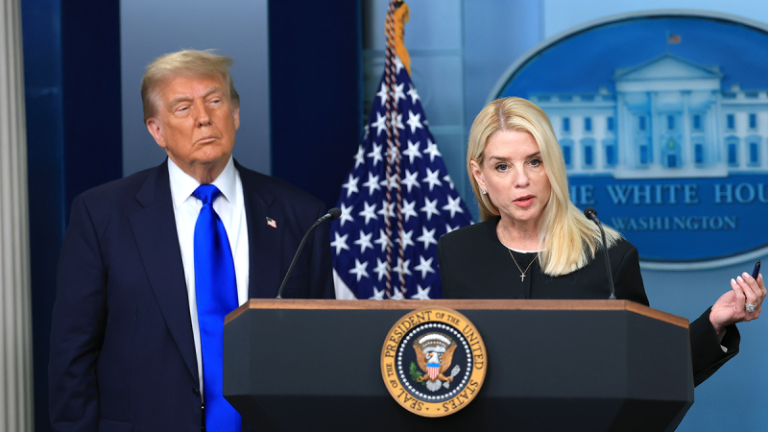
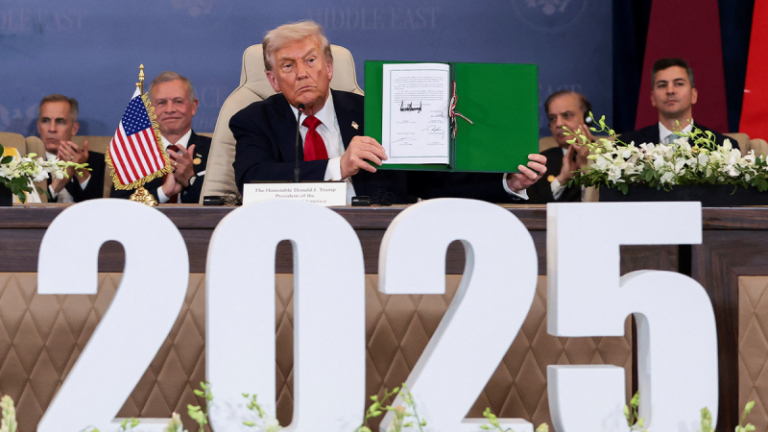
Donald Trump entered 2025 pledging to end wars and reorient U.S. foreign policy around what he repeatedly described as ‘peace through strength.’

Throughout the year, Trump has cast his diplomacy as peace-focused, telling reporters, ‘We think we have a way of getting peace,’ and publicly arguing that his record merited a Nobel Peace Prize. The U.S. State Department echoed that framing in its year-end summary of diplomatic efforts, highlighting initiatives it said aimed to ‘secure peace around the world.’

By the close of 2025, several conflicts saw impressive diplomatic progress, while others were still experiencing issues after years of hatred and violence.

Gaza (Israel–Hamas)

The most consequential diplomatic development of the year came in early October, when the Trump administration helped broker a ceasefire framework between Israel and Hamas. The agreement halted large-scale fighting after months of intense combat and enabled the release of all remaining hostages from Hamas’ Oct. 7 attack on Israel, except for the body of Ron Gvili that remains held captive by Hamas terrorists. 

The administration later cited the ceasefire as a central element of its 2025 diplomatic record. While the truce largely held through the end of the year, core issues including Gaza’s long-term governance, demilitarization and enforcement mechanisms remained unresolved, as well as rebuilding the enclave after the massive destruction and displacement. U.S. officials continued working with regional partners on next steps as fighting paused, as Israel’s Netanyahu is expected to meet with President Trump next week for talks on Gaza and other issues. 

Armenia–Azerbaijan

In August, Trump hosted the leaders of Armenia and Azerbaijan at the White House for a U.S.-brokered peace declaration aimed at addressing decades of conflict tied to Nagorno-Karabakh. The agreement focused on transit routes, economic cooperation and regional connectivity and was promoted by the administration as a historic step.

While the historic declaration was signed, implementation and deeper reconciliation is still ongoing.

Ukraine–Russia war

Ukraine remained the most ambitious and elusive peace target of Trump’s 2025 agenda. The year opened with Trump insisting the war could be ended through direct U.S. engagement and leverage over both Kyiv and Moscow. Diplomacy intensified in August, when Trump hosted Russian President Vladimir Putin in Alaska, a summit framed by the White House as a test of whether personal diplomacy could unlock a settlement.

In parallel, Ukrainian President Volodymyr Zelenskyy was received at the White House, where Trump reiterated U.S. support for Ukraine while signaling that any peace would require difficult compromises. U.S. officials explored security guarantees and economic incentives, while avoiding public commitments on borders or NATO membership.

By December, talks accelerated. Ukraine entered new rounds of U.S.-led negotiations, and Trump told reporters the sides were ‘getting close to something.’ On Christmas Zelenskyy said talks with U.S. officials had produced a 20-point plan and accompanying documents that include security guarantees involving Ukraine, the United States and European partners. He acknowledged the framework was not flawless but described it as a tangible step forward. Zelenskyy is reportedly readying a visit to meet with President Trump, possibly as soon as Sunday.

Bloomberg reported that Russia views the 20-point plan agreed to between Ukraine and the U.S. as only a starting point. According to a person close to the Kremlin, Moscow intends to seek key changes, including additional restrictions on Ukraine’s military, arguing that the proposal lacks provisions important to Russia and leaves many questions unanswered.

Democratic Republic of Congo–Rwanda

In early December, Trump hosted the signing of the Washington Accords for Peace and Prosperity between the Democratic Republic of Congo and Rwanda. The agreement reaffirmed commitments to end decades of conflict and expand economic cooperation through a regional integration framework.

By the end of the year, Reuters and the Associated Press reported that armed groups remained active in eastern Congo, underscoring the fragility of the accord, though both sides seemed to be invested in a long-term peace.

India–Pakistan

After a terrorist attack in Kashmir and retaliatory strikes raised fears of escalation, U.S. officials engaged in emergency diplomacy. Trump announced a ceasefire between the two nuclear-armed rivals, with a potentially catastrophic escalation between the two nuclear powers avoided.

Cambodia–Thailand border dispute

On the sidelines of an ASEAN summit, Trump helped mediate a ceasefire between Cambodia and Thailand following months of border clashes. 

Diplomatic efforts led by ASEAN and supported by external parties are ongoing, but fresh clashes and mutual recriminations between Thailand and Cambodia continue to challenge peace prospects and have led to large-scale displacement and civilian harm. Following the recent flare-ups, and with offers for mediation from Secretary of State Marco Rubio, a new ceasefire was agreed upon on Saturday to end weeks of fighting on the border.

Iran–Israel confrontation

Following U.S. and Israeli strikes on Iranian nuclear facilities, the Trump administration focused on containing escalation and reinforcing deterrence. No diplomatic agreement followed, but the confrontation did not expand into a broader regional war by year’s end.

Recently Israel warned that Iran might use its ballistic missile drills as a cover for a surprise attack. 

Sudan

Sudan remained one of the world’s deadliest conflicts. U.S. diplomacy has focused primarily on efforts to halt fighting and expand humanitarian access rather than brokering a comprehensive peace.

In December, Saudi Arabia and the United States presented Sudanese army chief Abdel Fattah al-Burhan with a three-point proposal aimed at ending the war, facilitating aid delivery and transferring power to civilians, according to Sudan Tribune.

Venezuela

As the year closed, Venezuela emerged as the United States’ clearest point of direct confrontation. The administration framed its posture as an extension of its broader ‘peace through strength’ doctrine, even as the risk of escalation lingered.

While the White House pursued de-escalation and negotiated arrangements elsewhere, its approach toward Nicolás Maduro relied almost entirely on pressure, not talks. Trump continued to cast Maduro as a criminal threat tied to drug trafficking, accusing him of rejecting the results of Venezuela’s last election and stealing the presidency.

With no diplomatic channel open, the U.S. maintained sweeping sanctions and stepped up efforts against cartel networks linked to the regime. There was no peace process in sight — but some opposition figures and U.S. allies argued that sustained pressure could still force political change in 2026, and ultimately hasten the end of Maduro’s rule.

 

This post appeared first on FOX NEWS

Capitol Hill is a ghost town with both the House and Senate out of session until a few days into the new year.

Lawmakers left town the week before Christmas, and with their departure have left several key fights unresolved — with deadlines looming large for both Republicans and Democrats.

Government funding

Congress voted to end the longest-ever government shutdown in history last month after 43 days of gridlock.

But lawmakers did not strike a deal on federal funding for the rest of fiscal year (FY) 2026, which they’re expected to do annually. Instead, they passed a portion of FY 2026 funding while punting the deadline for the majority of areas to Jan. 30.

Senate Republicans had hoped to strike a deal on the vast majority of the remaining funds before leaving town, but various objections from senators on both sides of the aisle delayed an actual vote. 

Now, that legislation will have to be reckoned with in early January. During that month, the House and Senate will only have a total of eight days in session together before the Jan. 30 deadline.

The Senate will have 15 total days in session, while the House will have 12.

Healthcare

Millions of people across the country are expected to see an increase in how much they pay for healthcare premiums every month starting in January.

Congress, meanwhile, has failed to pass a compromise between the House and Senate to help Americans deal with the rising cost.

For some Americans on Obamacare, part of that is due to COVID-19 pandemic-era enhanced subsidies expiring at the end of 2025. 

Republicans have largely rejected the notion of extending those subsidies, at least without significant reforms. But a small group of moderate GOP lawmakers are pushing for a short-term extension to give Congress time to create a more permanent system for lowering costs.

The House passed a healthcare reform bill aimed at expanding options in the commercial insurance marketplace the week before leaving town. In the Senate, however, dueling plans by Republicans and Democrats failed to advance.

It will now be an issue for GOP congressional leaders to tackle in 2026 — while Democrats are likely to seize on it as an election-year issue.

Redistricting

Mid-decade redistricting has upended state and federal politics across the U.S. this year, with President Donald Trump pushing multiple GOP-controlled states to change their congressional lines in order to give Republicans an advantage in the 2026 midterms.

Democrat-led states like California have responded by moving to redraw their own maps to give the left an advantage. It’s resulted in prolonged court battles on both sides.

In Texas, where new maps could give Republicans as many as five new House seats, the Supreme Court granted an emergency stay on a lower court’s order allowing the GOP-led initiative to move forward.

The federal court battle over the Golden State’s new map is likely to draw into the new year. Meanwhile, states like Virginia, Illinois, Alabama, and Louisiana could still move to make new lines before next November.

Multiple House lawmakers have introduced legislation to ban mid-decade redistricting, but to no avail so far.

House Minority Leader Hakeem Jeffries, D-N.Y., warned at a press conference earlier this month, ‘Republicans may have started this redistricting battle. We as Democrats plan to finish it.’

Speaker Mike Johnson, R-La., by contrast, has taken a largely hands-off approach, preferring to leave the matter to state legislatures and the courts.

This post appeared first on FOX NEWS

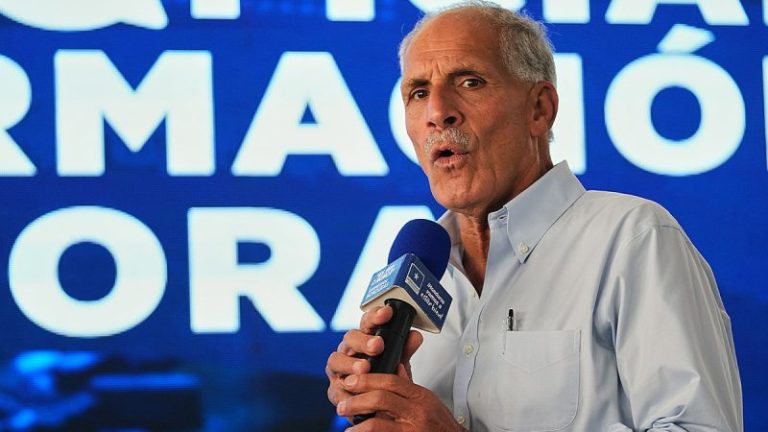
Nasry Asfura has won the 2025 Honduras presidential election, delivering victory for the right-of-center National Party of Honduras (PNH) and shifting the political landscape of Central America. 

The 40.3% to 39.5% result in favor of Asfura over Liberal Party candidate Salvador Nasralla arrived after the vote-counting process had been delayed for days by technical glitches and claims by other candidates of vote-rigging. Rixi Moncada, the candidate of the ruling LIBRE party, came in a distant third.

The results of the race were so tight and the ballot processing system was so chaotic, that about 15% of the tally sheets, which accounted for hundreds of thousands of ballots, had to be counted by hand to determine the winner.

Two electoral council members and one deputy approved the results despite disputes over the razor-thin difference in the vote. A third council member, Marlon Ocha, was not in a video declaring the winner.

‘Honduras: I am ready to govern. I will not let you down,’ Asfura said on X after the results were confirmed.

The head of the Honduran Congress, though, rejected the results and described them as an ‘electoral coup.’

‘This is completely outside the law,’ Congress President Luis Redondo of the LIBRE party said on X. ‘It has no value.’

Secretary of State Marco Rubio congratulated Asfura on X, saying the U.S. ‘looks forward to working with his administration to advance prosperity and security in our hemisphere.’

Initially, preliminary results on Monday showed Asfura, 67, had won 41% of the ballot, inching him ahead of Nasralla, 72, who had around 39%.

On Tuesday, the website set up to share vote tallies with the public experienced technical problems and crashed, according to The Associated Press.

With the candidates only having 515 votes between them, a virtual tie and site crash saw President Trump share a post on Truth Social.

‘Looks like Honduras is trying to change the results of their Presidential Election,’ he wrote. ‘If they do, there will be hell to pay!’

By Thursday, Asfura had 40.05%, about 8,000 votes ahead of Nasralla, who had 39.75%, according to Reuters, with the latter then calling for an investigation.

‘I publicly denounce that today, at 3:24 a.m., the screen went dark and an algorithm, similar to the one used in 2013, changed the data,’ Nasralla wrote on social media, adding 1,081,000 votes for his party were transferred to Asfura, while 1,073,000 votes for Asfura’s National Party were attributed to him.

Asfura, nicknamed ‘Tito,’ is a former mayor of Tegucigalpa and had entered the race with a reputation for leadership and focus on infrastructure, public order and efficiency.

His win ended a polarized campaign season, with one of the defining moments of the contest being Asfura’s endorsement by Trump.

‘If he [Asfura] doesn’t win, the United States will not be throwing good money after bad,’ Trump wrote on his Truth Social platform Nov. 28.

Before the start of voting Nov. 29, Trump also said he would pardon former President Juan Orlando Hernandez, who once led the same party as Asfura. Hernandez is serving a 45-year sentence for helping drug traffickers.

In the end, the election saw the defeat of centrist former vice president of Honduras, Nasralla and left-wing Moncada, 60, who served under President Xiomara Castro. 

Moncada, a prominent lawyer, financier and former minister of national defense, focused on institutional reform and social equity.

Nasralla, a high-profile television personality turned politician, mobilized a base but fell short of converting his popularity into a winning coalition.  

He was focusing on cleaning up Honduran corruption. The Honduran presidential race was also impacted by accusations of fraud.

In addition to electing a new president, Hondurans voted for a new Congress and hundreds of local positions.

Reuters contributed to this report.

This post appeared first on FOX NEWS

The Department of Justice said Wednesday it may have more than a million more documents related to the late Jeffrey Epstein that it needs to review and that the process could take weeks to complete.

The DOJ said two of its components, the FBI and the U.S. Attorney’s Office for the Southern District of New York, had just handed over the missing tranche of files, days after the Epstein Files Transparency Act deadline had passed.

‘We have lawyers working around the clock to review and make the legally required redactions to protect victims, and we will release the documents as soon as possible,’ the DOJ wrote in a statement on social media.

The ‘mass volume of material’ could ‘take a few more weeks’ to review, the DOJ said.

‘The Department will continue to fully comply with federal law and President Trump’s direction to release the files,’ the department wrote.

The DOJ has been sharing on a public website since Friday tens of thousands of pages of files related to Epstein’s and Ghislaine Maxwell’s sex-trafficking cases as part of its obligation under the transparency bill. 

President Donald Trump signed the bill into law Nov. 19, giving the DOJ 30 days to review and release all unclassified material related to the cases.

The file rollout has stirred controversy as critics have blasted the DOJ for what they say are excessive redactions and the law’s lapsed deadline Friday. Initially, the DOJ said it would miss the deadline by a couple of weeks, but Wednesday’s announcement signals that might extend further into the new year than the administration had anticipated.

Deputy Attorney General Todd Blanche said on ‘Meet the Press’ Sunday there was ‘well-settled law’ that supported the DOJ missing the bill’s deadline because of a need to meet other legal requirements, like redacting victim-identifying information.

The transparency bill required the DOJ to withhold information about victims and material that could jeopardize open investigations or litigation. Officials could also leave out information ‘in the interest of national defense or foreign policy,’ the bill said. 

The bill also explicitly directed the DOJ to keep visible any details that could be damaging to high-profile and politically connected people.

This post appeared first on FOX NEWS

North Korea showed off its apparent progress in the development of a nuclear-powered submarine. State media released photos of North Korean dictator Kim Jong Un and his daughter, a potential heir, as they inspected what appears to be a largely completed hull.

The Korean Central News Agency (KCNA), North Korea’s official state media, said Kim and his daughter visited the shipyard to examine the construction of what it describes as an 8,700-ton-class nuclear-propelled submarine, The Associated Press reported. Pyongyang has signaled that it plans to arm the submarine with nuclear weapons, the AP noted. Kim has said the development of the submarine is a crucial step toward the modernization and nuclear armament of his country’s navy.

The Christmas Day release of the photos marks the first time North Korean state media has shown an update on the nuclear-powered submarine since March. Earlier images mostly showed the lower sections of the vessel, the AP noted. The KCNA did not say when the photos released on Thursday were taken.

Moon Keun-sik, a submarine expert at Seoul’s Hanyang University, told the AP that the photos of a largely completed hull indicate that many of the core components are already in place, as submarines are typically built from the inside out. However, it was not immediately clear exactly how much progress Pyongyang had made.

‘Showing the entire vessel now seems to indicate that most of the equipment has already been installed and it is just about ready to be launched into the water,’ Moon, who also served as a submarine officer in the South Korean navy, told the AP. Moon added that North Korea’s submarine could be ready for testing at sea within months.

While at the shipyard, Kim condemned South Korea’s efforts to develop its own nuclear-powered submarine as an ‘offensive act,’ despite the fact that President Donald Trump has backed Seoul’s push toward the technology. Kim said South Korea’s efforts violate North Korea’s security and maritime sovereignty, according to the AP.

In October, during his tour of Asia aimed at securing investments, Trump said that the U.S. would share technology with South Korea that would allow it to build a nuclear-powered submarine. The president posted on Truth Social that the vessel would be built in Philadelphia.

‘South Korea will be building its nuclear-powered submarine in the Philadelphia shipyards, right here in the good ol’ U.S.A. Shipbuilding in our country will soon be making a BIG COMEBACK,’ the president wrote.

The White House underscored the point when it released a fact sheet in November which directly referenced Washington and Seoul’s efforts to ‘further our maritime and nuclear partnership.’

The Associated Press contributed to this report.

This post appeared first on FOX NEWS

A Christmas Eve jazz concert at the Kennedy Center was canceled just days after the White House announced that President Donald Trump’s name would be added to the iconic performing arts institution in Washington, D.C.

The show’s host, musician Chuck Redd, who has led the holiday ‘Jazz Jams’ at the Kennedy Center since 2006, said he called off his performance after Trump’s name was added to the facility.

‘When I saw the name change on the Kennedy Center website and then hours later on the building, I chose to cancel our concert,’ Redd told the Associated Press.

Fox News Digital has reached out to the Kennedy Center for comment. The Kennedy Center’s website lists the show as canceled.

The Kennedy Center’s board voted unanimously on Dec. 18 to rename the institution the ‘Trump-Kennedy Center,’ prompting swift backlash from members of the Kennedy family who said the decision undermined the legacy of President John F. Kennedy.

Maria Shriver, Kennedy’s niece, criticized the decision, calling it ‘beyond comprehension.’

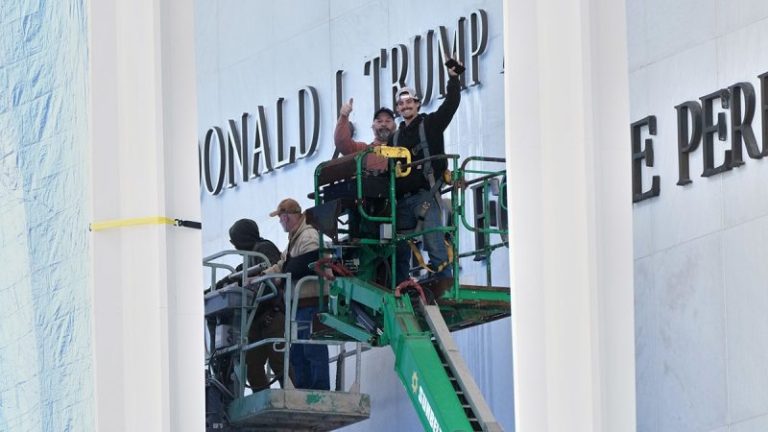
Last week, workers added Trump’s name to the outside of the center, and the website’s header was changed to ‘The Trump Kennedy Center.’

Another Kennedy niece, Kerry Kennedy, vowed to remove Trump’s name from the building after he leaves office.

President Lyndon Johnson signed a bill in 1964 that designated the center as a living memorial to Kennedy following his assassination in 1963. The law prohibits the board of trustees from making the center into a memorial to anyone else or from putting another person’s name on the building’s exterior, the AP reported.

Trump was elected chairman of the Kennedy Center board in February, after removing 18 trustees appointed by former President Joe Biden.

Since Trump returned to office on Jan. 20, several artists have canceled performances at the Kennedy Center, including Lin-Manuel Miranda, who called off a production of ‘Hamilton.’

Redd has toured worldwide and performed with numerous musicians, including Dizzy Gillespie, according to his website bio.

Fox News Digital has reached out to Redd for comment.

The Associated Press contributed to this report.

This post appeared first on FOX NEWS

A group of 19 Democrat-led states and Washington, D.C., filed a lawsuit against the Trump administration over a declaration that aims to restrict gender transition treatment for minors.

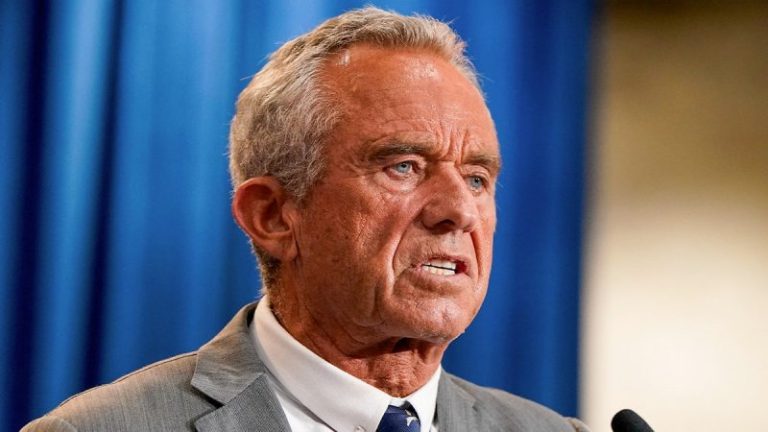
The lawsuit against the U.S. Department of Health and Human Services; its secretary, Robert F. Kennedy Jr.; and its inspector general comes after the declaration issued last week described treatments such as puberty blockers, hormone therapy and gender surgeries as unsafe and ineffective for children experiencing gender dysphoria.

The declaration also warned doctors they could be excluded from federal health programs, including Medicare and Medicaid, if they provide these treatments to minors.

The move seeks to build on President Donald Trump’s executive order in January calling on HHS to protect children from ‘chemical and surgical mutilation.’

‘We are taking six decisive actions guided by gold standard science and the week one executive order from President Trump to protect children from chemical and surgical mutilation,’ Kennedy said during a press conference last week.

HHS has also proposed new rules designed to further block gender transition treatment for minors, although the lawsuit does not address the rules, which have yet to be finalized.

The states’ lawsuit, filed Tuesday in Eugene, Oregon, argues that the declaration is inaccurate and unlawful and urges the court to prevent it from being enforced.

‘Secretary Kennedy cannot unilaterally change medical standards by posting a document online, and no one should lose access to medically necessary health care because their federal government tried to interfere in decisions that belong in doctors’ offices,’ New York Attorney General Letitia James, who led the lawsuit, said in a statement.

The lawsuit claims the declaration attempts to pressure providers into ending gender transition treatment for young people and circumvent legal requirements for policy changes. The complaint said federal law requires the public be given notice and an opportunity to comment before substantively amending health policy and that neither of these were done before the declaration was released.

The declaration based its conclusions on a peer-reviewed report that the department conducted earlier this year that called for more reliance on behavioral therapy rather than broad gender transition treatment for minors with gender dysphoria.

The report raised questions about standards for the treatment of transgender children issued by the World Professional Association for Transgender Health and brought concerns that youths may be too young to give consent to life-changing treatments that could result in future infertility.

Major medical groups and physicians who treat transgender children have criticized the report as inaccurate.

HHS also announced last week two proposed federal rules — one to cut off federal Medicaid and Medicare funding from hospitals that offer gender transition treatment to children and another to block federal Medicaid money from being used for these procedures.

The proposals have not yet been made final and are not legally binding because they must go through a lengthy rulemaking process and public comment before they can be enforced.

Several major medical providers have already pulled back on gender transition treatment for youths since Trump returned to office, even those in Democrat-led states where the procedures are legal under state law.

Medicaid programs in just under half of states currently cover gender transition treatment. At least 27 states have adopted laws restricting or banning the treatment, and the Supreme Court’s decision this year upholding Tennessee’s ban likely means other state laws will remain in place.

Democrat attorneys general from California, Colorado, Connecticut, Delaware, Illinois, Maine, Maryland, Massachusetts, Michigan, Minnesota, New Jersey, New Mexico, Oregon, Rhode Island, Vermont, Wisconsin, Washington state and Washington, D.C., as well as Pennsylvania’s Democrat governor, joined James in the lawsuit.

The Associated Press contributed to this report.

This post appeared first on FOX NEWS

Altius Minerals (TSX:ALS,OTCQX:ATUSF) is making a bet on a lithium market recovery, agreeing to acquire Lithium Royalty (TSX:LIRC) in a C$520 million deal that will expand its exposure to battery metals.

Under a definitive agreement announced by the two companies on Monday (December 22), Altius plans to purchase all of the issued common and convertible common shares of Lithium Royalty for C$9.50 each.

The amount will be paid as either C$9.50 in cash or 0.24 of a common Altius share, according to shareholders’ election.

For Altius, the acquisition will allow it to bring a portfolio of 37 lithium royalties into its fold. None of them involve streams, and they span projects from production through early exploration.

Four of the royalties are tied to producing assets, three of which were commissioned in 2025 and are currently ramping up or expanding. Another 12 projects are in advanced stages with completed economic studies, while three to five additional assets are targeting startup between 2026 and 2030.

The company said the portfolio is geographically concentrated in lower-risk jurisdictions, with most assets located in Canada, Australia and South America, and diversified across both brine-based and hard-rock lithium production.

At the current spot price, Altius expects the acquired royalties to contribute between US$29 million and US$43.7 million in annual revenue by the end of the decade. Lithium carbonate equivalent prices fell to multi-year lows in 2025, holding below US$9,000 per metric ton for most of the year, even as demand continues to expand beyond electric vehicles.

Altius said global lithium demand is expected to exceed 1.5 million metric tons of lithium carbonate equivalent in 2025, with supply deficits potentially re-emerging as early as 2026 after years of oversupply.

Altius Chief Executive Brian Dalton said lithium has “emerged as a mainstream scale mined commodity,” and described the acquired portfolio as featuring “very long resource lives,” strong cost positioning and low jurisdictional risk.

A special shareholders’ meeting is scheduled to happen no later than March 10, 2026.

If approved, the deal is expected to close in the first quarter of 2026, after which Lithium Royalty shares will be delisted and the company will cease to be a reporting issuer in Canada.

Securities Disclosure: I, Giann Liguid, hold no direct investment interest in any company mentioned in this article.

This post appeared first on investingnews.com

Craig Hemke, publisher of TFMetalsReport.com, shares his thoughts on the gold and silver markets heading into 2026, outlining why he remains bullish.

‘Just keep adding some — it’s your protection against the madness. It’ll get you through the storm,’ he said. ‘It preserves your net worth from the destruction of these bankers and politicians.’

Securities Disclosure: I, Charlotte McLeod, hold no direct investment interest in any company mentioned in this article.

This post appeared first on investingnews.com

The holiday season brings more than festive cheer, as for investors, it may signal the start of the so-called Santa Claus rally.

The Santa Claus rally is a period between the final trading days of December and the first days of January when stocks tend to climb. While this seasonal uptick isn’t guaranteed, historical data shows that markets rise more often than not during this window, driven by investor optimism, low trading volumes and year-end portfolio adjustments.

Historically, the last five trading days of December and the first two of January have been a period of above-average stock gains, offering a short, sharp rally for markets heading into the new year.

According to the Stock Trader’s Almanac, the Santa Claus rally has delivered an average gain of 1.3 percent for the S&P 500 (INDEXSP:.INX) since 1950. The phenomenon was first documented in 1972 by Yale Hirsch, founder of the Almanac, and continues to shape investor expectations today.

As for whether 2025 will deliver a Santa Claus rally to close out the year, after a choppy first half for December, markets have shown signs that a late-year recovery is possible.

When does the Santa Claus rally start?

The Santa Claus rally typically occurs over the final five trading days of December and the first two trading days of January. For 2025, the rally window begins on Wednesday, December 24, and runs through Monday, January 5, if historical patterns hold.

This narrow window often yields modest, yet consistent, returns for investors who time the market correctly.

While the rally’s timeframe is traditionally short, its effects can ripple through the market into early January. Essentially, a strong performance during this period can set the tone for January.

However, the exact timing of the Santa Claus rally can vary. Some analysts suggest that the rally has started earlier in recent years as investors attempt to front run the effect by increasing their positions in mid-December. This shift may blur the lines between the Santa Claus rally and broader December market upswings.

Will 2025 deliver a Santa Claus Rally?

This year, the S&P 500 fell during the middle of the month following a cooler-than-expected, albeit controversial, inflation report, which raised hopes for additional interest-rate cuts next year.

Despite this downturn, analysts note that a weak start to December has often failed to derail Santa’s run. Since 1950, the S&P 500 finished the Santa Claus rally period higher in 77 percent of years, even after early-month declines. By the end of the week, the index had already regained some ground, and it continued higher in the days leading up to Christmas.

“Barring any major shocks, it will be hard to fight the overwhelmingly positive seasonal period we are entering and the cleaner positioning set-up,” Goldman Sachs’ (NYSE:GS) trading desk team wrote in a note to clients, as reported by Bloomberg. ‘While we don’t necessarily see a dramatic rally, we do think there is room to go up from here into year end.”

Jeffrey Hirsch, editor-in-chief of the Stock Trader’s Almanac and Yale Hirsch’s son, also weighed in on the markets.

“It looks like (the Santa Claus rally) is set up and we can make another high by the end of the year,” he told MarketWatch. Hirsch cited cooler inflation readings and slower job growth in November, which may give the Federal Reserve room to cut interest rates in 2026.

It remains to be seen whether these predictions will come true, or if the market will be weighed down by factors including recent volatility in technology and artificial-intelligence-linked stocks.

Is the Santa Claus rally reliable?

Despite skepticism in some quarters, historical data supports the existence of the Santa Claus rally, and it is well documented.

Historically, the Santa Claus rally has been a relatively consistent period of gains. That said, historical patterns do not guarantee results, and not every year delivers the expected results. The S&P 500 lost about half a percentage point during the Santa rally period in 2024, and consecutive losses are rare but possible.

Columnist Mark Hulbert has expressed skepticism about the event in the past, noting that there is no definitive evidence that the market consistently outperforms during this period.

“An analysis of the past century reveals that the stock market in the weeks prior to Christmas is no more likely to rally than at other times of the year. (I suggest investors) ignore any arguments based on an alleged Santa Claus Rally,” Hulbert warned in an opinion piece posted on MarketWatch in 2018.

In 2019, for example, the market experienced volatility in December, defying the usual pattern.

In a December 2025 interview with CNBC, Jeffrey Hirsch cautioned that failure to rally is not an immediate bear-market signal, but rather “a flag to start looking at the other data — whether it’s seasonal indicators or other fundamental or technical measures.”

Despite the varying takes, many investors view the rally as a psychological phenomenon — one that influences market sentiment even if the returns are marginal.

Strategies for the Santa Claus rally

Now that the Santa Claus rally seems to be underway, investors interested in joining in have a variety of options, including domestic markets, international diversification or targeted sector plays such as mega-cap tech stocks.

As always, consulting with a financial advisor and conducting thorough research remains essential. While the Santa Claus rally offers potential rewards, market conditions can shift quickly, making flexibility and prudence key to success.

Securities Disclosure: I, Giann Liguid, hold no direct investment interest in any company mentioned in this article.

This post appeared first on investingnews.com