Author

admin

Browsing

Rio Tinto (ASX:RIO,NYSE:RIO,LSE:RIO)said on Monday (May 19) that it has signed binding agreements with Corporación Nacional Del Cobre de Chile (Codelco) to develop and operate a high-grade lithium project.

The asset is located in the Salar de Maricunga, a large lithium-containing resource base in Atacama, Chile. Its brine is said to have one of the highest average grades of lithium content in the world.

According to Rio Tinto, it will acquire a 49.99 percent interest in the company Salar de Maricunga, through which Codelco holds its licenses and mining concessions related to the resource base.

Codelco is a state-owned firm formed in 1976. Its full name translates to “National Copper Corporation of Chile.”

“We are honoured to be chosen as Codelco’s partner to deliver a world-class project using Direct Lithium Extraction technology in the Salar de Maricunga, leveraging our expertise as a leading producer of lithium for the global market,” said Rio Tinto Chief Executive Jakob Stausholm. “Developing this significant lithium resource will deliver further value-adding growth in our portfolio of critical minerals essential for the energy transition.”

In 2023, Rio and Codelco entered a joint venture for the exploration of Nuevo Cobre, situated within the Potrerillos mining district, also in Atacama. Codelco owns about 43 percent of Nuevo Cobre, while Rio Tinto owns about 58 percent.

For the Salar de Maricunga partnership, Rio will invest AU$350 million in initial funding for additional studies and resource analysis that will assist in creating a final investment decision.

Once a decision is made, AU$500 million will be dedicated toward construction costs. Another AU$50 million will be allocated should the venture deliver its first lithium target by the end of 2030.

The new partnership with Codelco forms part of Rio Tinto’s long-term lithium plan, which includes a production goal of over 200,000 metric tons of lithium carbonate equivalent annually by 2028.

The company recently completed its acquisition of Arcadium Lithium, making it the world’s third top lithium producer.

Subject to regulatory approvals and the satisfaction of customary conditions, the Salar de Maricunga transaction is expected to close by the end of the first quarter of 2026.

Securities Disclosure: I, Gabrielle de la Cruz, hold no direct investment interest in any company mentioned in this article.

This post appeared first on investingnews.com

The Federal Trade Commission voted to dismiss a lawsuit filed in the last days of the Biden administration that accused PepsiCo of offering sweetheart pricing to big retailers.

FTC Chair Andrew Ferguson dissented to the suit when it was filed in January, when he was one of the regulator’s commissioners. Now the agency’s leader, Ferguson on Thursday again criticized the case as “a nakedly political effort to commit this administration to pursuing little more than a hunch that Pepsi had violated the law.”

“The FTC’s outstanding staff will instead get back to work protecting consumers and ensuring a fair and competitive business environment,” he said in a statement.

The FTC voted 3-0 to drop the suit. The panel is supposed to be made up of five commissioners, no more than three of whom can share the same political party. But it is currently led by three Republicans after President Donald Trump fired its two Democratic commissioners in March. The two ousted officials have slammed their removals as illegal and are urging a judge to reinstate them.

Pepsi welcomed the FTC decision Thursday. “PepsiCo has always and will continue to provide all customers with fair, competitive, and non-discriminatory pricing, discounts and promotional value,” a spokesperson said in a statement. Beyond its namesake soda, the company makes an array of snacks and other food products, including Doritos, Rold Gold pretzels and Sabra hummus.

Former FTC Chair Lina Khan, who led the commission when the agency brought its case against Pepsi, criticized the move Thursday as “disturbing behavior” by the agency.

“This lawsuit would’ve protected families from paying higher prices at the grocery store and stopped conduct that squeezes small businesses and communities across America,” she wrote on X Thursday evening. “Dismissing it is a gift to giant retailers as they gear up to hike prices.”

The decision comes little more than a week after top-ranking Democrats on Capitol Hill sent a letter to Pepsi demanding more information about its pricing strategy. They sought to revive a Biden-era focus on price-gouging as a driver of inflation, an argument that has taken a back seat to the Trump administration’s attention on purportedly unfair trade arrangements.

But major corporations continue to draw scrutiny from the White House over pricing in other ways. Last weekend, Trump slammed Walmart for warning that it was likely to raise prices to offset the costs of his import taxes, demanding on social media that it “EAT THE TARIFFS.”

In the days since then, other major consumer brands have appeared to tread cautiously around pricing. Target said Wednesday that charging customers more would be its “very last resort.” Home Depot virtually ruled out price hikes this week, and Lowe’s barely mentioned tariff impacts in its Wednesday earnings call at all.

CORRECTION (May 22, 2025, 8:45 p.m. ET): Due to an editing error, a previous version of this article misstated when congressional Democrats sent their letter to Pepsi. It was on May 11, not last weekend.

This post appeared first on NBC NEWS

It took six months, countless hours on hold and intervention from state regulators before Sue Cover says she finally resolved an over $1,000 billing dispute with UnitedHealthcare in 2023.

Cover, 46, said she was overbilled for emergency room visits for her and her son, along with a standard ultrasound. While Cover said her family would eventually have been able to pay the sum, she said it would have been a financial strain on them.

Cover, a San Diego benefits advocate, said she had conversations with UnitedHealthcare that “felt like a circular dance.” Cover said she picked through dense policy language and fielded frequent calls from creditors. She said the experience felt designed to exhaust patients into submission.

“It sometimes took my entire day of just sitting on the phone, being on hold with the hospital or the insurance company,” Cover said.

Cover’s experience is familiar to many Americans. And it embodies rising public furor toward insurers and in particular UnitedHealthcare, the largest private health insurer in the U.S., which has become the poster child for problems with the U.S. insurance industry and the nation’s sprawling health-care system.

The company and other insurers have faced backlash from patients who say they were denied necessary care, providers who say they are buried in red tape and lawmakers who say they are alarmed by its vast influence.

UnitedHealthcare in a statement said it is working with Cover’s provider to “understand the facts of these claims.” The company said it is “unfortunate that CNBC rushed to publish this story without allowing us and the provider adequate time to review.” CNBC provided the company several days to review Cover’s situation before publication.

Andrew Witty, CEO of UnitedHealthcare’s company, UnitedHealth Group, stepped down earlier this month for what the company called “personal reasons.” Witty had led the company through the thick of public and investor blowback. The insurer also pulled its 2025 earnings guidance this month, partly due to rising medical costs, it said.

UnitedHealth Group is by far the biggest company in the insurance industry by market cap, worth nearly $275 billion. It controls an estimated 15% of the U.S. health insurance market, serving more than 29 million Americans, according to a 2024 report from the American Medical Association. Meanwhile, competitors Elevance Health and CVS Health control an estimated 12% of the market each.

It’s no surprise that a company with such a wide reach faces public blowback. But the personal and financial sensitivity of health care makes the venom directed at UnitedHealth unique, some experts told CNBC.

Shares of UnitedHealth Group are down about 40% this year following a string of setbacks for the company, despite a temporary reprieve sparked in part by share purchases by company insiders. In the last month alone, UnitedHealth Group has lost nearly $300 billion of its $600 billion market cap following Witty’s exit, the company’s rough first-quarter earnings and a reported criminal probe into possible Medicare fraud.

In a statement about the investigation, UnitedHealth Group said, “We stand by the integrity of our Medicare Advantage program.”

Over the years, UnitedHealthcare and other insurers have also faced numerous patient and shareholder lawsuits and several other government investigations.

UnitedHealth Group is also contending with the fallout from a February 2024 ransomware attack on Change Healthcare, a subsidiary that processes a significant portion of the country’s medical claims.

More recently, UnitedHealthcare became a symbol for outrage toward insurers following the fatal shooting of its CEO, Brian Thompson, in December. Thompson’s death reignited calls to reform what many advocates and lawmakers say is an opaque industry that puts profits above patients.

The problems go deeper than UnitedHealth Group: Insurers are just one piece of what some experts call a broken U.S. health-care system, where many stakeholders, including drugmakers and pharmacy benefit managers, are trying to balance patient care with making money. Still, experts emphasized that insurers’ cost-cutting tactics — from denying claims to charging higher premiums — can delay or block crucial treatment, leave patients with unexpected bills, they say, or in some cases, even mean the difference between life and death.

In a statement, UnitedHealthcare said it is unfortunate that CNBC appears to be drawing broad conclusions based on a small number of anecdotes.”

Frustration with insurers is a symptom of a broader problem: a convoluted health-care system that costs the U.S. more than $4 trillion annually.

U.S. patients spend far more on health care than people anywhere else in the world, yet have the lowest life expectancy among large, wealthy countries, according to the Commonwealth Fund, an independent research group. Over the past five years, U.S. spending on insurance premiums, out-of-pocket co-payments, pharmaceuticals and hospital services has also increased, government data show.

While many developed countries have significant control over costs because they provide universal coverage, the U.S. relies on a patchwork of public and private insurance, often using profit-driven middlemen to manage care, said Howard Lapin, adjunct professor at the University of Illinois Chicago School of Law.

But the biggest driver of U.S. health spending isn’t how much patients use care — it’s prices, said Richard Hirth, professor of health management and policy at the University of Michigan.

There is “unbelievable inflation of the prices that are being charged primarily by hospitals, but also drug companies and other providers in the system,” said Sabrina Corlette, co-director of the Center on Health Insurance Reforms at Georgetown University.

Lapin said factors such as overtreatment, fraud, health-care consolidation and administrative overhead raise costs for payers and providers, who then pass those on through higher prices. U.S. prescription drug prices are also two to three times higher than those in other developed countries, partly due to limited price regulation and pharmaceutical industry practices such as patent extensions.

While patients often blame insurers, the companies are only part of the problem. Some experts argue that eliminating their profits wouldn’t drastically lower U.S. health-care costs.

Still, UnitedHealthcare and other insurers have become easy targets for patient frustration — and not without reason, according to industry experts.

Their for-profit business model centers on managing claims to limit payouts, while complying with regulations and keeping customers content. That often means denying services deemed medically unnecessary, experts said. But at times, insurers reject care that patients need, leaving them without vital treatment or saddled with hefty bills, they added.

Insurers use tools such as deductibles, co-pays, and prior authorization — or requiring approval before certain treatments — to control costs. Industry experts say companies are increasingly relying on artificial intelligence to review claims, and that can sometimes lead to inaccurate denials.

“It’s all part of the same business model — to avoid paying as many claims as possible in a timely fashion,” said Dylan Roby, an affiliate at the UCLA Center for Health Policy Research.

While other private U.S. insurers employ many of the same tactics, UnitedHealth Group appears to have faced the most public backlash due to its size and visibility.

UnitedHealth Group’s market value dwarfs the sub-$100 billion market caps of competitors such as CVS, Cigna and Elevance. UnitedHealth Group booked more than $400 billion in revenue in 2024 alone, up from roughly $100 billion in 2012.

It has expanded into many parts of the health-care system, sparking more criticism of other segments of its business — and the company’s ability to use one unit to benefit another.

UnitedHealth Group grew by buying smaller companies and building them into its growing health-care business. The company now serves nearly 150 million people and controls everything from insurance and medical services to sensitive health-care data.

UnitedHealth Group owns a powerful pharmacy benefit manager, or PBM, called Optum Rx, which gives it even more sway over the market.

PBMs act as middlemen, negotiating drug rebates on behalf of insurers, managing lists of drugs covered by health plans and reimbursing pharmacies for prescriptions. But lawmakers and drugmakers accuse them of overcharging plans, underpaying pharmacies and failing to pass savings on to patients.

Owning a PBM gives UnitedHealth Group control over both supply and demand, Corlette said. Its insurance arm influences what care is covered, while Optum Rx determines what drugs are offered and at what price. UnitedHealth Group can maximize profits by steering patients to lower-cost or higher-margin treatments and keeping rebates, she said.

The company’s reach goes even further, Corlette added: Optum Health now employs or affiliates with about 90,000 doctors — nearly 10% of U.S. physicians — allowing UnitedHealth Group to direct patients to its own providers and essentially pay itself for care.

A STAT investigation last year found that UnitedHealth uses its physicians to squeeze profits from patients. But the company in response said its “providers and partners make independent clinical decisions, and we expect them to diagnose and document patient information completely and accurately in compliance with [federal] guidelines.”

Other insurers, such as CVS and Cigna, also own large PBMs and offer care services. But UnitedHealth Group has achieved greater scale and stronger financial returns.

“I think the company is certainly best in class when it comes to insurers, in terms of providing profits for shareholders,” said Roby. “But people on the consumer side probably say otherwise when it comes to their experience.”

No one knows exactly how often private insurers deny claims, since they aren’t generally required to report that data. But some analyses suggest that UnitedHealthcare has rejected care at higher rates than its peers for certain types of plans.

A January report by nonprofit group KFF found that UnitedHealthcare denied 33% of in-network claims across Affordable Care Act plans in 20 states in 2023, one of the highest rates among major insurers. CVS denied 22% of claims across 11 states, and Cigna denied 21% in eight states.

UnitedHealth did not respond to a request for comment on that report. But in December, the company also pushed back on public criticism around its denial rates, saying it approves and pays about 90% of claims upon submission. UnitedHealthcare’s website says the remaining 10% go through an additional review process. The company says its claims approval rate stands at 98% after that review.

In addition, UnitedHealth Group is facing lawsuits over denials. In November, families of two deceased Medicare Advantage patients sued the company and its subsidiary, alleging it used an AI model with a “90% error rate” to deny their claims. UnitedHealth Group has argued it should be dismissed from the case because the families didn’t complete Medicare’s appeals process.

A spokesperson for the company’s subsidiary, NaviHealth, also previously told news outlets that the lawsuit “has no merit” and that the AI tool is used to help providers understand what care a patient may need. It does not help make coverage decisions, which are ultimately based on the terms of a member’s plan and criteria from the Centers for Medicare & Medicaid Services, the spokesperson said.

Meanwhile, the reported Justice Department criminal probe outlined by the Wall Street Journal targets the company’s Medicare Advantage business practices. In its statement, the company said the Justice Department has not notified it about the reported probe, and called the newspaper’s reporting “deeply irresponsible.”

Inside the company, employees say customers and workers alike face hurdles.

One worker, who requested anonymity for fear of retaliation, said UnitedHealthcare’s provider website often includes doctors listed as in-network or accepting new patients when they’re not, leading to frequent complaints. Management often replies that it’s too difficult to keep provider statuses up to date, the person said.

UnitedHealthcare told CNBC it believes “maintaining accurate provider directories is a shared responsibility among health plans and providers,” and that it “proactively verifies provider data on a regular basis.” The vast majority of all inaccuracies are due to errors or lack of up-to-date information submitted by providers, the company added.

Emily Baack, a clinical administrative coordinator at UMR, a subsidiary of UnitedHealthcare, criticized the length of time it can take a provider to reach a real support worker over the phone who can help assess claims or prior authorization requests. She said the company’s automated phone system can misroute people’s calls or leave them waiting for a support person for over an hour.

But Baack emphasized that similar issues occur across all insurance companies.

She said providers feel compelled to submit unnecessary prior authorization requests out of fear that claims won’t be paid on time. Baack said that leads to a massive backlog of paperwork on her end and delays care for patients.

UnitedHealthcare said prior authorization is “an important checkpoint” that helps ensure members are receiving coverage for safe and effective care.

The company noted it is “continually taking action to simplify and modernize the prior authorization process.” That includes reducing the number of services and procedures that require prior authorization and exempting qualified provider groups from needing to submit prior authorization requests for certain services.

While UnitedHealthcare is not the only insurer facing criticism from patients, Thompson’s killing in December reinforced the company’s unique position in the public eye. Thousands of people took to social media to express outrage toward the company, sharing examples of their own struggles.

The public’s hostile reaction to Thompson’s death did not surprise many industry insiders.

Alicia Graham, co-founder and chief operating officer of the startup Claimable, said Thompson’s murder was “a horrible crime.” She also acknowledged that anger has been bubbling up in various online health communities “for years.”

Claimable is one of several startups trying to address pain points within insurance. It’s not an easy corner of the market to enter, and many of these companies, including Claimable, have been using the AI boom to their advantage.

Claimable, founded in 2024, said it helps patients challenge denials by submitting customized, AI-generated appeal letters on their behalf. The company can submit appeals for conditions such as migraines and certain pediatric and autoimmune diseases, though Graham said it is expanding those offerings quickly.

Many patients aren’t aware that they have a right to appeal, and those who do can spend hours combing through records to draft one, Graham said. If patients are eligible to submit an appeal letter through Claimable, she said they can often do so in minutes. Each appeal costs users $39.95 plus shipping, according to the company’s website.

“A lot of patients are afraid, a lot of patients are frustrated, a lot of patients are confused about the process, so what we’ve tried to do is make it all as easy as possible,” Graham told CNBC.

Some experts have warned about the possibility of health-care “bot wars,” where all parties are using AI to try to gain an edge.

Mike Desjadon, CEO of the startup Anomaly, said he’s concerned about the potential for an AI arms race in the sector, but he remains optimistic. Anomaly, founded in 2020, uses AI to help providers determine what insurers are and aren’t paying for in advance of care, he said.

“I run a technology company and I want to win, and I want our customers to win, and that’s all very true, but at the same time, I’m a citizen and a patient and a husband and a father and a taxpayer, and I just want health care to be rational and be paid for appropriately,” Desjadon told CNBC.

Dr. Jeremy Friese, founder and CEO of the startup Humata Health, said patients tend to interact with insurers only once something goes wrong, which contributes to their frustrations. Requirements such as prior authorization can be a “huge black box” for patients, but they’re also cumbersome for doctors, he said.

Friese said his business was inspired by his work as an interventional radiologist. In 2017, he co-founded a prior-authorization company called Verata Health, which was acquired by the now-defunct health-care AI startup Olive. Friese bought back his technology and founded his latest venture, Humata, in 2023.

Humata uses AI to automate prior authorization for all specialties and payers, Friese said. The company primarily works with medium and large health systems, and it announced a $25 million funding round in June.

“There’s just a lot of pent-up anger and angst, frankly, on all aspects of the health-care ecosystem,” Friese told CNBC.

UnitedHealth Group also set a grim record last year that did little to help public perception. The company’s subsidiary Change Healthcare suffered a cyberattack that affected around 190 million Americans, the largest reported health-care data breach in U.S. history.

Change Healthcare offers payment and revenue cycle management tools, as well as other solutions, such as electronic prescription software. In 2022, it merged with UnitedHealth Group’s Optum unit, which touches more than 100 million patients in the U.S.

In February 2024, a ransomware group called Blackcat breached part of Change Healthcare’s information technology network. UnitedHealth Group isolated and disconnected the affected systems “immediately upon detection” of the threat, according to a filing with the U.S. Securities and Exchange Commission, but the ensuing disruption rocked the health-care sector.

Money stopped flowing while the company’s systems were offline, so a major revenue source for thousands of providers across the U.S. screeched to a halt. Some doctors pulled thousands of dollars out of their personal savings to keep their practices afloat.

“It was and remains the largest and most consequential cyberattack against health care in history,” John Riggi, the national advisor for cybersecurity and risk at the American Hospital Association, told CNBC.

Ransomware is a type of malicious software that blocks victims from accessing their computer files, systems and networks, according to the Federal Bureau of Investigation. Ransomware groups such as Blackcat, which are often based in countries such as Russia, China and North Korea, will deploy this software, steal sensitive data and then demand a payment for its return.

Ransomware attacks within the health-care sector have climbed in recent years, in part because patient data is valuable and relatively easy for cybercriminals to exploit, said Steve Cagle, CEO of the health-care cybersecurity and compliance firm Clearwater.

“It’s been a very lucrative and successful business for them,” Cagle told CNBC. “Unfortunately, we’ll continue to see that type of activity until something changes.”

UnitedHealth Group paid the hackers a $22 million ransom to try to protect patients’ data, then-CEO Witty said during a Senate hearing in May 2024.

In March 2024, UnitedHealth Group launched a temporary funding assistance program to help providers with short-term cash flow.

The program got off to a rocky start, several doctors told CNBC, and the initial deposits did not cover their mounting expenses.

UnitedHealth Group ultimately paid out more than $9 billion to providers in 2024, according to the company’s fourth-quarter earnings report in January.

Witty said in his congressional testimony that providers would only be required to repay the loans when “they, not me, but they confirm that their cash flow is normalized.”

Almost a year later, however, the company is aggressively going after borrowers, demanding they “immediately repay” their outstanding balances, according to documents viewed by CNBC and providers who received funding. Some groups have been asked to repay hundreds of thousands of dollars in a matter of days, according to documents viewed by CNBC.

A spokesperson for Change Healthcare confirmed to CNBC in April that the company has started recouping the loans.

We continue to work with providers on repayment and other options, and continue to reach out to those providers that have not been responsive to previous calls or email requests for more information,” the spokesperson said.

The pressure for repayment drew more ire toward UnitedHealth Group on social media, and some providers told CNBC that dealing with the company was a “very frustrating experience.”

The vast majority of Change Healthcare’s services have been restored over the last year, but three products are still listed as “partial service available,” according to UnitedHealth’s cyberattack response website.

Witty’s departure and the company’s warning about elevated medical costs, combined with the fallout from Thompson’s murder and the Change Healthcare cyberattack, could mean UnitedHealth faces an uphill battle.

UnitedHealth Group appears to be trying to regain the public’s trust. For example, Optum Rx in March announced plans to eliminate prior authorizations on dozens of drugs, easing a pain point for physicians and patients.

But policy changes at UnitedHealth Group and other insurers may not drastically improve care for patients, health insurance industry experts previously told CNBC.

They said there will need to be structural changes to the entire insurance industry, which will require legislation that may not be high on the priority list for the closely divided Congress.

The spotlight on UnitedHealth Group may only grow brighter in the coming months. The trial date for Luigi Mangione, the man facing federal stalking and murder charges in connection with Thompson’s shooting, is expected to be set in December. Mangione has pleaded not guilty to the charges.

This post appeared first on NBC NEWS

Republicans are targeting China’s efforts to sidestep U.S. tariffs through foreign production, with new legislation introduced Thursday by House Budget Chairman Jodey Arrington, R-Texas.

The Axing Nonmarket Tariff Evasion (ANTE) Act aims to stop subsidized and state-owned entities from setting up production in other countries to avoid tariffs.

‘For far too long, adversaries like China have engaged in unfair trade practices, cheated the American economy, and cost the U.S. millions of jobs,’ Arrington said in a statement to Fox News Digital.

On April 2, which the White House dubbed ‘Liberation Day,’ President Donald Trump announced sweeping tariffs with the intention of ending trade imbalances. Some of the harshest of the tariffs were imposed on China, which was initially hit with a 145% tariff that was later lowered to 30%. 

While tariffs seem to be discouraging Chinese manufacturers from exporting to the U.S., as evidenced by a recent Commerce Department report showing import levels at their lowest since the COVID-19 pandemic, imports have not stopped entirely.

The Chinese Communist Party (CCP) has found ways to evade the tariffs, such as setting up production in third-party countries or by shipping goods to another country and re-labeling them before sending them to the U.S. By labeling the goods as originating from another country, manufacturers dodge the high tariffs on China and instead get hit with much lower tariffs that are imposed on other nations. This is something that Arrington hopes to stop with his legislation.

‘The ANTE Act will stop highly-subsidized, state-owned businesses from using third countries as backdoors to evade President Trump’s tariffs and help ensure a level playing field for American producers and manufacturers,’ Arrington told Fox News Digital.

Sen. Jim Banks, R-Ind., who is introducing companion legislation in the Senate, is also confident the bill will stop the CCP from falsifying the origins of imports.

‘Communist China shouldn’t be able to dodge U.S. tariffs by slapping a ‘Made in Mexico’ label on their products,’ Banks said in a statement to Fox News Digital. ‘My bill closes loopholes and stops the CCP from cheating American workers and manufacturers.’ 

The phenomenon of ‘place-of-origin washing’ is not limited to large businesses. Chinese social media platforms are filled with ads offering services to help sellers avoid tariffs, the Financial Times reported. The outlet also noted that South Korea’s customs agency has seen an uptick in cases involving sellers using their country to avoid U.S. tariffs.

Under U.S. law, goods must undergo ‘substantial transformation’ in a country to qualify as originating from there. The transformation must significantly add to the value of the good, according to the International Trade Administration’s (ITA) website. 

As an example, the ITA writes that if ingredients are taken from several countries and turned into baked goods, the country of origin can be listed as where the items were baked, as this constitutes a ‘substantial transformation.’ However, if produce from multiple countries is frozen and mixed in another nation, then the origin of each ingredient must be listed.

This post appeared first on FOX NEWS

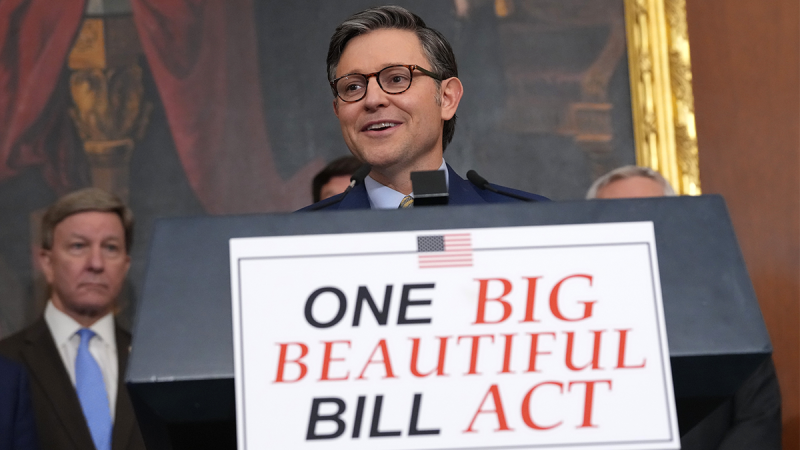
House Republicans took a victory lap Thursday morning after passing President Donald Trump’s ‘one big, beautiful bill.’ 

‘It’s finally morning in America again,’ House Speaker Mike Johnson, R-La., told reporters. 

The One Big Beautiful Bill Act passed 215 to 214. All Democrats and two Republicans, Reps. Thomas Massie, R-Ky., and Warren Davidson, R-Ohio, voted against the bill. House Freedom Caucus Chair Andy Harris, R-Md., voted ‘present.’

‘Today, the House has passed generational, truly nation-shaping legislation to reduce spending and permanently lower taxes for families and job creators, secure the border, unleash American energy dominance, restore peace through strength and make government work more efficiently and effectively for all Americans,’ Johnson added. 

The bill is a victory for Trump and House Republicans, who overcame policy disagreements to deliver on Trump’s key campaign promises, including an extension of his 2017 tax cuts and no tax on tips, overtime and Social Security. 

‘We look forward to the Senate’s timely consideration of this once-in-a-generation legislation. We stand ready to continue our work together to deliver on the one big, beautiful bill, as President Trump named it himself. We’re going to send that to his desk. We’re going to get there by Independence Day, on July 4th, and we are going to celebrate a new golden age in America,’ Johnson said. 

House leaders took turns Thursday thanking Republicans for rallying together to pass the bill. 

‘Democrats made it very clear they didn’t want to have any part in helping get America back on track again, but we were never fettered when this bill could have failed 10 times over. We said we were going to get this done, and failure is not an option. And we meant it,’ said House Majority Leader Steve Scalise, R-La.

Trump celebrated his victory on Thursday in a Truth Social post. 

‘Great job by Speaker Mike Johnson, and the House Leadership, and thank you to every Republican who voted YES on this Historic Bill! Now, it’s time for our friends in the United States Senate to get to work, and send this Bill to my desk AS SOON AS POSSIBLE! There is no time to waste,’ Trump wrote. 

The multi-trillion-dollar bill includes provisions to advance Trump’s ‘America First’ agenda by lowering taxes, securing the border, increasing national defense, reforming Medicaid and slashing Biden-era energy policies. 

The bill aims to make a dent in the federal government’s spending trajectory by cutting roughly $1.5 trillion in government spending elsewhere. The U.S. government is still more than $36 trillion in debt and has spent $1.05 trillion more than it has collected in the 2025 fiscal year, according to the Treasury Department.

‘Take this as a lesson. Don’t bet against the House Republicans. We’ve shown, time and time again, that we deliver for the American people, especially when it matters most. By taking hold of this historic opportunity, I truly believe we’ve unlocked the opportunities for generations to come,’ House Majority Whip Tom Emmer, R-Minn., said. 

Republicans on Thursday slammed their House Democratic colleagues for delaying the bill’s passage – down to House Minority Leader Hakeem Jeffries’ 30-minute ‘magic minute’ before House votes. 

‘Democrats voted to put Americans last, and it’s a shame. But thank God for House Republicans, and thank God for our president, Donald J. Trump,’ said GOP Conference Chair Lisa McClain, R-Mich.

But the ‘big, beautiful bill’ still has a big hurdle ahead. The Senate is tasked with passing its own version of the bill, and Republican leaders are hoping to send the bill to Trump’s desk by the Fourth of July. 

Senate Republicans have already signaled they expect to make changes to the bill when it reaches the upper chamber, despite House GOP leaders publicly urging them to amend as little as possible.

A significant number of senators have voiced concern over the extent of Medicaid and SNAP cuts proposed by the House. Meanwhile, raising the SALT deduction cap could face resistance in the Senate, where no Republicans represent blue states—unlike in the House, where districts in New York and California are key to the GOP majority.

And Senate Democrats are already piling on the criticism of Trump’s ‘big, beautiful bill.’

‘This is not one big, beautiful bill. It’s ugly. There’s nothing beautiful about stripping away people’s healthcare, forcing kids to go hungry, denying communities the resources they need, and increasing poverty,’ Senate Minority Leader Chuck Schumer, D-N.Y., said in a statement Thursday. 

This post appeared first on FOX NEWS

A new book sheds light on former White House deputy press secretary Andrew Bates’ role in defending President Joe Biden’s mental acuity, which the book alleges was done without the White House staff having the full picture of the president’s actual condition. 

‘Some of Bates’s colleagues believed that Biden’s inner circle took advantage of his loyalty and told him to deny things they knew were true,’ Jake Tapper and Alex Thompson wrote in their new book ‘Original Sin,’ detailing the inner workings of the Biden White House and attempts to downplay concerns about the president’s mental and physical fitness.

‘He, along with most of the press team, rarely met with the president and didn’t have firsthand knowledge of the president’s wherewithal,’ the book continued. ‘They relied on senior staff for answers. Still, risking his own credibility, Bates willingly became the White House’s tip of the spear when it came to fighting off any reporting on Biden’s acuity.’

Outside of White House press secretary Karine Jean-Pierre, Bates was perhaps the most prominent face of the public-facing defense of Biden during his administration, often handling requests for comment from reporters and is mentioned about half a dozen times in the book.

The book goes into detail about an alleged ‘modus operandi’ from the Biden campaign and the White House for ‘attacking any journalist who covered any questions about the president’s age’ with the goal to ‘shame journalists and create a disincentive structure for those curious about the president’s condition.’

‘To answer the question on everyone’s minds: No, Joe Biden does not have a doctorate in foreign affairs. He’s just that f—ing good,’ Bates posted on X following a Biden press conference two weeks after the debate performance that many believe was the beginning of the end of his campaign. 

The book looked back on that remark and stated that it ‘reflected the views of the Politburo but among professional Democrats, it became an instant legend for its sycophancy and tone-deafness.’

Bates dismissed the book’s narrative about him, telling Fox News Digital it ‘is distorted, stretching select facts while excluding others.’

A former Biden White House staffer also came to Bates’ defense, telling Fox News Digital, ‘This gets important facts wrong.’

‘Bates served as a senior spokesperson who met with and traveled with the President, including in the Oval and on Air Force One, staffing him around the country and on Capitol Hill. That’s public information. He served as a point person in the press office on major legislative and political issues,’ the former White House staffer continued. ‘He was known for being respectful and considerate if a colleague didn’t want to do an interview for a challenging story, whether it was about policy or anything else.’

The book details one specific instance of the White House successfully killing a story when ‘weeks’ before the explosive Wall Street Journal story detailing concern about Biden’s decline came out in June, Steve Ricchetti, former White House deputy chief of staff, strongly denied claims that the president was slipping to another journalist.

‘[A] reporter with a different national news outlet had been hearing from White House aides that behind the scenes the president was having serious and disturbing moments, forgetting names and facts, sometimes seeming seriously confused at meetings,’ the book read.

‘The reporter reached out to members of the White House press office, which not only aggressively—and angrily—disputed her reporting but also took the unusual step of having Steve Ricchetti call her,’ the book said. ‘He talked to her off the record, so she couldn’t use any of what he said or even attribute it to ‘a White House source.’ But he told her that everything the others were saying was false, and that he was at the meetings as a counselor to the president.’

According to Tapper and Thompson, the Biden White House was going all out trying to control the perception of his health.

‘The message from the White House was clear, this reporter believed: If she went forward with the story from anonymous aides, the White House would aggressively dispute it, on the record, and portray her as a liar,’ the book reads. ‘The tacit threat worked.’

The book has sparked intense reactions from both sides of the aisle, leading many to slam the media’s coverage of Biden’s mental acuity and blame the media and Biden’s team for covering up the facts of the situation. 

Fox News Digital has written extensively dating back to the 2020 presidential campaign about Biden’s cognitive decline and his inner circle’s role in covering it up.

Others have pushed back against the framing of the book, including Naomi Biden, Joe Biden’s granddaughter, who delivered a scathing rebuke to the new book, calling it ‘silly’ and ‘political fairy smut.’

CNN, Tapper’s network, has also faced pushback for its promotion of the book, including from ‘The View’ and Daily Show host Jon Stewart, who took issue with the network promoting the book under the backdrop of Biden’s recent cancer diagnosis.

In a statement to Fox News Digital, a Biden spokesperson said, ‘There is nothing in this book that shows Joe Biden failed to do his job, as the authors have alleged, nor did they prove their allegation that there was a cover up or conspiracy.’

‘Nowhere do they show that our national security was threatened or where the President wasn’t otherwise engaged in the important matters of the Presidency. In fact, Joe Biden was an effective President who led our country with empathy and skill.’

Fox News Digital’s Hanna Panreck and Rachel del Guidice contributed to this report

This post appeared first on FOX NEWS

A federal judge blocked President Donald Trump’s administration from firing two Democratic members of the Privacy and Civil Liberties Oversight Board on Wednesday.

Trump fired all three Democratic members of the five-person board in February, resulting in two of them filing a lawsuit. U.S. District Judge Reggie Walton found that allowing unilateral firings would prevent the board from carrying out its purpose.

Walton wrote that allowing at-will removals would make the board ‘beholden to the very authority it is supposed to oversee on behalf of Congress and the American people.’

The oversight board was initially created by Congress to ensure that federal counterterrorism policies were in line with privacy and civil liberties law.

‘To hold otherwise would be to bless the President’s obvious attempt to exercise power beyond that granted to him by the Constitution and shield the Executive Branch’s counterterrorism actions from independent oversight, public scrutiny, and bipartisan congressional insight regarding those actions,’ Walton wrote.

Trump’s firings left just one Republican on the board. The third Democratic member had just two days left in her term when she was removed, and she did not sue the administration.

The two plaintiffs, Travis LeBlanc and Edward Felten, argued in their lawsuit that members of the board cannot be fired without cause. Meanwhile, lawyers for Trump’s administration argued that members of other congressionally created boards do have explicit job protections, and it would therefore be wrong for Walton to create such protections where they are absent.

‘The Constitution gives President Trump the power to remove personnel who exercise his executive authority,’ White House spokesman Harrison Fields told the Associated Press. ‘The Trump Administration looks forward to ultimate victory on the issue.’

The plaintiffs also argued that their firings left just one member on the board, a Republican, and that falls short of the quorum required for the board to function.

The Associated Press contributed to this report.

This post appeared first on FOX NEWS

President Donald Trump’s ‘one big, beautiful bill’ passed the House of Representatives early on Thursday morning with few Republican defections.

It is a significant victory for House Speaker Mike Johnson, R-La., who navigated deep inter-party friction within the House GOP Conference to deliver a product from which few Republican lawmakers ultimately defected.

The bill is a sweeping multi-trillion-dollar piece of legislation that advances Trump’s agenda on taxes, immigration, energy, defense and the national debt. It’s sought to make a dent in the federal government’s spending trajectory by cutting roughly $1.5 trillion in government spending elsewhere. The U.S. government is over $36 trillion in debt and has spent $1.05 trillion more than it’s collected in the 2025 fiscal year, according to the Treasury Department.

The bill passed 215 to 214 with just two Republicans, Reps. Thomas Massie, R-Ky., and Warren Davidson, R-Ohio, voting against it. All Democrats voted against the bill as well, and House Freedom Caucus Chair Andy Harris, R-Md., voted ‘present.’

Republicans spent more than 48 hours continuously working on the bill from the time it came before the House Rules Committee – the final gatekeeper before a House-wide vote – at 1 a.m. on Wednesday to when it passed the chamber just after 7 a.m. on Thursday.

‘It quite literally is morning again in America,’ Johnson said. ‘What we’re achieving today is nothing short of historic.’

All the while, Democratic lawmakers attempted a variety of delay tactics, from introducing amendments targeting key Trump policies to forcing several procedural votes on the House floor ahead of debate on the legislation.

House Minority Leader Hakeem Jeffries, D-N.Y., notably spoke on the House floor for over 30 minutes just before the vote in a last-ditch effort to stretch out the seemingly endless day of debate and votes.

‘This bill represents a failed promise. Last year, Donald Trump and House Republicans spent all of their time to lower the high cost of living in the United States of America,’ Jeffries said on the House floor. ‘We’re now more than 120 days past the inauguration. Costs aren’t going down, they’re going up.’ 

Tensions flared at multiple points as visibly weary lawmakers continued to fight their ideological battle into the early morning. 

Rep. Steve Womack, R-Ark., who was presiding over the House at the time, warned Jeffries multiple times to address the chair in his remarks rather than directly attacking Republicans sitting across the chamber.

‘Every time I’m interrupted, that’s going to add another 15 minutes to my remarks,’ Jeffries said as Democrats sitting around him sounded off in support.

The bill seeks to permanently extend Trump’s 2017 Tax Cuts and Jobs Act (TCJA) while also implementing newer Trump campaign promises like eliminating taxes on tips and overtime pay, and giving senior citizens a higher tax deduction for a period of four years.

The legislation also included new funding for the border and defense, including more money for Immigration and Customs Enforcement (ICE) operations and $25 billion to kick-start construction of a ‘Golden Dome’ defense system over the U.S.

Cuts include new work requirements for able-bodied Medicaid recipients, as well as putting more of the cost-sharing burden on states that took advantage of the Affordable Care Act (ACA)’s expanded Medicaid enrollment by giving illegal immigrants access to the healthcare program.

The legislation would also roll back a host of green energy tax credits awarded in former President Joe Biden’s Inflation Reduction Act (IRA) – which Trump vowed to repeal in its entirety on the campaign trail. 

It also would cut the Supplemental Nutrition Assistance Program (SNAP) by roughly 20% by introducing some cost-sharing burdens on the states and increasing the amount of able-bodied Americans facing work requirements to be eligible for food stamps.

All House Democrats rejected the bill, accusing Republicans of disproportionately favoring the wealthy at the expense of critical programs for working Americans. Republicans, on the other hand, have contended that they are preserving tax cuts that prevent a 22% tax increase on Americans next year if TCJA was allowed to expire, as well as streamlining programs like Medicaid and SNAP for vulnerable Americans who need it most.

Rep. August Pfluger, R-Texas, chair of the House’s 189 member-strong Republican Study Committee, told Fox News Digital, ‘This transformational legislation permanently extends President Trump’s historic tax cuts, provides unprecedented funding for border security, and obliterates the last four years of catastrophic Democratic policies.’

And while most GOP lawmakers united on the final bill, divisions appeared to persist until the final moments. Conservatives had pushed for more aggressive targeting of Medicaid waste and Biden green energy subsidies, while blue state Republicans pushed for tax relief for Americans in high-cost-of-living areas. 

To resolve outstanding differences, House Republican leaders released a list of eleventh-hour changes to President Donald Trump’s ‘one big, beautiful bill,’ hours before their full chamber is expected to consider the legislation.

New provisions in the bill include a ban on federal funding for transgender adults’ medical care, and $12 billion in new funding to reimburse states for money they spent countering the former Biden administration’s border policies. 

A key request from fiscal conservatives was also honored, with House GOP leaders apparently agreeing to speed up the implementation of work requirements for certain able-bodied recipients of Medicaid.

The bill initially had Medicaid work requirements going into effect in 2029.

Rep. Chip Roy, R-Texas, one of the fiscal hawks leading GOP opposition to the bill, told Fox News Digital just after midnight Thursday that he was not sure if the legislation went far enough – but suggested the White House could persuade him with other avenues for change.

‘There are things in the executive space, executive actions that we think could take care of … some of our concerns on the Medicaid expansion,’ Roy said.

The legislative update also included a victory for blue state Republicans who have been pushing for a higher state and local tax (SALT) deduction cap – the current $10,000 cap would be quadrupled to roughly $40,000, but only for people making less than $500,000 per year. The $10,000 cap was first instituted in TCJA. 

‘This is what real leadership looks like. President Trump and House Republicans made a promise to the American people to secure our border, protect seniors, cut taxes on tips and overtime, and shut off the spigot of benefits for illegal immigrants,’ first-term Rep. Mike Haridopolos, R-Fla., told Fox News Digital. 

Rep. Randy Feenstra, R-Iowa, told Fox News Digital, ‘More than 77 million Americans made clear at the polls that they want President Trump’s America First agenda codified into law, and our ‘One, Big, Beautiful Bill’ delivers on this promise.’

But while House GOP leaders are enjoying their hard-fought victory now, the battle over Trump’s ‘big, beautiful bill’ is not over.

Senate Republicans have already signaled they expect to make changes to the bill when it reaches the upper chamber, despite House GOP leaders publicly urging them to amend as little as possible.

There is a significant number of senators who have expressed wariness at the level of Medicaid and SNAP cuts sought by the House. An increase to the SALT deduction cap could also be met with skepticism in the Senate, where no Republican represents a blue state – unlike the House, where New York and California districts are critical to the majority.

The House and Senate must pass identical bills before sending them to Trump’s desk for a signature. GOP leaders have signaled they hope to do that by the Fourth of July.

This post appeared first on FOX NEWS

(TheNewswire)

Vancouver, British Columbia TheNewswire – May 22, 2025 Element79 Gold Corp. (the ‘Company’ or ‘Element79’) (CSE: ELEM, OTC: ELMGF, FSE: 7YS0) wishes to comment on recent developments affecting the mining sector in Peru, where the Company’s flagship Lucero Project is located.

Highlights:

  • The Peruvian government has enacted Supreme Decree No. 009-2025-EM , transferring oversight of small-scale and artisanal mining from regional governments to the Ministry of Energy and Mines (MINEM) .

  • The deadline for the mandated Formalization of REINFO (Comprehensive Mining Formalization Registry) permit holders with mineral right holders has been extended until December 31, 2025 , giving operators more time to formalize.

  • MINEM’s Directorate General of Mining Formalization will now handle all administrative, monitoring, and enforcement processes related to mining formalization.

  • Reform is grounded in Law No. 32213 , published in December 2024.

  • A new national traceability platform (SIPMMA) is being launched to improve transparency and monitoring of registered small-scale mining operations.

  • The reform has raised concerns among regional governments over loss of local oversight and potential impacts on decentralized governance.

  • The Lucero Project remains a core focus , with continued efforts to formalize local artisanal miners and advance exploration toward production.

  • The Company reaffirms its commitment to social investment and long-term community relationships in Chachas and surrounding areas.

In May 2025, the Government of Peru enacted Supreme Decree No. 009-2025-EM, which extends the validity of the Comprehensive Mining Formalization Registry (REINFO) until December 31, 2025, and shifts responsibility for supervising small-scale and artisanal mining from regional governments to the Ministry of Energy and Mines (MINEM).

Under this reform, the Directorate General of Mining Formalization within MINEM will assume exclusive responsibility for the administrative processing, monitoring, and enforcement of formalization-related matters. The changes are grounded in Law No. 32213, published in December 2024, and are designed to enable a more centralized, technical, and transparent regulatory process.

This centralization will be further supported by the implementation of a new national traceability platform, the Sistema Interoperable de la Pequeña Minería y Minería Artesanal (SIPMMA), which aims to improve oversight and data integration across registered mining activities.

While the reform has raised concerns among regional governments regarding reduced local oversight and the implications for decentralized governance, Element79 believes the changes may ultimately contribute to improved regulatory clarity and operational efficiencies across the sector.

‘We are closely monitoring this policy shift and its implementation,’ commented James Tworek, CEO and Director of Element79 Gold Corp. ‘Given Lucero’s location and strategic focus within the artisanal and small-scale mining segment, we view enhanced regulatory structure and centralized oversight as potentially beneficial, provided that community engagement and regional collaboration remain part of the process.’

The Company further notes that the extension of the REINFO deadline through December 2025 allows additional time for regional operators and stakeholders to advance their formalization efforts, which may support ongoing engagement strategies with artisanal miners operating within and around the Lucero Project.

Element79 Gold Corp believes in the long-term potential of the Lucero Project, continues to maintain the project’s mineral leases, and is proud of the community-based investments, social development efforts, and relationships it has built since acquiring Lucero at the end of June 2022. The Company will continue its efforts in forging contracts with the local community for both the formalization of local artisanal miners as well as the Company’s own exploration and development of Lucero into a producing mine.

Corporate Strategy Refocus

In addition to ongoing efforts and campaigns to work in Chachas, the Company’s management and board identifies that following notable successes in developing and monetizing assets in Nevada, it will be carrying out a renewed strategic focus in the region.  This strategic shift will include dealing and development of its current portfolio of Nevada projects, growth of the management team with regionally-specific exploration experience, as well as is reviewing additional M&A opportunities in the region.

For more information about the Company and its projects, please visit: www.element79.gold

ON BEHALF OF THE BOARD OF DIRECTORS

James C. Tworek

Chief Executive Officer, Director

Element79 Gold Corp.

E: jt@element79.gold

Investor Relations Contact:

E: investors@element79.gold

T: +1.403.850.8050

About Element79 Gold Corp.

Element79 Gold Corp. is a mining company focused on the exploration and development of high-grade gold and silver projects in the Americas. The Company’s flagship asset, the Lucero Project, is a past-producing high-grade gold-silver mine located in Arequipa, Peru. The Company is actively advancing Lucero toward renewed production and tailings reprocessing while supporting formalization initiatives with local operators.

The Company also holds several exploration projects along Nevada’s Battle Mountain trend, a region renowned for prolific gold production, and these assets are under contract for sale in the first half of 2025.  Additionally, Element79 has transferred its Dale Property in Ontario to its subsidiary, Synergy Metals Corp., as part of a Plan of Arrangement spin-out process.

Cautionary Note Regarding Forward-Looking Statements

This press contains ‘forward‐looking information’ and ‘forward-looking statements’ under applicable securities laws (collectively, ‘forward‐looking statements’). These statements relate to future events or the Company’s future performance, business prospects or opportunities that are based on forecasts of future results, estimates of amounts not yet determinable and assumptions of management made considering management’s experience and perception of historical trends, current conditions and expected future developments. Forward-looking statements include, but are not limited to, statements with respect to: the timing and completion of the arrangement and the timing and completion of the amalgamation. Assumptions may prove to be incorrect and actual results may differ materially from those anticipated. Consequently, forward-looking statements cannot be guaranteed. As such, investors are cautioned not to place undue reliance upon forward-looking statements as there can be no assurance that the plans, assumptions or expectations upon which they are placed will occur. All statements other than statements of historical fact may be forward‐looking statements. Any statements that express or involve discussions with respect to predictions, expectations, beliefs, plans, projections, objectives or future events or performance (often, but not always, using words or phrases such as ‘seek’, ‘anticipate’, ‘plan’, ‘continue’, ‘estimate’, ‘expect’, ‘may’, ‘will’, ‘project’, ‘predict’, ‘forecast’, ‘potential’, ‘target’, ‘intend’, ‘could’, ‘might’, ‘should’, ‘believe’ and similar expressions) are not statements of historical fact and may be ‘forward‐looking statements’.

The Canadian Securities Exchange has not reviewed and does not accept responsibility for the adequacy or accuracy of this release.

Copyright (c) 2025 TheNewswire – All rights reserved.

News Provided by TheNewsWire via QuoteMedia

This post appeared first on investingnews.com

Purepoint Uranium Group Inc. (TSXV: PTU) (OTCQB: PTUUF) (‘Purepoint’ or the ‘Company’) today reported the completion of its initial drill program at the Smart Lake Joint Venture in Saskatchewan’s Athabasca Basin. The first-pass program, which included 1,264 metres of diamond drilling across three holes, was conducted to test newly identified electromagnetic (EM) conductors along the Groomes Lake Conductive Corridor. The drill program provided a critical step in defining high-priority uranium exploration targets associated with the Groomes Lake conductive features.

The Smart Lake Project is a joint venture between Cameco Corporation (73%) and Purepoint (27%) and is located approximately 60 km south of the former Cluff Lake uranium mine and 18 km west-northwest of Purepoint’s Hook Lake JV project.

Highlights

  • 1,264 metres of drilling completed in three holes across all three Groomes Lake EM conductors
  • Geological evidence suggests the Groomes Lake Corridor is a component of the regional-scale Beatty River Fault (Figure 2)
  • All three drill holes intersected graphitic shear zones and complex structural features
  • The central EM conductor hosts the strongest structural deformation, possibly representing a critical fluid pathway for uranium mobilization and precipitation
  • The top priority Groomes Lake exploration target is the Central EM conductor where it intersects the unconformity

‘The drill program was designed to give us a first look into a geologically complex and previously untested portion of the Smart Lake JV project,’ said Scott Frostad, VP Exploration at Purepoint. ‘With last year’s ground EM survey results and our current drilling, we’ve made meaningful progress in understanding the project’s geologic setting as we continue to advance exploration.’

Program Summary and Outcomes

The 2025 Smart Lake JV uranium exploration program marked the first pass drill test of the Groomes Lake Corridor. Drill hole SMT25-13 intersected multiple graphitic shear zones and structural complexities, particularly along the central EM conductor, which appears to be the primary structural feature. Drill and geophysical results indicate the northern portion of the Smart Lake project contains a NE-trending structural zone that is different from the NNW-trending structures that were previously drill-tested to the south.

Following completion of the Groomes Lake drill program, the joint venture’s technical and management committees reviewed these initial results. Although uranium mineralization was not intersected in the three 2025 holes, the evidence of strong shear zone development along the Central EM conductor suggests it may have influenced the flow of uranium-bearing hydrothermal fluids. Testing of the Groomes Lake Central EM conductor at the unconformity is now considered a top priority exploration target at Smart Lake.

Figure 1: Graphitic shear zone in drill hole SMT25-13 with lower interval of silicified and brecciated rock

To view an enhanced version of this graphic, please visit:
https://images.newsfilecorp.com/files/3218/252952_f17b1e8a943cfba8_002full.jpg

Next Steps

The joint venture is currently reviewing potential follow-up strategies, including additional ground fixed-loop EM surveying within the central portion of the project covering the NNW-trending airborne EM conductors. Potential follow-up drilling would include the Groomes Lake unconformity target, the new geophysical grid and select historic ground EM results.

Broader Exploration Outlook

Smart Lake is one of several high-priority projects Purepoint is advancing in the Athabasca Basin. The Company’s 50/50 Joint Venture with IsoEnergy is currently preparing for a 5,400-metre drill program at the Dorado Project, located along the Larocque Trend and adjacent to the high-grade Hurricane Deposit. Through strategic partnerships and a disciplined exploration approach, Purepoint continues to position itself for discovery in one of the world’s most prolific uranium districts.

Figure 2: Smart Lake JV Project – Regional Magnetics (Tilt Derivative) Showing Interpreted Geological Relationship with Beatty River Fault and Shea Creek Uranium Deposits

To view an enhanced version of this graphic, please visit:
https://images.newsfilecorp.com/files/3218/252952_f17b1e8a943cfba8_003full.jpg

Figure 3: Groomes Lake Conductive Corridor – Geologic Interpretation at Unconformity (300 m asl)

To view an enhanced version of this graphic, please visit:
https://images.newsfilecorp.com/files/3218/252952_f17b1e8a943cfba8_004full.jpg

Figure 4: Smart Lake Project Location

To view an enhanced version of this graphic, please visit:
https://images.newsfilecorp.com/files/3218/252952_f17b1e8a943cfba8_005full.jpg

About Smart Lake

The Smart Lake Project is located approximately 60 km south of the former Cluff Lake mine site and 18 km west-northwest of the Hook Lake JV Project (Figure 2). The property spans 9,860 hectares within the Athabasca Basin, an area renowned for hosting the world’s highest-grade uranium deposits.

Initial exploration at Smart Lake established the presence of graphitic shear zones, hydrothermal alteration, and anomalous radioactivity. The favourable geological indicators, combined with its strategic location and extensive geophysical data, position Smart Lake for uranium exploration success.

About Purepoint

Purepoint Uranium Group Inc. (TSXV: PTU) (OTCQB: PTUUF) is a focused explorer with a dynamic portfolio of advanced projects within the renowned Athabasca Basin in Canada. The most prospective projects are actively operated on behalf of partnerships with industry leaders including Cameco Corporation, Orano Canada Inc. and IsoEnergy Ltd.

Additionally, the Company holds a promising volcanogenic massive sulphide (VMS) project currently optioned to Foran Mining Corporation that is geologically on trend with its McIlvenna Bay project. Through a robust and proactive exploration strategy, Purepoint is solidifying its position as a leading explorer in one of the globe’s most significant uranium districts.

Scott Frostad BSc, MASc, P.Geo., Purepoint’s Vice President, Exploration, is the Qualified Person responsible for technical content of this release.

For more information, please contact:

Chris Frostad, President & CEO
Phone: (416) 603-8368
Email: cfrostad@purepoint.ca

For additional information please visit our new website at https://purepoint.ca, our Twitter feed: @PurepointU3O8 or our LinkedIn page @Purepoint-Uranium.

Neither the Exchange nor its Regulation Services Provider (as that term is defined in the policies of the Exchange) accepts responsibility for the adequacy or accuracy of this Press release.

Disclosure regarding forward-looking statements

This news release contains ‘forward-looking information’ within the meaning of applicable Canadian securities legislation. ‘Forward-looking information’ includes, but is not limited to, statements with respect to the activities, events or developments that the Company expects or anticipates will or may occur in the future, including the completion and anticipated results of the Company’s planned exploration activities. Generally, but not always, forward-looking information and statements can be identified by the use of words such as ‘plans’, ‘expects’, ‘is expected’, ‘budget’, ‘scheduled’, ‘estimates’, ‘forecasts’, ‘intends’, ‘anticipates’, or ‘believes’ or the negative connotation thereof or variations of such words and phrases or state that certain actions, events or results ‘may’, ‘could’, ‘would’, ‘might’ or ‘will be taken’, ‘occur’ or ‘be achieved’ or the negative connotation thereof.

Such forward-looking information and statements are based on numerous assumptions, including among others, that the Company’s planned exploration activities will be completed in a timely manner. Although the assumptions made by the Company in providing forward-looking information or making forward-looking statements are considered reasonable by management at the time, there can be no assurance that such assumptions will prove to be accurate. Important factors that could cause actual results to differ materially from the Company’s plans or expectations include risks relating to the actual results of current exploration activities, fluctuating uranium prices, possibility of equipment breakdowns and delays, exploration cost overruns, availability of capital and financing, general economic, market or business conditions, regulatory changes, timeliness of government or regulatory approvals and other risks detailed from time to time in the filings made by the Company with securities regulators.

Although the Company has attempted to identify important factors that could cause actual results to differ materially from those contained in the forward-looking information or implied by forward-looking information, there may be other factors that cause results not to be as anticipated, estimated or intended. There can be no assurance that forward-looking information and statements will prove to be accurate, as actual results and future events could differ materially from those anticipated, estimated or intended. Accordingly, readers should not place undue reliance on forward-looking statements or information. The Company expressly disclaims any intention or obligation to update or revise any forward-looking statements whether as a result of new information, future events or otherwise except as otherwise required by applicable securities legislation.

To view the source version of this press release, please visit https://www.newsfilecorp.com/release/252952

News Provided by Newsfile via QuoteMedia

This post appeared first on investingnews.com