
Author

admin

Browsing

Will the First Majestic Silver CEO’s silver price prediction of more than US$100 per ounce come true?

The silver spot price has surged nearly 30 percent in the first half of 2025 to reach a 13 year high as it broke through the US$36 mark in early June. Silver has rallied on growing economic uncertainty amidst ongoing geopolitical tensions and Trump’s escalating trade war.

Well-known figure Keith Neumeyer, CEO of First Majestic Silver (TSX:FR,NYSE:AG), has frequently said he believes the white metal could climb even further, hitting the US$100 mark or even reaching as high as US$130 per ounce.

Neumeyer has voiced this opinion often in recent years. He put up a US$130 price target in a November 2017 interview with Palisade Radio, and he also discussed it in an August 2022 interview with Wall Street Silver. He has reiterated his triple-digit silver price forecast in multiple interviews with Kitco over the years, including one in March 2023.

In 2024, Neumeyer made his US$100 silver call in a conversation with ITM Trading’s Daniela Cambone at the Prospectors & Developers Association of Canada (PDAC) convention and in April of that year he acknowledged his reputation as the ‘triple-digit silver guy’ on the Todd Ault Podcast.

At times he’s been even bolder, suggesting in 2016 that silver could reach US$1,000 if gold were to hit US$10,000. More recently, his expected timeline for US$100 silver has been pushed back, but he remains very bullish in the long term.

In order to better understand where Neumeyer’s opinion comes from and whether a triple-digit silver price is really in the cards, it’s important to take a look at the factors that affect the metal’s movements, as well as where prices have been in the past and where other industry insiders think silver could be headed.

First, let’s dive a little deeper into Neumeyer’s US$100 prediction.

In this article

    Why is Neumeyer calling for a US$100 silver price?

    Neumeyer believes silver could hit US$100 due to a variety of factors, including its consistent deficit, its industrial demand and how undervalued it is compared to gold.

    There’s a significant distance for silver to go before it reaches the success Neumeyer has boldly predicted. In fact, in order for the precious metal to jump to the US$100 mark, its price would have to increase from its current value by around 175 percent.

    Neumeyer has previously stated that he expects a triple-digit silver price in part because he believed the market cycle could be compared to the year 2000, when investors were sailing high on the dot-com bubble and the mining sector was down. He thinks it’s only a matter of time before the market corrects, like it did in 2001 and 2002, and commodities see a big rebound in pricing. It was during 2000 that Neumeyer himself invested heavily in mining stocks and came out on top.

    “I’ve been calling for triple-digit silver for a few years now, and I’m more enthused now,” Neumeyer said at an event in January 2020, noting that there are multiple factors behind his reasoning. “But I’m cautiously enthused because, you know, I thought it would have happened sooner than it currently is happening.”

    In his August 2022 with Wall Street Silver, he reiterated his support for triple-digit silver and said he’s fortunately not alone in this optimistic view — in fact, he’s been surpassed in that optimism. ‘I actually saw someone the other day call for US$500 silver,’ he said. ‘I’m not quite sure I’m at the level. Give me US$50 first and we’ll see what happens after that.’

    Another factor driving Neumeyer’s position is his belief that the silver market is in a deficit. In a May 2021 interview, when presented with supply-side data from the Silver Institute indicating the biggest surplus in silver market history, Neumeyer was blunt in his skepticism. “I think these numbers are made up,” he said. “I wouldn’t trust them at all.”

    He pointed out that subtracting net investments in silver exchange-traded products leaves the market in a deficit, and also questioned the methodology behind the institute’s recycling data given that most recycled silver metal comes from privately owned smelters and refineries that typically don’t make those figures public.

    ‘I’m guessing the mining sector produced something in the order of 800, maybe 825 million ounces in 2022,’ Neumeyer said when giving a Q4 2022 overview for his company. ‘Consumption numbers look like they’re somewhere between 1.2 and 1.4 billion ounces. That’s due to all the great technologies, all the newfangled gadgets that we’re consuming. Electric vehicles, solar panels, windmills, you name it. All these technologies require silver … that’s a pretty big (supply) deficit.’

    In a December 2023 interview with Kitco, Neumeyer stressed that silver is more than just a poor man’s gold and he spoke to silver’s important role in electric vehicles and solar cells.

    In line with its view on silver, First Majestic is a member of a consortium of silver producers that in January 2024 sent a letter to the Canadian government urging that silver be recognized as a critical mineral. Silver’s inclusion on the list would allow silver producers to accelerate the development of strategic projects with financial and administrative assistance from the Canadian government. Canada’s critical minerals list is expected to get an update in the summer of 2024.

    In his 2024 PDAC interview, Neumeyer once again highlighted this sizable imbalance in the silver’s supply-demand picture. “We’re six years into this deficit. The deficit in 2024 looks like it’s gonna be bigger than 2023, and why is that? Because miners aren’t producing enough silver for the needs of the human race,” he said.

    More controversially, Neumeyer is of the opinion that the white metal will eventually become uncoupled from its sister metal gold, and should be seen as a strategic metal due to its necessity in many everyday appliances, from computers to electronics, as well as the technologies mentioned above. He has also stated that silver production has gone down in recent years, meaning that contrary to popular belief, he believes the metal is actually a rare commodity.

    Neumeyer’s March 2023 triple-digit silver call is a long-term call, and he explained that while he believes gold will break US$3,000 this year, he thinks silver will only reach US$30 in 2023. However, once the gold/silver ratio is that unbalanced, he believes that silver will begin to take off, and it will just need a catalyst.

    ‘It could be Elon Musk taking a position in the silver space,’ Neumeyer said. ‘There’s going to be a catalyst at some time, and headlines in the Wall Street Journal might talk about the silver supply deficit … I don’t know what the catalyst will be, but investors and institutions will wake up to the fundamentals of the metal, and that’s when it will start to move.’

    In an August 2023 interview with SilverNews, Neumeyer discussed his belief that banks are holding the silver market down. He pointed to the paper market for the metal, which he said the banks have capped at US$30 even in times of high buying.

    ‘If you want to go and buy 100 billion ounces of silver (in the paper market), you might not even move the price because some bank just writes you a contract that says (you own that),’ he explained, saying banks are willing to get short, because once the buying stops, they push the price down to get the investors out of the market and buy the silver back. ‘… If the miners started pulling their metal out of the current system, then all of a sudden the banks wouldn’t know if they’re going to get the metal or not, so they wouldn’t be taking the same risks they’re taking today in the paper markets.’

    The month after the interview, his company First Majestic launched its own 100 percent owned and operated minting facility, named First Mint.

    In 2024, gold experienced a resurgence in investor attention as the potential for Fed rate cuts came into view. In his interview with Cambone at PDAC 2024, Neumeyer countered that perception, stating, “There’s a rush into gold because of the de-dollarization of the world. It has nothing to do with the interest rates.”

    More recently, in an April 25, 2025 of Money Metals’ Weekly Market Wrap Podcast Neumeyer reiterated his belief that the silver market is in an extreme supply deficit and that eventually silver prices will have to rise in order to incentivize silver miners to dig up more of the metal. ‘You need triple digit silver just to motivate the mining companies to start investing again because the mining companies aren’t going to make the investment because there’s just so much risk in it,’ he said.

    Moreover, in April at the Sprott Silver Conference, Maria Smirnova, senior portfolio manager and chief investment officer at Sprott Asset Management, highlighted the deficit as well. Smirnova explained that silver has been in a supply deficit of 150 million ounces to 200 million ounces annually (or 10 percent to 20 percent of total supply), while production has been stagnant or declining over the past decade. She emphasized that above-ground inventories have declined by nearly 500 million ounces in recent years.

    What factors affect the silver price?

    In order to glean a better understanding of the precious metal’s chances of trading around the US$100 range, it’s important to examine the elements that could push it to that level or pull it further away.

    The strength of the US dollar and US Federal Reserve interest rate changes are factors that will continue to affect the precious metal, as are geopolitical issues and supply and demand dynamics. Although Neumeyer believes that the ties that bind silver to gold need to be broken, the reality is that most of the same factors that shape the price of gold also move silver.

    For that reason, it’s helpful to look at gold price drivers when trying to understand silver’s price action. Silver is, of course, the more volatile of the two precious metals, but nevertheless it often trades in relative tandem with gold.

    Looking first at the Fed and interest rates, it’s useful to understand that higher rates are generally negative for gold and silver, while lower rates tend to be positive. That’s because when rates are higher interest shifts to products that can accrue interest.

    When the COVID-19 pandemic hit, the Fed cut rates down to zero from 1 to 1.25 percent. However, rising inflation led the Fed and other central banks to hike rates, which negatively impacted gold and silver. In February 2023, the Fed raised rates by just 25 basis points, the smallest hike since March 2022, as Chair Jerome Powell said the process of disinflation has begun. The Fed continued these small rate hikes over the next year with the last in July 2023.

    In this leg of the upward cycle of the silver market, Fed interest rate moves have played an oversized role in pumping up silver prices. In early July, as analysts factored in the rising potential for interest rate cuts in the remainder of 2024, silver prices were once again testing May’s nearly 12-year high, and they topped US$31 in September in the days leading up to the anticipated first rate cut.

    While central bank actions are important for gold, and by extension silver, another key price driver lately has been geopolitical uncertainty. The past few years have been filled with major geopolitical events such as tensions between the US and other countries such as North Korea, China and Iran. The huge economic impact of the COVID-19 pandemic, the banking crisis in early 2023, Russia’s ongoing war with Ukraine, and rising tensions in the Middle East brought about by the Israel-Hamas war have been sources of concern for investors.

    More recently, US President Donald Trump’s penchant for tariffs has rattled stock markets and ratcheted up the level of economic uncertainty pervading the market landscape in 2025. This has proved price positive for gold, bringing silver along for the ride.

    However, silver’s industrial side can not be ignored. In the current environment, the industrial case of silver is weakening in the short term; but longer term still holds some prospects for larger gains.

    Higher industrial demand from emerging sectors due to factors like the transition to renewable energy and the emergence of AI technology will be highly supportive for the metal over the next few years. Solar panels are an especially exciting sector as manufacturers have found increasing the silver content increases energy efficiency.

    “Even in the US, the policy really is ‘all of the above’ — all forms of energy. So I’m not concerned about solar cells diminishing. Could they go flat? Yeah, that’s fine. Flat at 300 million ounces? That’s great demand for silver,” said former Hecla Mining (NYSE:HL) CEO Phil Baker during a silver-focused webinar hosted by Simon Catt of Arlington Group in May 2025.

    “(Prime Minister Narendra) Modi made a policy decision a year ago to grow the solar industry in India. So in India, only about 10 percent of their demand for silver is used for industrial purposes. In China, it’s 90 percent, and so what you’re going to have in India is you’re going to see their solar panel growth skyrocket,” he added.

    Could silver hit US$100 per ounce?

    While we can’t know if we’ll reach a $100 per ounce silver price in the near future, there is support for Neumeyer’s belief that the metal is undervalued and that “ideal conditions are present for silver prices to rise.”

    So, if the silver price does rise further, can it go that high?

    Let’s look at silver’s recent history. The highest price for silver was just under US$50 in the 1970s, and it came close to that level again in 2011. The commodity’s price uptick came on the back of very strong silver investment demand. While it has yet to reach these levels again, the silver price has increased significantly in recent years.

    After spending the latter half of the 2010s in the teens, the 2020s have seen silver largely hold above US$20. In August 2020, the price of silver reached nearly US$28.50 before pulling back again, and moved back up near those heights in February 2021. The price of silver saw a 2022 high point of US$26.46 in February, and passed US$26 again in both May and November 2023.

    Silver rallied in the later part of the first quarter of 2024, and by April 12 was once again flirting with the US$30 mark as it reached an 11 year high of US$29.26. Despite pulling back to the US$26 level soon after, by October 22 the price of silver had a nice run in the lead up to the election, rising up to US$34.80. However, a stronger dollar and signs that the Federal Reserve may not be so quick to cut interest rates as deeply as previously expected were seen as price negative for silver. The precious metal’s price was in a downward slide for much of the remainder of the year.

    For much of the first half of 2025, silver has followed gold higher on factors including persistent inflationary pressures brought on by Trump’s aggressive tariff announcements and the ongoing geopolitical risks in the Middle East.

    As of June 10, 2025, the price of silver had reached a 13 year high above the US$36 mark, up almost 30 percent since the beginning of the year.

    What do other experts think about US$100 silver?

    As mentioned, some market experts agree with the triple digit silver hypothesis.

    Substack newsletter writer John Rubino sees the silver supply deficit as not only an issue for the industrial sector, but for the COMEX futures markets as well, which could spark a major rally in the silver price.

    Rubino explained that there is real danger in an exchange defaulting on delivering physical metal to futures contract traders and needing to pay cash instead. This scenario is likely to trigger panic buying. He added he’d be shocked if silver didn’t reach US$100 an ounce “somewhere along the way, and it’s possible that much higher prices could happen when the panic buying starts.”

    When asked by webinar host Simon Catt where he sees silver prices heading by the end of 2025, Sprott (TSX:SII,NYSE:SII) founder Eric Sprott said he’s sure the metal will be trading above US$50. He believes there’s no reason to think prices couldn’t go even higher given current gold prices and the historical ratio between gold and silver prices.

    ‘Silver used to trade at 15:1 to the price of gold. At today’s price of gold that would be over US$200,’ he explained during the May 8 webinar. ‘I have no reason to think we’re not going there. We only mine at 8:1. Why is the price 101:1? It’s because it was manipulated, pure and simple. It’s going to go back to some very, very low ratio, and the price will so far outperform gold.’

    Many experts in the space expect silver to perform strongly in the years to come, but don’t necessarily see it reaching US$100 or more, especially given the current macroeconomic conditions.

    At the time, he said this makes the potential for the silver price to revisit US$35 per ounce ‘very realistic and likely in the first half of (2025),’ before moving on to US$40 by the end of the year.

    However, he cautioned that the market is not acting like one with very little resistance.

    Analyst firm InvestingHaven is very bullish on the silver market and is expecting prices to test all-time highs in 2025, moving as high as US$49 per ounce before blasting through new records in the next few years. InvestingHaven even sees the precious metal reaching as high as US$77 in 2027 and US$82 by 2030.

    ‘One day the market will run, and if you’re not in, you won’t win it,’ Middelkoop said.

    FAQs for silver

    Can silver hit $1,000 per ounce?

    As things are now, it seems unlikely silver will ever reach highs of US$1,000 per ounce, which Keith Neumeyer predicted in 2016 could happen if gold ever climbed to US$10,000 per ounce.

    This is related to the gold to silver production ratio discussed above. At the time of the 2016 prediction, this ratio was around 1 ounce of gold to 9 ounces of silver, or 1:9. In 2024, it was about 1:7.5.

    If silver was priced according to production ratio today, when gold is at US$3,000 silver would be around US$400, or US$333 at 1:9. However, the gold to silver pricing ratio has actually sat around 1:80 to 1:90 recently, and when gold moved above US$3,000 in March 2025, silver was around US$34.

    Additionally, even if pricing did change drastically to reflect production rates, gold would need to climb by more than 300 percent from its current price to hit the US$10,000 gold price Neumeyer mentioned back in 2016.

    Why is silver so cheap?

    The primary reason that silver is sold at a significant discount to gold is supply and demand, with more silver being mined annually. While silver does have both investment and industrial demand, the global focus on gold as an investment vehicle, including countries stockpiling gold, can overshadow silver.

    Additionally, jewelry alone is a massive force for gold demand.

    There is an abundance of silver — according to the US Geological Survey, to date 1,740,000 metric tons (MT) of silver have been discovered, while only 244,000 MT of gold have been found, a ratio of about 1 ounce of gold to 7.1 ounces of silver. In terms of output, 25,000 MT of silver were mined in 2024 compared to 3,300 MT for gold. Looking at these numbers, that puts gold and silver production at about a 1:7.5 ratio last year, while the price ratio on June 11, 2025, was around 1:92 — a huge disparity.

    Is silver really undervalued?

    Many experts believe that silver is undervalued compared to fellow currency metal gold. As discussed, their production and price ratios are currently incredibly disparate.

    While investment demand is higher for gold, silver has seen increasing time in the limelight in recent years, including a 2021 silver squeeze that saw new entrants to the market join in.

    Another factor that lends more intrinsic value to silver is that it’s an industrial metal as well as a precious metal. It has applications in technology and batteries — both growing sectors that will drive demand higher.

    Silver’s two sides has been on display in recent years: Silver demand hit record highs in 2022, according to the Silver Institute, with physical silver investment rising by 22 percent and industrial by 5 percent over 2021. For 2023, industrial demand was up 11 percent over the previous year, compared to a 28 percent decline in physical silver investment.

    Is silver better than gold?

    There are merits for both metals, especially as part of a well-balanced portfolio. As many analysts point out, silver has been known to outperform its sister metal gold during times of economic prosperity and expansion.

    On the other hand, during economic uncertainty silver values are impacted by declines in fabrication demand.

    Silver’s duality as a precious and industrial metal also provides price support. As a report from the CPM Group notes, “it can be seen that silver in fact almost always (but not always) out-performs gold during a gold bull market.”

    At what price did Warren Buffet buy silver?

    Warren Buffett’s Berkshire Hathaway (NYSE:BRK.A) bought up 37 percent of global silver supply between 1997 and 2006. Silver ranged from US$4 to US$10 during that period.

    In fact, between July 1997 and January 1998 alone, the company bought about 129 million ounces of the metal, much of which was for under US$5. Adjusted for inflation, the company’s purchases in that window cost about US$8.50 to US$11.50.

    How to invest in silver?

    There are a variety of ways to get into the silver market. For example, investors may choose to put their money into silver-focused stocks by buying shares of companies focused on silver mining and exploration. As a by-product metal, investors can also gain exposure to silver through some gold companies.

    There are also silver exchange-traded funds that give broad exposure to silver companies and the metal itself, while more experienced traders may be interested in silver futures. And of course, for those who prefer a more tangible investment, purchasing physical bullion in silver bar and silver coin form is also an option.

    Securities Disclosure: I, Melissa Pistilli, hold no direct investment interest in any company mentioned in this article.


    This post appeared first on investingnews.com

    Harvest Gold Corporation (TSXV: HVG) (“Harvest Gold ” or the “Company ”) is pleased to announce the finalization of drill targets for its planned diamond drill program at the Company’s Mosseau Project, located in the Urban-Barry Greenstone Belt of Quebec (Figure 1).

    Rick Mark, President and CEO of Harvest Gold, states: “Our geological team has done a tremendous job in compiling and collating the many datasets from the historic work of many companies in the northern area of Mosseau. They also built a new database for the central area with Harvest Gold’s 2024 air and ground programs data, captured using today’s technologies, layered over the data from historic work done sporadically. Drill permits are secured and a drill contract for a 5,000-metre program is signed. We are ready to drill.”

    The planned 5,000 metre diamond drill program will focus on testing near-surface gold targets in two key areas of the property, the northern and central areas. (Figure 2, Figure 3, Figure 4). Both of these areas host similar geological, geophysical and structural features:

    The more known northern area hosts numerous gold showings that remain open along strike and at depth.

    The central area, and particularly the Kiask River Mineralized Corridor, has seen very limited historical exploration and was the focus of Harvest’s 2024 field work.

    The drill targets have been developed through a detailed review and integration of:

    • Historical showings
    • Previous exploration work, including Induced Polarization and geological mapping surveys
    • High-resolution airborne magnetic surveys
    • Prospecting and reconnaissance mapping
    • Soil sampling program

    These exploration efforts have highlighted fifteen high-priority targets that can host significant gold mineralization. The planned drill program will also be the first systematic testing of the central area of Mosseau and is the beginning of unlocking the mineral potential of the Mosseau Project.

    Permits Secured from Quebec Government

    Harvest Gold is pleased to report that it has received the required Authorization to Initiate (ATI) permits from the Quebec Government, allowing the Company to proceed with its upcoming drill program. The ATI permits cover the planned drill sites and associated activities for the next two years, ensuring the program is compliant with all regulatory requirements.

    Drill Contract Awarded to Forage Rouillier

    The Company is also pleased to announce that it has awarded the drill contract for the upcoming program to Forage Rouillier Drilling, based in Amos, Quebec. Forage Rouillier is a highly regarded, locally-based contractor with extensive experience drilling in the Abitibi region. Harvest Gold looks forward to working with Forage Rouillier to execute the program safely and efficiently.

    About Harvest Gold Corporation

    Harvest Gold is focused on exploring for near surface gold deposits and copper-gold porphyry deposits in politically stable mining jurisdictions. Harvest Gold’s board of directors, management team and technical advisors have collective geological and financing experience exceeding 400 years.

    Harvest Gold has three active gold projects focused in the Urban Barry area, totalling 377 claims covering 20,016.87 ha, located approximately 45-70 km west of Gold Fields – Windfall Deposit (Figure 1).

    Harvest Gold acknowledges that the Mosseau Gold Project straddles the Eeyou Istchee-James Bay and Abitibi territories. Harvest Gold is committed to developing positive and mutually beneficial relationships based on respect and transparency with local Indigenous communities.

    Harvest Gold’s three properties, Mosseau, Urban-Barry and LaBelle, together cover over 50 km of favorable strike along mineralized shear zones.

    Qualified Person Statement

    All scientific and technical information in this news release has been prepared and approved by Louis Martin, P.Geo., Technical Advisor to the Company and considered a Qualified Person for the purposes of NI 43-101.

    ON BEHALF OF THE BOARD OF DIRECTORS

    Rick Mark
    President and CEO
    Harvest Gold Corporation

    For more information please contact:

    Rick Mark or Jan Urata
    @ 604.737.2303 or info@harvestgoldcorp.com

    Neither TSX Venture Exchange nor its Regulation Services Provider (as that term is defined in the policies of the TSX Venture Exchange) accepts responsibility for the adequacy or accuracy of this release.

    Forward Looking Information

    This news release includes certain statements that may be deemed ‘forward looking statements’. All statements in this news release, other than statements of historical facts, that address events or developments that Harvest Gold expects to occur, are forward looking statements. Forward looking statements are statements that are not historical facts and are generally, but not always, identified by the words ‘expects’, ‘plans’, ‘anticipates’, ‘believes’, ‘intends’, ‘estimates’, ‘projects’, ‘potential’ and similar expressions, or that events or conditions ‘will’, ‘would’, ‘may’, ‘could’ or ‘should’ occur.

    Although the Company believes the expectations expressed in such forward-looking statements are based on reasonable assumptions, such statements are not guarantees of future performance and actual results may differ materially from those in the forward-looking statements. Factors that could cause the actual results to differ materially from those in forward looking statements include market prices, exploitation and exploration successes, and continued availability of capital and financing, and general economic, market or business conditions. Investors are cautioned that any such statements are not guarantees of future performance and actual results or developments may differ materially from those projected in the forward-looking statements. Forward looking statements are based on the beliefs, estimates and opinions of the Company’s management on the date the statements are made. Except as required by securities laws, the Company undertakes no obligation to update these forward-looking statements in the event that management’s beliefs, estimates or opinions, or other factors, should change.

    Source

    This post appeared first on investingnews.com

    Juggernaut Exploration Ltd. (TSX-V: JUGR) (OTCQB: JUGRF) (FSE: 4JE) (the “Company” or “Juggernaut the Company is pleased to announce that it has filed documents with theTSX Venture Exchange (the “Exchange”) seeking conditional approval of its $0.64 unit (“Unit”) private placement financing (the “Financing”) for aggregate gross proceeds of $1.1 million.

    The Financing consists of 1,718,731 Units, each Unit consisting of 1 common share of the Company and 1 common share purchase warrant, each warrant being exercisable at $0.84 for 5 years, subject to the right of the Company to accelerate the exercise period to 30 days if, after the 4-month hold has expired, shares of the Company close at or above $1.50 for 10 consecutive trading days. Proceeds of the Financing will be used for general corporate and operating purposes.

    All securities issued pursuant to the Financing will be subject to a 4-month-plus-one-day hold. Finders’ fees in cash and non-transferable broker warrants, and in accordance with Exchange policies, may be paid.

    About Juggernaut Exploration Ltd.

    Juggernaut Exploration Ltd. is an explorer and generator of precious metals projects in the prolific Golden Triangle of northwestern British Columbia. Its projects are in world-class geological settings and geopolitical safe jurisdictions amenable to Tier 1 mining in Canada. Juggernaut is a member and active supporter of CASERM, an organization representing a collaborative venture between the Colorado School of Mines and Virginia Tech. Juggernaut’s key strategic cornerstone shareholder is Crescat Capital.

    For more information, please contact

    Juggernaut Exploration Ltd.

    Dan Stuart

    President, Director, and Chief Executive Officer

    604-559-8028

    info@juggernautexploration.com

    www.juggernautexploration.com

    Qualified Person

    Rein Turna P. Geo is the independent qualified person as defined by National Instrument 43-101, for Juggernaut Exploration projects, and supervised the preparation of, and has reviewed and approved, the technical information in this release.

    Grab samples are selected samples and may not represent true underlying mineralization.

    NEITHER THE TSX VENTURE EXCHANGE NOR ITS REGULATION SERVICES PROVIDER (AS THAT TERM IS DEFINED IN THE POLICIES OF THE TSX VENTURE EXCHANGE) ACCEPTS RESPONSIBILITY FOR THE ADEQUACY OR ACCURACY OF THIS RELEASE.

    FORWARD LOOKING STATEMENT

    Certain disclosures in this release may constitute forward-looking statements that are subject to numerous risks and uncertainties relating to Juggernaut’s operations that may cause future results to differ materially from those expressed or implied by those forward-looking statements, including its ability to complete the contemplated private placement. Readers are cautioned not to place undue reliance on these statements. NOT FOR DISSEMINATION IN THE UNITED STATES OR TO U.S. PERSONS OR FOR DISTRIBUTION TO U.S. NEWSWIRE SERVICES. THIS PRESS RELEASE DOES NOT CONSTITUTE AN OFFER TO SELL OR AN INVITATION TO PURCHASE ANY SECURITIES DESCRIBED IN IT.

    Source

    Click here to connect with Juggernaut Exploration Ltd. (TSX-V: JUGR) (OTCQB: JUGRF) (FSE: 4JE) to receive an Investor Presentation

    This post appeared first on investingnews.com

    Empire Metals Limited (‘Empire’ or ‘the Company’) (LON:EEE)(OTCQB:EPMLF), the AIM-quoted resource exploration and development company, announces that it has received notification from SP Angel Corporate Finance LLP, Nominated Adviser and Broker to the Company, of the exercise of a warrant over 70,000 new ordinary shares of no par value in the share capital of the Company (the ‘New Ordinary Shares’) at a price of £0.06 per share. Accordingly, the Company has today issued the New Ordinary Shares to the warrant holder for an aggregate cash value of £4,200. The Company has also received notification from Shard Capital Stockbrokers, Broker to the Company, of the exercise of a warrant over 689,988 new ordinary shares of no-par value in the share capital of the Company (the ‘New Ordinary Shares’) at a price of £0.105 per share. Accordingly, the Company has today issued the New Ordinary Shares to the warrant holder for an aggregate cash value of £72,448.74.

    Application for Admission

    Application will be made to the London Stock Exchange for the new shares to be admitted to trading on AIM (‘Admission’). It is expected that Admission will become effective on or around 18 June 2025.

    Following Admission of the new shares as described above, the issued share capital of the Company will consist of 690,393,221 ordinary shares of no-par value. 690,393,221 represents the total number of voting rights in the Company and may be used by shareholders as the denominator for the calculations by which they can determine if they are required to notify their interest in, or a change to their interest in the Company under the Financial Conduct Authority’s Disclosure and Transparency Rules.

    **ENDS**

    For further information please visit www.empiremetals.co.uk or contact:

    About Empire Metals Limited

    Empire Metals is an AIM-listed exploration and resource development company (LON: EEE) with a primary focus on developing Pitfield, an emerging giant titanium project in Western Australia.

    The high-grade titanium discovery at Pitfield is of unprecedented scale, with airborne surveys identifying a massive, coincident gravity and magnetics anomaly extending over 40km by 8km by 5km deep. Drill results have indicated excellent continuity in grades and consistency of the mineralised beds and confirm that the sandstone beds hold the higher-grade titanium dioxide (TiO₂) values within the interbedded succession of sandstones, siltstones and conglomerates. The Company is focused on two key prospects (Cosgrove and Thomas), which have been identified as having thick, high-grade, near-surface, bedded TiO₂ mineralisation, each being over 7km in strike length.

    An Exploration Target* for Pitfield was declared in 2024, covering the Thomas and Cosgrove mineral prospects, and was estimated to contain between 26.4 to 32.2 billion tonnes with a grade range of 4.5 to 5.5% TiO2. Included within the total Exploration Target* is a subset that covers the weathered sandstone zone, which extends from surface to an average vertical depth of 30m to 40m and is estimated to contain between 4.0 to 4.9 billion tonnes with a grade range of 4.8 to 5.9% TiO2.

    The Exploration Target* covers an area less than 20% of the overall mineral system at Pitfield which demonstrates the potential for significant further upside.

    Empire is now accelerating the economic development of Pitfield, with a vision to produce a high-value titanium metal or pigment quality product at Pitfield, to realise the full value potential of this exceptional deposit.

    The Company also has two further exploration projects in Australia; the Eclipse Project and the Walton Project in Western Australia, in addition to three precious metals projects located in a historically high-grade gold producing region of Austria.

    *The potential quantity and grade of the Exploration Target is conceptual in nature. There has been insufficient exploration to estimate a Mineral Resource and it is uncertain if further exploration will result in the estimation of a Mineral Resource.

    This information is provided by RNS, the news service of the London Stock Exchange. RNS is approved by the Financial Conduct Authority to act as a Primary Information Provider in the United Kingdom. Terms and conditions relating to the use and distribution of this information may apply. For further information, please contact rns@lseg.com or visit www.rns.com.

    Source

    Click here to connect with Empire Metals Limited (LON:EEE)(OTCQB:EPMLF) to receive an Investor Presentation

    This post appeared first on investingnews.com

    CoTec Holdings Corp. (TSXV:CTH)(OTCQB:CTHCF) (‘CoTec’) and Mkango Resources Ltd. (AIM:MKA)(TSXV:MKA) (‘Mkango’) are pleased to announce HyProMag USA, LLC, a Delaware corporation (‘HyProMag USA’ or the ‘Project’) has received a Make More in America (MMIA) domestic finance letter of interest (‘LOI’) from the U.S. Export-Import (‘EXIM’) Bank for its first integrated rare earth recycling and magnet making facility in Dallas-Fort Worth, Texas.

    In terms of the letter, EXIM may be able to consider potential financing of up to $92 million of the project’s costs with a repayment tenor of 10 years.

    Julian Treger, CoTec CEO commented:We are very pleased with EXIM’s interest in the Project. The Project is strongly aligned with EXIM’s ‘Make More in America’ initiative, which provides beneficial financing terms for U.S. companies facing oversees competition to ensure the United States reshores certain critical export areas, including the domestic manufacturing of permanent NdFeB magnets. We believe that the Project could be a major contributor to the United States’ targeted permanent magnet independence and the speed at which HyProMag USA’s capabilities could be deployed distinguishes the Project from potential competitors.

    Will Dawes, Mkango CEO commented: ‘The HyProMag USA development will be transformational for rare earth supply chains in the United States, and we are very pleased to see this reflected in the interest from EXIM. With the detailed engineering phase for the project well underway, HyProMag USA is well positioned to create a major new domestic hub for recycling and magnet manufacturing, and a platform for further growth in North America.’

    The issuance of this LOI is aligned with Executive Order 2421 of March 20, 2025 ‘Immediate Measures to Increase American Mineral Production’ which includes near-term actions to be determined and implemented by the agencies to fast-track permits, mobilize capital for mineral producers, and create offtake agreements for strategic stockpiling for minerals critical to the United States’ defense, technology, and energy.

    HyProMag is commercializing Hydrogen Processing of Magnet Scrap (HPMS) recycling technology in the UK, Germany and the United States. HPMS technology was developed at the Magnetic Materials Group (MMG) at the University of Birmingham, underpinned by approximately US$100 million of research and development funding, and has major competitive advantages versus other rare earth magnet recycling technologies, which are largely focused on chemical processes but do not solve the challenges of liberating magnets from end-of-life scrap streams.

    In November 2024, HyProMag announced an independent Feasibility Study which includes a Dallas Fort Worth recycling and magnet Hub, and two pre-processing facilities located in South Carolina and Nevada respectively[i]. In March 2025, HyProMag USA announced the expansion of the detailed engineering phase to include three HPMS vessels[ii] and that it was initiating concept studies for further expansion and complementary ‘Long Loop’ recycling[iii]. The DFW Hub’s annual production is expected to be 750 metric tons per annum of recycled sintered NdFeB magnets and 807 metric tons per annum of associated NdFeB co-products (total payable capacity – 1,557 metric tons NdFeB within five years of commissioning) over a 40-year operating life. It is expected the production facility will provide significant optionality to supply the U.S. market with additional NdFeB alloy powder while assisting in revitalising the U.S. magnet sector with the creation of 90-100 skilled magnet manufacturing jobs.

    In March 2025, HyProMag USA announced the results of an independent ISO-Compliant product carbon footprint study which confirmed an exceptionally low CO2 footprint of 2.35 kg CO2 eq. per kg of NdFeB cut sintered block product.[iv]

    Ownership

    HyProMag USA is owned 50:50 by CoTec and HyProMag Limited (‘HyProMag’). HyProMag is 100 per cent owned by Maginito Limited (‘Maginito’), which is owned on a 79.4/20.6 per cent basis by Mkango and CoTec.

    About CoTec Holdings Corp.

    CoTec is a publicly traded investment issuer listed on the Toronto Venture Stock Exchange (‘TSX-V’) and the OTCQB and trades under the symbols CTH and CTHCF respectively. CoTec Holdings Corp. is a forward-thinking resource extraction company committed to revolutionizing the global metals and minerals industry through innovative, environmentally sustainable technologies and strategic asset acquisitions. With a mission to drive the sector toward a low-carbon future, CoTec employs a dual approach: investing in disruptive mineral extraction technologies that enhance efficiency and sustainability while applying these technologies to undervalued mining assets to unlock their full potential. By focusing on recycling, waste mining, and scalable solutions, the Company accelerates the production of critical minerals, shortens development timelines, and reduces environmental impact. CoTec’s strategic model delivers low capital requirements, rapid revenue generation, and high barriers to entry, positioning it as a leading mid-tier disruptor in the commodities sector.

    For more information, please visit www.cotec.ca.

    About Mkango Resources Ltd.

    Mkango is listed on the AIM and the TSX-V. Mkango’s corporate strategy is to become a market leader in the production of recycled rare earth magnets, alloys and oxides, through its interest in Maginito Limited, which is owned 79.4 per cent by Mkango and 20.6 per cent by CoTec, and to develop new sustainable sources of neodymium, praseodymium, dysprosium and terbium to supply accelerating demand from electric vehicles, wind turbines and other clean energy technologies.

    Maginito holds a 100 per cent interest in HyProMag and a 90 per cent direct and indirect interest (assuming conversion of Maginito’s convertible loan) in HyProMag GmbH, focused on short loop rare earth magnet recycling in the UK and Germany, respectively, and a 100 per cent interest in Mkango Rare Earths UK Ltd (‘Mkango UK’), focused on long loop rare earth magnet recycling in the UK via a chemical route.

    Maginito and CoTec are rolling out HPMS recycling technology into the United States via the 50/50 owned HyProMag USA joint venture company.

    Mkango also owns the advanced stage Songwe Hill rare earths project in Malawi (‘Songwe’) and the Pulawy rare earths separation project in Poland (‘Pulawy’). Both the Songwe and Pulawy projects have been selected as Strategic Projects under the European Union Critical Raw Materials Act. Mkango has signed a letter of Intent with Crown PropTech Acquisitions to list the Songwe and Pulawy projects on NASDAQ via a SPAC Merger.

    For more information, please visit www.mkango.ca

    Market Abuse Regulation (MAR) Disclosure

    The information contained within this announcement is deemed by the Company to constitute inside information as stipulated under the Market Abuse Regulations (EU) No. 596/2014 (‘MAR’), which has been incorporated into UK law by the European Union (Withdrawal) Act 2018. Upon the publication of this announcement via Regulatory Information Service, this inside information is now considered to be in the public domain.

    Cautionary Note Regarding Forward-Looking Statements

    This news release contains forward-looking statements (within the meaning of that term under applicable securities laws) with respect to Mkango and CoTec. Generally, forward-looking statements can be identified by the use of words such as ‘plans’, ‘expects’ or ‘is expected to’, ‘scheduled’, ‘estimates’ ‘intends’, ‘anticipates’, ‘believes’, or variations of such words and phrases, or statements that certain actions, events or results ‘can’, ‘may’, ‘could’, ‘would’, ‘should’, ‘might’ or ‘will’, occur or be achieved, or the negative connotations thereof. Readers are cautioned not to place undue reliance on forward-looking statements, as there can be no assurance that the plans, intentions or expectations upon which they are based will occur. By their nature, forward-looking statements involve numerous assumptions, known and unknown risks and uncertainties, both general and specific, that contribute to the possibility that the predictions, forecasts, projections and other forward-looking statements will not occur, which may cause actual performance and results in future periods to differ materially from any estimates or projections of future performance or results expressed or implied by such forward-looking statements. Such factors and risks include, without limiting the foregoing, the availability of the potential financing from EXIM, the expected annual production from HyProMag USA, the availability of (or delays in obtaining) financing to develop Songwe Hill, the Recycling Plants being developed by Maginito in the UK, Germany and the United States (the ‘Maginito Recycling Plants’), governmental action and other market effects on global demand and pricing for the metals and associated downstream products for which Mkango is exploring, researching and developing, geological, technical and regulatory matters relating to the development of Songwe Hill, the ability to scale the HPMS and chemical recycling technologies to commercial scale, competitors having greater financial capability and effective competing technologies in the recycling and separation business of Maginito and Mkango, availability of scrap supplies for Maginito’s recycling activities, government regulation (including the impact of environmental and other regulations) on and the economics in relation to recycling and the development of the Maginito Recycling Plants, and the Pulawy separation plant and future investments in the United States pursuant to the proposed cooperation agreement between Maginito and CoTec, the outcome and timing of the completion of the Feasibility Studies, cost overruns, complexities in building and operating the plants, and the positive results of Feasibility Studies on the various proposed aspects of Mkango’s, Maginito’s and CoTec’s activities. The forward-looking statements contained in this press release are made as of the date of this news release. Except as required by law, the Company and CoTec disclaim any intention and assume no obligation to update or revise any forward-looking statements, whether because of new information, future events or otherwise, except as required by applicable law. Additionally, the Company and CoTec undertake no obligation to comment on the expectations of, or statements made by, third parties in respect of the matters discussed above.

    For further information on CoTec, please contact:
    CoTec Holdings Corp.
    Braam Jonker
    Chief Financial Officer
    braam.jonker@cotec.ca
    +1 604 992-5600

    For further information on Mkango, please contact:
    Mkango Resources Limited
    William Dawes
    Chief Executive Officer
    will@mkango.ca
    +1 403 444 5979

    Alexander Lemon
    President
    alex@mkango.ca

    www.mkango.ca
    @MkangoResources

    SP Angel Corporate Finance LLP
    Nominated Adviser and Joint Broker
    Jeff Keating, Jen Clarke, Devik Mehta
    UK: +44 20 3470 0470

    Alternative Resource Capital
    Joint Broker
    Alex Wood, Keith Dowsing
    UK: +44 20 7186 9004/5

    The TSX Venture Exchange has neither approved nor disapproved the contents of this press release. Neither the TSX Venture Exchange nor its Regulation Services Provider (as that term is defined in the policies of the TSX Venture Exchange) accepts responsibility for the adequacy or accuracy of this release.

    This press release does not constitute an offer to sell or a solicitation of an offer to buy any equity or other securities of the Company in the United States. The securities of the Company will not be registered under the United States Securities Act of 1933, as amended (the ‘U.S. Securities Act’) and may not be offered or sold within the United States to, or for the account or benefit of, U.S. persons except in certain transactions exempt from the registration requirements of the U.S. Securities Act.

    Source

    Click here to connect with CoTec Holdings Corp. (TSXV:CTH)(OTCQB:CTHCF) to receive an Investor Presentation

    This post appeared first on investingnews.com

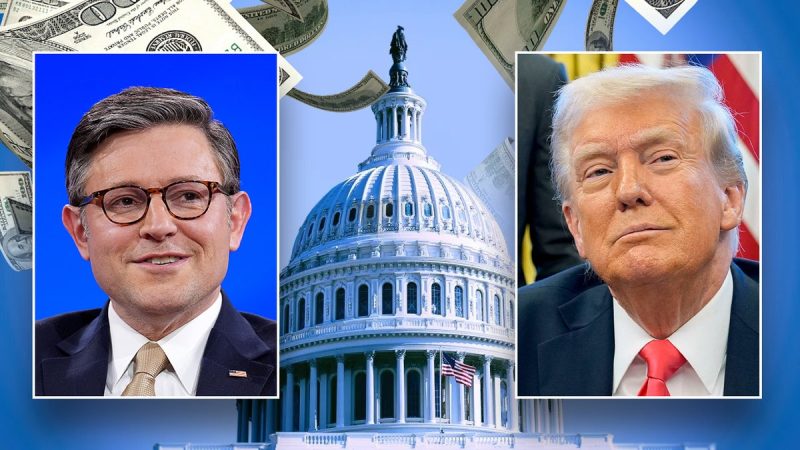
    The fate of President Donald Trump’s $9.4 billion spending cuts request could rest on the shoulders of a handful of moderate House Republicans.

    The House of Representatives is set to consider the measure on Thursday afternoon, which cuts $8.3 billion in funds to the U.S. Agency for International Development (USAID) and just over $1 billion from the Corporation for Public Broadcasting, which routes federal funds to NPR and PBS.

    But at least four GOP lawmakers are known to have expressed some concerns about various aspects of the package. 

    House Republican leaders have a razor-thin, three-seat majority in the chamber, which means any dissent beyond that could sink the bill.

    None of the four Republicans – Reps. Mark Amodei, R-Nev., David Valadao, R-Calif., Nicole Malliotakis, R-N.Y., and Don Bacon, R-Neb. – have said how they will vote on the bill, however. They also all approved a procedural vote to allow for debate on the measure.

    But Amodei, co-chair of the Public Broadcasting Caucus, told Fox News Digital on Wednesday afternoon that he was not worried about NPR and PBS’ national brands, with which he acknowledged the GOP’s bias concerns, and that his fear was gutting funding to smaller local outlets that rely on federal funding to keep people informed in areas with less access.

    ‘These aren’t the people that are doing editorial boards that are flipping you the bird,’ Amodei argued to his fellow Republicans. ‘They’re kind of important pieces of infrastructure in their communities.’

    Amodei, who is intimately familiar with the government funding process as a House appropriator, said ‘a whole bunch of red counties’ depend on public broadcast funding.

    ‘It’s easier for the nationals to raise money if they’ve got to make up for some funding they lost than it is these guys,’ he said.

    Valadao, who represents a California swing district, told Politico he was not sure if the measure would pass.

    He declined to elaborate on his concerns to Fox News Digital, however, and his office did not respond to a request for clarification.

    Meanwhile, Malliotakis told reporters on Wednesday that she met with Republican voters in her district who wanted PBS funding preserved – but that her real concern was the process.

    ‘I think that there’s a lot of questions that members have regarding what programs specifically are going to be cut. This is a broad look at general accounts. We are, at the end of the day, the Congress that holds the power of the purse. We’re the ones who we’re supposed to be identifying where funding is going. And this gives a lot of discretion to the White House to be doing that unilaterally without Congress,’ Malliotakis said.

    ‘I think there’s a large number of members that do have concerns about that. And whether members are going to vote yes or no is a different story in this place. But I have, certainly, reservations… and we’ll see how things go.’

    Bacon, one of three House Republicans representing a district that former Vice President Kamala Harris won in 2024, told reporters Tuesday morning that he was feeling better about the legislation after getting assurances that the foreign aid cuts would not gut money for critical medical research.

    He did not say whether his earlier concerns about PBS and NPR were alleviated, however, nor did he say how he would vote on the bill.

    Bacon told reporters last week, ‘It does bother me, because I have a great rapport with Nebraska Public Radio and TV.’

    When reached for comment, his office pointed Fox News Digital to Bacon’s Wednesday morning appearance on C-SPAN.

    ‘I think the president has to work with us and make this better. So I’m in opposition. That said, I’m in current negotiations with the leadership on this as well,’ Bacon said.

    The $9.4 billion proposal is called a rescissions package, a mechanism for the White House to block congressionally approved funding it disagrees with.

    Once transmitted to Capitol Hill, lawmakers have 45 days to approve the rescissions proposal, otherwise it is considered rejected. 

    Such measures only need a simple majority in the House and Senate to pass. But that’s no easy feat with Republicans’ thin majorities in both chambers.

    If passed, Republican leaders hope the bill will be the first of several rescissions packages codifying spending cuts identified by Elon Musk’s Department of Government Efficiency (DOGE).

    Musk set out with a goal of finding $2 trillion in federal waste, but wound up identifying about $180 billion.

    House GOP leaders lauded the proposal during their weekly press conference on Tuesday.

    ‘These are commonsense cuts. And I think every member of this body should support it. It’s a critical step in restoring fiscal sanity and beginning to turn the tides and removing fraud, waste, and abuse from our government,’ Speaker Mike Johnson, R-La., said.

    This post appeared first on FOX NEWS

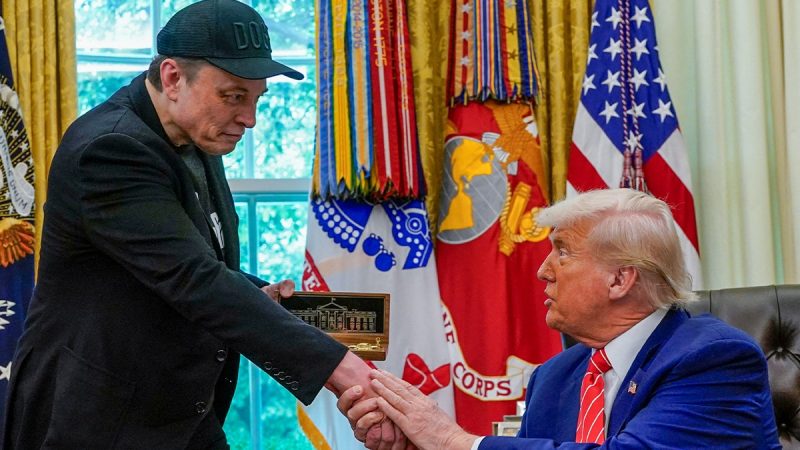
    The war of words between President Donald Trump and Elon Musk, the world’s richest man, appears to be over, and there are signs of some reconciliation.

    However, a new poll suggests that the verbal attacks by Musk, who spent the first four months of Trump’s second administration as a special White House advisor steering the recently created Department of Government Efficiency (DOGE), have hurt his standing among Republicans.

    Sixty-two percent of Republicans hold a favorable opinion of Musk, the billionaire CEO of Tesla and SpaceX, according to a Quinnipiac University national poll released on Wednesday.

    That is down 16 points from a Quinnipiac survey in March, when 78% of Republicans viewed Musk in a favorable way.

    Among all voters, 30% held a favorable opinion of Musk, with 57% viewing him unfavorably. Favorable opinions of Musk dropped six points from Quinnipiac’s March survey, with the unfavorable rating holding steady.

    Musk went all in for Trump last summer and autumn. He endorsed the then-GOP presidential nominee in July right after the assassination attempt against Trump in Butler, Pennsylvania.

    Musk became the top donor of the 2024 election cycle, dishing out nearly $300 million in support of Trump’s bid through America PAC, a mostly Musk-funded super PAC aligned with Trump.

    Trump named Musk to steer DOGE soon after the November election, and the president repeatedly praised Musk during his headline-making and controversial tenure at DOGE.

    The feud broke out days after Musk left the White House late last month, as he dubbed the administration’s massive landmark spending bill – which Trump calls his ‘big, beautiful bill’ – a ‘disgusting abomination,’ which he said would sink the nation into unsustainable debt.

    Musk also argued that Trump would not have won last year’s presidential election without all his support. 

    Trump and Musk traded fire with blistering social media posts, with Musk even claiming without evidence that the government was concealing information about Trump’s association with infamous pedophile Jeffrey Epstein. Musk later deleted the post.

    Musk on Wednesday wrote on his well-watched X account, ‘I regret some of my posts about President @realDonaldTrump last week. They went too far.’

    Trump said in a podcast interview with the New York Post that was published on Wednesday that ‘things like that happen. I don’t blame him for anything.’

    However, when asked about Musk’s apology as he spoke with reporters later in the day, the president said ‘I really haven’t thought too much about it.’

    During his months at DOGE, Musk aimed, but fell far short, of trimming $2 trillion from the federal government’s budget.

    According to the Quinnipiac poll, 38% of voters said that Musk did an excellent or good job at DOGE, with 57% describing his tenure as not so good or poor.

    However, 80% of Republicans questioned said Musk’s work was excellent or good, with just 13% viewing his tenure at DOGE as not so good or poor.

    ‘Though Musk isn’t as popular with Republicans as he once was, he and DOGE get a hearty high five from a healthy majority of Republicans,’ Quinnpiac University polling analyst Tim Malloy said in a statement.

    The Quinnipiac poll was conducted June 5-9, with 1,265 registered voters across the country questioned. The survey’s overall sampling error is plus or minus 2.8 percentage points.

    This post appeared first on FOX NEWS

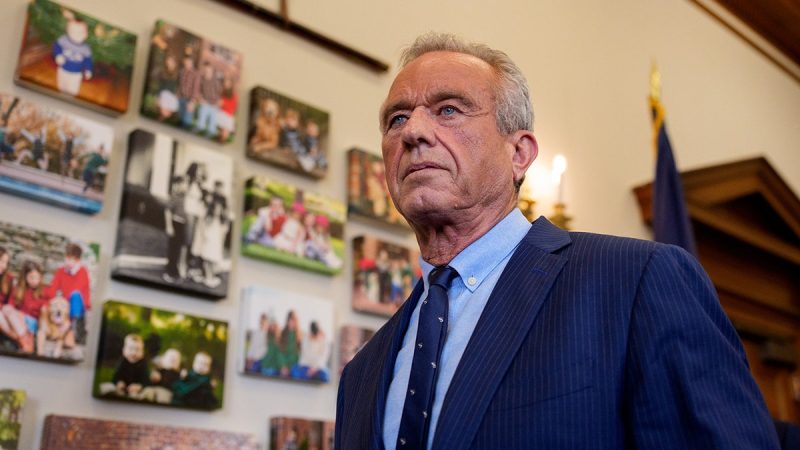
    Health and Human Services Secretary Robert F. Kennedy Jr. announced Wednesday that he has selected eight new people to join the national vaccine panel after firing all 17 of its members. 

    In an X post, Kennedy revealed that he ‘took a major step towards restoring public trust in vaccines’ on Monday by reconstituting the Advisory Committee for Immunization Practices (ACIP). 

    ‘I retired the 17 current members of the committee. I’m now repopulating ACIP with the eight new members who will attend ACIP’s scheduled June 25 meeting,’ Kennedy wrote on Wednesday. ‘The slate includes highly credentialed scientists, leading public-health experts, and some of America’s most accomplished physicians. All of these individuals are committed to evidence-based medicine, gold-standard science, and common sense.’ 

    The new members are: Joseph R. Hibbeln, MD; Martin Kulldorff, MD, PhD; Retsef Levi, PhD; Robert W. Malone, MD; Cody Meissner, MD; James Pagano, MD; Vicky Pebsworth, OP, PhD, RN; and Michael A. Ross, MD. 

    The secretary said all eight people ‘have each committed to demanding definitive safety and efficacy data before making any new vaccine recommendations.’ He said the committee will review safety and efficacy data for the current schedule.’

    Notably, Kulldorff was one of the co-authors of the Great Barrington Declaration, which was written alongside Dr. Sunetra Gupta of Oxford University and Dr. Jay Bhattacharya of Stanford University. 

    The declaration, published in October 2020, promoted lifting lockdown orders sooner and allowing COVID-19 to spread among young, healthy people to more quickly reach herd immunity. The strategy also included precautions to shield those most vulnerable to severe illness, and the authors said the approach would help mitigate the long-term societal and economic harms of prolonged lockdown orders. 

    It was condemned harshly at the time by the World Health Organization and Dr. Anthony Fauci, then-Director of the U.S. National Institute of Allergy and Infectious Diseases.

    On Tuesday, before he announced his picks, Kennedy said, ‘We’re going to bring great people onto the ACIP panel – not anti-vaxxers – bringing people on who are credentialed scientists.’

    Kennedy on Monday ousted all 17 members of the ACIP, saying he would appoint a new group before the next scheduled meeting in late June. The agenda for that meeting has not yet been posted, but a recent federal notice said votes are expected on vaccinations against flu, COVID-19, HPV, RSV and meningococcal bacteria. 

    ACIP members typically serve staggered four-year terms, although several appointments were delayed during the Biden administration before positions were filled last year. The voting members all have scientific or clinical expertise in immunization, except for one ‘consumer representative’ who can bring perspective on community and social facets of vaccine programs. The committee, created in 1964, makes recommendations to the director of the Centers for Disease Control and Prevention.

    Kennedy provided a brief biography of each of his new picks. 

    Hibbeln is a psychiatrist and neuroscientist with a career in clinical research, public health policy and federal service. 

    ‘As former Acting Chief of the Section on Nutritional Neurosciences at the National Institutes of Health, he led research on immune regulation, neurodevelopment, and mental health,’ Kennedy wrote. ‘His work has informed U.S. public health guidelines, particularly in maternal and child health. With more than 120 peer-reviewed publications and extensive experience in federal advisory roles, Dr. Hibbeln brings expertise in immune-related outcomes, psychiatric conditions, and evidence-based public health strategies.’ 

    Kulldorff is a biostatistician and epidemiologist formerly at Harvard Medical School and a leading expert in vaccine safety and infectious disease surveillance. 

    ‘He has served on the Food and Drug Administration’s Drug Safety and Risk Management Advisory Committee and the CDC’s Vaccine Safety Subgroup of the Advisory Committee on Immunization Practices, where he contributed to national vaccine safety monitoring systems,’ Kennedy wrote, adding that he developed tools used ‘for detecting disease outbreaks and vaccine adverse events.,’ and has expertise that ‘includes statistical methods for public health surveillance, immunization safety, and infectious disease epidemiology.’

    Levi is the Professor of Operations Management at the MIT Sloan School of Management and a leading expert in healthcare analytics, risk management, and vaccine safety. 

    ‘Dr. Levi has collaborated with public health agencies to evaluate vaccine safety, including co-authoring studies on mRNA COVID-19 vaccines and their association with cardiovascular risks. His research has contributed to discussions on vaccine manufacturing processes, safety surveillance, and public health policy,’ Kennedy wrote, adding that Levi ‘has also served on advisory committees and engaged in policy discussions concerning vaccine safety and efficacy,’ and that his ‘work continues to inform national and international debates on immunization safety and health system resilience.’ 

    Malone is a physician-scientist and biochemist known for his early contributions to mRNA vaccine technology, specifically ‘foundational research in the late 1980s on lipid-mediated mRNA delivery, which laid the groundwork for later developments in mRNA-based therapeutics,’ Kennedy wrote, adding that Malone’s ‘expertise spans molecular biology, immunology, and vaccine development.’

    Meissner is a Professor of Pediatrics at the Geisel School of Medicine at Dartmouth and a nationally recognized expert in pediatric infectious diseases and vaccine policy. 

    ‘He has served as Section Chief of Pediatric Infectious Disease at Dartmouth-Hitchcock Medical Center and has held advisory roles with both the Centers for Disease Control and Prevention (CDC) and the Food and Drug Administration (FDA),’ Kennedy wrote, adding that Meissner was a voting member of the CDC’s Advisory Committee on Immunization Practices and the FDA’s Vaccines and Related Biological Products Advisory Committee, through which ‘he has contributed to national immunization guidelines and regulatory decisions.’

    ‘His expertise spans vaccine development, immunization safety, and pediatric infectious disease epidemiology. Dr. Meissner has also been a contributing author to American Academy of Pediatrics policy statements and immunization schedules, helping shape national standards for pediatric care.’ 

    Pagano is a board-certified Emergency Medicine physician with over 40 years of clinical experience following his residency at UCLA. 

    ‘He has worked in diverse emergency settings, from Level 1 trauma centers to small community hospitals, caring for patients across all age groups, including infants, pregnant women, and the elderly,’ Kennedy wrote, adding that he has also served on various committees and medical executive boards. ‘He is [a] strong advocate for evidence-based medicine.’

    Pebsworth earned a doctorate in public health and nursing from the University of Michigan. 

    ‘She has worked in the healthcare field for more than 45 years, serving in various capacities, including critical care nurse, healthcare administrator, health policy analyst, and research scientist with a focus on public health policy, bioethics, and vaccine safety,’ Kennedy wrote, pointing to her current leadership role with the National Association of Catholic Nurses, and previous positions with the FDA’s Vaccine and Related Biological Products Advisory Committee, the National Vaccine Advisory Committee’s 2009 H1N1 Vaccine Safety Risk Assessment Working Group and Vaccine Safety Working Group.

    Ross is a Clinical Professor of Obstetrics and Gynecology at George Washington University and Virginia Commonwealth University, with a career spanning clinical medicine, research, and public health policy. 

    ‘He has served on the CDC’s Advisory Committee for the Prevention of Breast and Cervical Cancer, where he contributed to national strategies for cancer prevention and early detection, including those involving HPV immunization,’ Kennedy wrote, pointing to his experience with ‘clinical investigations with immunologic relevance,’ advising organizations like the American College of Obstetricians and Gynecologists, and advocacy efforts related to women’s health. 

    ‘His continued service on biotech and healthcare boards reflects his commitment to advancing innovation in immunology, reproductive medicine, and public health,’ Kennedy added.

    The Associated Press contributed to this report.

    This post appeared first on FOX NEWS

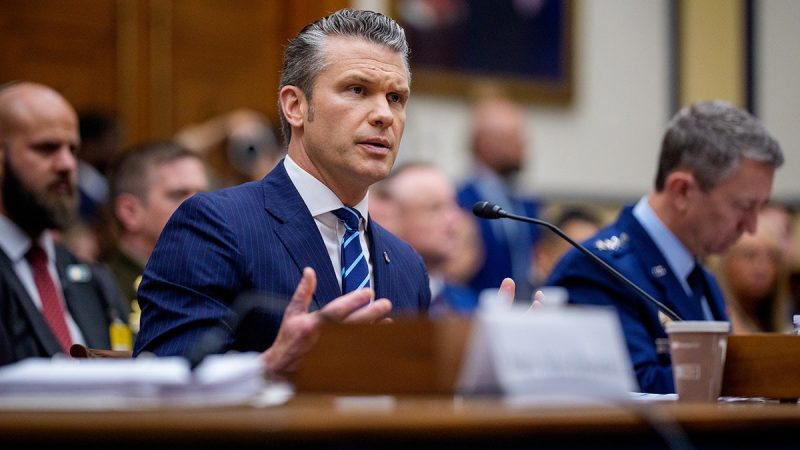
    A California Democrat told Pete Hegseth on Thursday that he is an ’embarrassment’ to the United States and should ‘get the hell out’ of the Department of Defense after the Secretary chided the lawmaker for a ‘silly question’ he asked during a house hearing.

    The outburst from Rep. Salud Carbajal was immediately followed by a call for decorum as lawmakers from the House Armed Services Committee were questioning Hegseth about the Department of Defense’s Fiscal Year 2026 budget request.

    Tensions started escalating on Capitol Hill as Carbajal asked Hegseth a series of yes or no questions, beginning with the deployment of the National Guard and U.S. Marines in Los Angeles to quell the unrest generated by anti-ICE protests. 

    ‘Let’s call it for what it is. It’s political theater. Hegseth, are the Marines in Los Angeles ordered to protect property by any means necessary?’ Carbajal asked him.

    ‘Sir, I would say the ICE officers and police officers being attacked is not political theater,’ he responded, before Carbajal cut him off and said ‘just yes or no?’

    ‘The National Guard and Marines have the full authority to protect federal ICE agents,’ Hegseth continued.

    ‘Yes or no? Can you just say yes or no? This isn’t Fox anymore. Just yes or no,’ Carbajal said.

    At one point, Carbajal told Hegseth that ‘Kindergartners can give me a yes or no’ and asked him ‘Do you think political allegiance to Trump is a requirement for serving our nation, either in uniform or a civilian in the department?’

    ‘Congressman, you know what a silly question that is,’ Hegseth responded.

    ‘You know what? I’m not going to waste my time anymore. You’re not worthy of my attention or my questions. You’re an embarrassment to this country. You’re unfit to lead. And there’s been bipartisan members of Congress that have called for your resignation. You should just get the hell out and let somebody competently lead this department,’ Carbajal concluded.

    In his opening statement, Hegseth said ‘Under President Trump’s leadership, this budget puts America first and gives our warriors what they need. The $961 billion budget request — more than 1 trillion in total for national security — ends four years of chronic underinvestment in our military.’

    ‘We are restoring the warrior ethos. President Trump charged me to focus relentlessly on war fighting, lethality, meritocracy, standards and readiness. And that is exactly what we’ve done since day one. We are refocusing on what is truly important, which is war fighting and our warriors, sweeping away distractions and bureaucracy. We are setting standards that are high, equal and unwavering,’ Hegseth continued.

    ‘DEI is dead. We replaced it with a colorblind, gender-neutral, merit-based approach. Our forces are responding incredibly to these changes. Because of President Trump and his America First priorities, recruitment and retention under this administration are higher than they’ve been in decades. Historic numbers of young Americans are putting on the uniform and raising their right hand because they believe in the leadership they see,’ he added.

    Hegseth also told lawmakers on Capitol Hill that ‘we applaud allies who are stepping up, but others need to do more, and they need to do it quickly and at the NATO heads of state meeting later this month, we expect our NATO allies to commit to 5% of GDP on defense and defense related investments, something that was almost inconceivable before President Trump led the charge in his first administration and continues in this one.’

    This post appeared first on FOX NEWS

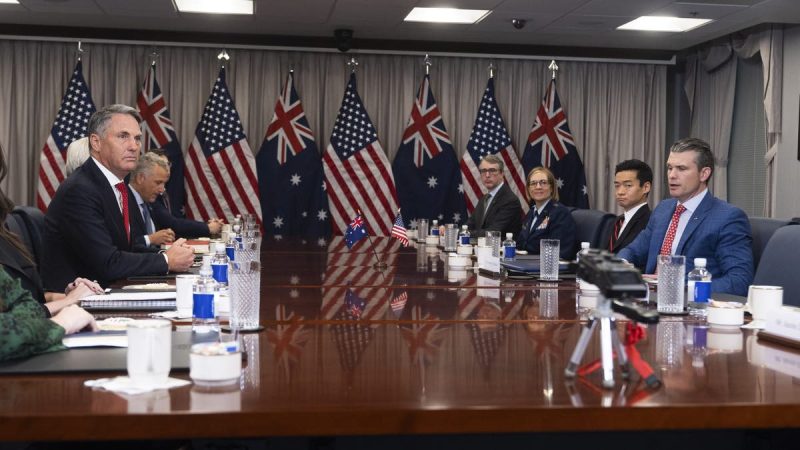
    The Pentagon is considering backing out of the nuclear submarine agreement former President Joe Biden struck with Australia and the United Kingdom, amid shipbuilding problems back at home. 

    ‘The Department is reviewing AUKUS as part of ensuring that this initiative of the previous Administration is aligned with the president’s ‘America First’ agenda,’ a U.S. defense official said. 

    ‘As Secretary Hegseth has made clear, this means ensuring the highest readiness of our service members, that allies step up fully to do their part for collective defense, and that the defense industrial base is meeting our needs. This review will ensure the initiative meets these common sense, ‘America First’ criteria.’

    Under the deal, which was seen as a response to China’s growing military threat in the Indo-Pacific, the U.S. and the UK would help Australia acquire conventionally armed, nuclear-powered submarines. Canberra would initially purchase several Virginia-class submarines in the early 2030s. The three nations would jointly design a new class of submarines, with Australian production beginning in the 2040s.

    The three nations also agreed to share technology in cyber and quantum capabilities, AI, hypersonics and deep sea radar. 

    In a confirmation hearing in March, Pentagon policy chief Elbridge Colby seemed leery of offering Australia nuclear-powered submarines while the U.S. struggles to produce enough for itself. 

    ‘If we can produce the attack submarines in sufficient number and sufficient speed, then great. But if we can’t, that becomes a very difficult problem because we don’t want our servicemen and women to be in a weaker position,’ Colby said.

    Australia plans to increase its defense spending to 2.4% by the mid-2030s, but the U.S. is pushing it to boost that figure much faster. 

    In a recent meeting in Singapore with Australian defense minister Richard Marles, Defense Secretary Pete Hegseth told Marles the U.S. wants to see Australia spend 3.5% on defense. 

    Admiral Sam Paparo, head of Indo-Pacific Command, voiced support for the AUKUS initiative in April. 

    ‘AUKUS delivers something to INDOPACOM that is critical and could be a key advantage, and that is a Indian Ocean submarine base. This gives us faster response time to the South China Sea than in Hawaii, in Washington, in San Diego,’ Paparo said.

    Congress has appropriated billions of dollars to boost submarine- and ship-building capabilities, but some lawmakers claim the Pentagon’s plans to do so remain opaque. Meanwhile, experts estimate that China’s shipbuilding capabilities are around 230 times higher than those of the U.S. 

    Rep. Rosa DeLauro, the House’s top Democrat appropriator, pressed Hegseth on his shipbuilding plan in a hearing this week. 

    ‘There is a gap,’ Hegseth admitted, ‘but we believe we are closing it.’

    However, DeLauro was not satisfied, demanding detailed data to back up that claim.

    ‘We do not have any information or data that can substantiate what you’re saying,’ she shot back. ‘Give us the details.’

    ‘We’ve had difficulty with the prior administration, and I don’t mind calling them out. What is your plan for the future?’

    This post appeared first on FOX NEWS