Author

admin

Browsing

Here’s a quick recap of the crypto landscape for Friday (July 11) as of 9:00 a.m. UTC.

Get the latest insights on Bitcoin, Ethereum and altcoins, along with a round-up of key cryptocurrency market news.

Bitcoin and Ethereum price update

Bitcoin (BTC) is priced at US$118,008 a 6.3 percent increase in the last 24 hours. The day’s range for the cryptocurrency brought a low of US$110,768 and a high of US$118,667.

Bitcoin price performance, July 11, 2025.

Chart via TradingView

Ethereum (ETH) is priced at US$3,003.27, up by 7.4 percent over the past 24 hours. Its lowest valuation as of Friday was US$2,767.71, and its highest was US$3,027.12.

Altcoin price update

  • Solana (SOL) was priced at US$163.68, up by 5.3 percent over 24 hours. Its lowest valuation as of Friday was US$156.41, and its highest was US$166.09.
  • XRP was trading for US$2.59, up 10 percent in the past 24 hours. The cryptocurrency’s lowest valuation was US$2.43, and its highest was US$2.69.
  • Sui (SUI) is trading at US$3.50, up by 7.9 percent over the past 24 hours. Its lowest valuation was US$3.22 and its highest was US$3.54.
  • Cardano (ADA) is priced at US$0.7123, up by 18.4 percent in the last 24 hours. Its lowest valuation as of Friday was US$0.6233, and its highest was US$0.7521.

Today’s crypto news to know

Bitcoin hits US$118,000 as ETF inflows surge and US crypto legislation advances

Bitcoin shattered previous records by surging past US$118,000 this week, with bullish momentum sustained by large inflows into spot bitcoin ETFs and favorable policy signals from Washington.

The world’s largest cryptocurrency jumped over 7 percent Friday, closing in on US$119,000 as investors cheered bipartisan Senate passage of the GENIUS Act—a bill that would establish regulatory guardrails for stablecoins.

Market optimism is also supported by a softer US dollar and the Trump administration’s overt crypto friendliness.

The GENIUS Act would codify requirements for fiat-pegged stablecoins, offering investor protections while legitimizing the sector in the eyes of institutional capital. ETFs tracking Bitcoin have posted record volumes, drawing billions in net inflows.

Bitcoin is now up over 26 percent year-to-date, with total crypto market capitalization nearing US$3.5 trillion.

Analysts expect next week’s “crypto week” in Congress to further catalyze sentiment, as lawmakers debate multiple digital asset bills.

Trump-linked WLFI Token gets US$100M buy from anonymous entity

A little-known group called Aqua 1 Foundation became the largest public investor in Donald Trump’s World Liberty Financial (WLFI) crypto token, buying US$100 million worth of tokens in late June.

According to Reuters, though the foundation says it is based in the UAE, public records offered no clarity on the group’s financial backers or its supposed founder Dave Lee.

The token purchase directly benefits the Trump family, which reportedly receives 75 percent of all WLFI proceeds; the family’s estimated crypto earnings have now topped US$500 million.

While Aqua 1 said in a brief statement it was backed by ‘mission-aligned partners,’ it declined to offer transparency on its structure, citing privacy. US ethics experts have raised concerns over potential conflicts of interest, despite the White House stating Trump’s assets are in a trust managed by his children.

World Liberty and Trump Media did not respond to press inquiries.

EU regulator warns crypto firms over misleading investors

The European Securities and Markets Authority (ESMA) warned crypto platforms against blurring the distinction between regulated and unregulated products under MiCA, the EU’s new crypto framework.

ESMA said that many crypto firms are offering both compliant and non-compliant services on the same platform, creating investor confusion and undermining MiCA’s consumer protections.

Under MiCA, only firms licensed as crypto asset service providers (CASPs) are allowed to market specific financial products across the EU.

However, direct investments in commodities or crypto lending still fall outside the scope of those protections. ESMA also criticized some firms for using their regulated status as a marketing tactic to legitimize riskier services.

Securities Disclosure: I, Giann Liguid, hold no direct investment interest in any company mentioned in this article.

Securities Disclosure: I, Meagen Seatter, hold no direct investment interest in any company mentioned in this article.

This post appeared first on investingnews.com


(TheNewswire)


July 11, 2025 TheNewswire – Vancouver, British Columbia Blue Lagoon Resources Inc. (the ‘ Company ‘) (CSE: BLLG,OTC:BLAGF; OTCQB: BLAGF; FSE: 7BL) is pleased to announce the official opening of its wholly owned Dome Mountain Gold Mine Project, that recently received its mining permit making it one of only nine mining permits granted in British Columbia in the past decade – and one of just a few high-grade, road-accessible gold projects to reach production-ready status in recent years.


  The celebration, held on July 9, 2025, brought together over 100 guests from across Canada and abroad — including attendees from Germany, South Carolina, Denver, Montana and Toronto — to mark this significant milestone for the Company and the region.  


Dignitaries in attendance included the Mayor of Smithers, Gladys Atrill; MLA Sharon Hartwell (Bulkley Valley-Stikine); and MP Ellis Ross (Skeena-Bulkley Valley). Also present were various representatives from the Ministry of Mines and Critical Minerals and other provincial agencies. Minister of Mining and Critical Minerals, Jagrup Brar, was unable to attend in person due to his participation in the annual Conference of Mines Ministers of Canada, held in Prince Edward Island. However, he shared a recorded message acknowledging the importance of the project, which was played during the event. Minister Brar is scheduled to visit and tour the Dome Mountain site later this month.


In a powerful display of cultural heritage and support, 18 Hereditary Chiefs and Guardians from the Lake Babine Nation (LBN) joined Hereditary Chief and Council Member Fabian Michell for the opening ceremony, which featured a traditional drum ceremony representing songs from all four LBN clans: Bear, Beaver, Frog, and Caribou.


‘We were deeply honoured to stand alongside the Lake Babine Nation, whose presence and participation made this day truly meaningful,’ said Rana Vig, President & CEO of Blue Lagoon Resources. ‘This is more than just the opening of a gold mine — it’s a moment that reflects years of hard work, resilience, and respectful collaboration.’


During the two-day event, guests had the opportunity to take underground tours as well as visit the recently completed, state-of-the-art water treatment plant — a key environmental safeguard for the project. The facility has the capacity to treat over six times the current needs at Dome Mountain, ensuring long-term environmental resilience as production scales.


With the mine officially open, pre-production work will begin next week, setting up Dome Mountain to   begin mining and transition to near-term cash flow   once the Moving Bed Biofilm Reactor (MBBR) system is commissioned – expected in about four weeks. The two-stage water-treatment facility features a functioning High-Density Sludge (HDS) circuit and the MBBR circuit, which uses microbes to remove blasting-related ammonia and nitrates. The MBBR’s biological ramp-up phase typically takes approximately four weeks. Mining will commence immediately upon the completion of this phase.


‘As a geologist, this is a proud moment in my career,’ said Bill Cronk, Chief Geologist and Project Manager at Blue Lagoon Resources. ‘To see a project go from exploration to production — and to be part of that transformation — is something most geologists only dream of. This team made it happen and I’m very proud of that.’


The event also welcomed strategic investors and partners, including Dr. Quinton Hennigh, technical advisor to Crescat Capital, and Peter Espig, CEO of Nicola Mining, with whom Blue Lagoon has a long-term toll milling agreement.


‘Dome Mountain represents what’s possible when entrepreneurial determination meets responsible mining practices,’ said Peter Espig, CEO of Nicola Mining. ‘We’re proud to support Blue Lagoon in bringing this project to life, and to be part of a partnership grounded in trust, transparency, and technical excellence.’


Throughout the event, Blue Lagoon’s highly experienced technical team was on site to answer questions and provide detailed explanations of the mining methods and techniques planned for Dome Mountain. This included Steve Cutler of Roughstock Mining, an accomplished underground mining consultant with decades of experience who has worked on a wide range of underground gold projects across North America. Also present was Peter Bojtos, a professional mining engineer with global experience who has been directly involved in the opening or reopening of 19 mines over the course of his career — making Dome Mountain his 20th. Mr. Bojtos is a current director of Avino Silver & Gold Mines Ltd (formerly Chairman) (ASM:NYSE) and a technical advisor on the Dome Mountain Gold Project.


   With pre-production work beginning next week, Blue Lagoon Resources is now positioned to become one of British Columbia’s next producing high-grade gold mines.   


  About Blue Lagoon Resources Inc.  


  Blue Lagoon Resources is a Canadian based publicly listed mining company (CSE: BLLG,OTC:BLAGF; FSE: 7BL; OTCQB: BLAGF) focused on building shareholder value through the aggressive development of its 100% owned Dome Mountain Gold project. The Company is run by professionals with significant finance and mining experience and operates within a prime mining  


  jurisdiction in British Columbia, Canada. With the granting of a full    mining permit,    a key milestone achieved in February 2025 – one of only nine such permits issued in British Columbia since 2015 – Blue Lagoon is now focused on last preparatory activities and tasks related to the safe and secure opening of the Dome Mountain Gold Mine, targeting    Q3 2025    as the start of gold    production    . The Company’s primary objective has always been to become a cash-flowing mining company, to ultimately deliver tangible monetary value to shareholders, state, and local communities.  


  The Company is not basing its production decision at Dome Mountain on a feasibility study of mineral reserves demonstrating economic and technical viability. The production decision is based on having existing mining infrastructure, past bulk sampling and processing activity, and the established mineral resource.  The Company understands that there is increased uncertainty, and consequently a higher risk of failure, when production is undertaken in advance of a feasibility study.  


  For   further   information,   please   contact:  


  Rana   Vig  


  President   and   CEO  


  Telephone:   604-218-4766  


  Email:     ranavig@bluelagoonresources.com    


  The   CSE   has   not   reviewed   and   does   not   accept   responsibility   for   the   adequacy   or   accuracy   of   this   release.  


  Statement Regarding Forward-Looking Information: This release includes certain statements that may be deemed ‘forward-looking statements’. All statements in this release, other than statements of historical facts, that address events or developments that Blue Lagoon Resources Inc. (the ‘Company’) expects to occur, are forward-looking statements. Forward-looking statements are statements that are not historical facts and are generally, but not always, identified by the words ‘expects’, ‘targets’, ‘plans’, ‘anticipates’, ‘believes’, ‘intends’, ‘estimates’, ‘projects’, ‘potential’, ‘mine’, ‘production’ and similar expressions, or that events or conditions ‘will’, ‘would’, ‘may’, ‘could’ or ‘should’ occur. Although the Company believes the expectations expressed in such forward-looking statements are based on reasonable assumptions, such statements are not guarantees of future performance and actual results may differ materially from those in the forward-looking statements. Factors that could cause the actual results to differ materially from those in forward-looking statements include results of exploration activities may not show quality and quantity necessary for further exploration or future exploitation of minerals deposits, volatility of gold and silver prices, delays in mine development activities, future cash flow expectations and continued availability of capital and financing, permitting and other approvals, and general economic, market or business conditions.  Investors are cautioned that any such statements are not guarantees of future performance and actual results or developments may differ materially from those projected in the forward-looking statements. Forward-looking statements are based on the beliefs, estimates and opinions of the Company’s management, contractors and consultants on the date the statements are made. Except as required by applicable securities laws, the Company undertakes no obligation to update these forward-looking statements in the event that management’s, contractor’s and consultants’ beliefs, estimates or opinions, or other factors, should change.  


Copyright (c) 2025 TheNewswire – All rights reserved.


News Provided by TheNewsWire via QuoteMedia

This post appeared first on investingnews.com

An appeals court has reversed the conviction of a pro-Trump influencer charged with spreading false information on social media to suppress Democratic voter turnout during the 2016 election, voiding conspiracy charges and a monthslong federal prison sentence handed down by a jury in Brooklyn, New York.

The U.S. Court of Appeals for the 2nd Circuit on Wednesday unanimously voided the conviction of Douglass Mackey on federal conspiracy charges and remanded the case back to the U.S. Court in the Eastern District of New York to enter a new judgment of acquittal.

The unanimous three-judge panel said in their ruling that ‘no rational jury’ could have found that Mackey, 36, ‘knowingly’ joined others in an illegal conspiracy aimed at influencing the outcome of the 2016 election or depriving people of their right to vote.

‘The jury’s verdict and the resulting judgment of conviction must be set aside,’ Chief Judge Debra Ann Livingston wrote.

The verdict is a win for Mackey, a self-styled right-wing influencer and self-described ‘troll,’ who amassed roughly 58,000 followers on Twitter in the run-up to the 2016 election. 

Mackey, who used the handle ‘Ricky Vaughn,’ used his account to post false information designed to support then-presidential candidate Donald Trump, including memes designed to look like Hillary Clinton ads that told voters they could submit their ballots via text message.

Mackey was convicted in 2023 on conspiracy charges and sentenced to seven months in federal prison.

The three-judge panel ruled Wednesday that Mackey’s posts, including the false memes he posted, were not sufficient evidence to prove that he had violated U.S. conspiracy laws, ‘even assuming that he did so with the intent to injure other citizens in the exercise of their right to vote,’ they said. 

‘The government was obligated to show that Mackey knowingly entered into an agreement with other people to pursue that objective,’ Chief Judge Debra Ann Livingston and Judges Reena Raggi and Beth Robinson wrote. ‘This the government failed to do.’

The decision was praised by Mackey, who immediately posted on social media about the verdict.

‘HALLELUJAH!’ Mackey said on X after the appellate court ruling on Wednesday. Mackey proceeded to thank God, his family, wife, lawyers and others who supported him during the trial in subsequent posts. He then threatened to pursue legal action over his conviction.

‘Now we sue,’ he said.

This post appeared first on FOX NEWS

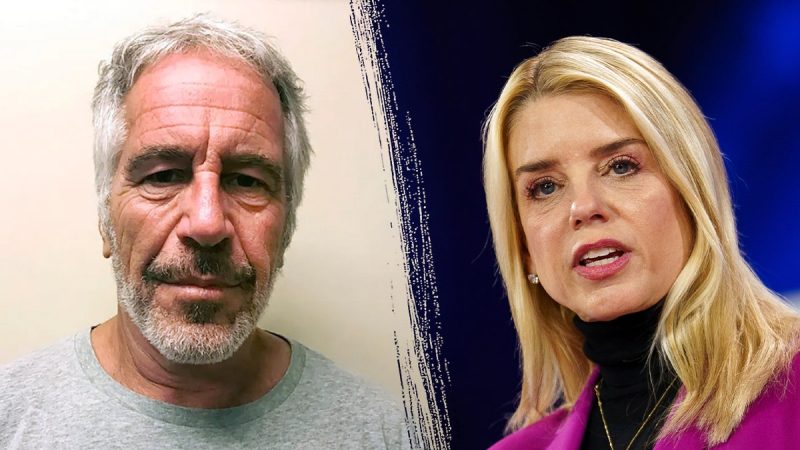
Department of Justice leaders are facing sharp criticism and resignation calls from a faction of their supporters after they ended their inquiry into Jeffrey Epstein’s sex trafficking case without releasing new files.

The outrage, emanating largely from the right, can be tied to several past instances when those same leaders and other Republicans with large platforms once promoted the existence of incriminating, nonpublic Epstein case files, including a supposed list of sexual predators who were his clients.

Attorney General Pam Bondi, FBI Director Kash Patel and FBI Deputy Director Dan Bongino now say they have nothing further to share with the public about Epstein’s case.

In a joint, unsigned memo, the DOJ and FBI said Monday that after an exhaustive inquiry uncovering 300 gigabytes’ worth of material related to Epstein’s case, they found no signs of illegal activity by any new third parties. 

‘We did not uncover evidence that could predicate an investigation against uncharged third parties,’ the memo read.

The memo stated that ‘much of the material’ related to the Epstein case was subject to court-ordered seals, prohibiting the DOJ from releasing it. The client list, a point of significant discourse, does not exist, the memo said.

Some of President Donald Trump’s supporters and Patel’s and Bongino’s massive fan bases are now making it clear that they expected more. Below are 10 possible reasons for that.

1. Kash Patel said House Republicans should release ‘Epstein’s list’ of ‘pedophiles.’ 

Right-wing commentator Benny Johnson asked Patel why the government had not released information about Epstein’s purported clients, according to a clip Johnson shared in December 2023, before Patel became FBI director.

‘Simple, because of who’s on that list,’ Patel replied. ‘You don’t think that Bill Gates is lobbying Congress night and day to prevent the disclosure of that list?’

Patel criticized the Republican-led House for failing to obtain ‘Epstein’s list.’

 ‘What the hell are the House Republicans doing? They have the majority. You can’t get the list?’ Patel asked, later adding, ‘We can’t even get basic documents out. This is why America hates Congress.’

‘Put on your big boy pants, and let us know who the pedophiles are,’ Patel said.

2. Kash Patel told Glenn Beck that the FBI director has ‘direct control’ of Epstein’s address book.

In an interview in December 2023, Patel addressed questions from BlazeTV host Glenn Beck about Epstein’s ‘black book.’ Patel said the FBI had the book.

‘That’s under direct control of the director of the FBI,’ the now-FBI director said.

Patel added, ‘That’s a thing I think President Trump should run on. On day one, roll out the black book.’

Epstein’s address books have long been a point of scrutiny. His house manager tried to sell one, according to a 2009 FBI affidavit. Gawker published one of the address books in 2015 with phone numbers redacted. That version contains hundreds of both well-known and obscure names. A judge allowed one of the address books to be entered under seal into the court record during his associate Ghislain Maxwell’s sex trafficking trial in 2021.

3. Trump told Fox News during his campaign that he plans to release the Epstein files.

When asked on ‘Fox & Friends Weekend’ last year if Trump would ‘declassify the Epstein files’ if he were elected president, Trump replied that he would.

‘Yeah, yeah I would. I guess I would,’ Trump said. ‘I think less so because you don’t know, you don’t want to affect people’s lives if it’s phony stuff in there, because there’s a lot of phony stuff with that whole world, but I think I would.’

On Tuesday during a Cabinet meeting, Trump brushed off the topic of Epstein when asked by a reporter about him.

‘Are people still talking about this guy, this creep?’ Trump said. ‘That is unbelievable.’

4. Rep. Marjorie Taylor Greene, R-Ga., insisted there is a ‘list,’ even after the Bondi-led DOJ said otherwise.

‘What about her little black book? The 97-page book, contains the names and contact details of almost 2,000 people including world leaders, celebrities and businessmen,’ Rep. Marjorie Taylor Greene wrote this week on X. ‘No one believes there is not a client list.’

The Miami Herald’s Julie Brown, who followed and reported on Epstein’s case for years, has said claims about the list are dubious.

‘There is no client list that I am aware of. My theory is it was something conspiracy theorists cooked up to monetize their podcasts online,’ Brown wrote in response to social media users in 2024.

5. Sen. Marsha Blackburn, R-Tenn., claimed ‘Epstein’s client list’ was ‘key to helping us crack this trafficking ring wide open.’

Sen. Marsha Blackburn has made the release of the Epstein files one of her top priorities over the past couple of years.

From promoting anticipated disclosures on the Senate floor to posting dozens of times about the matter on social media, Blackburn has vowed that ‘accountability for these predators is coming.’

‘Epstein’s client list and the information I requested to reveal his associates & business dealings are key to helping us crack this trafficking ring wide open,’ Blackburn wrote on social media in February.

Ahead of the DOJ releasing a small tranche of files in February, Blackburn said ‘this will be a ‘phase 1’ release. There will be more to come.’

The Trump administration first released that batch of information, which contained no new revelations, in February to right-wing social media influencers. They appeared in photos at the White House with binders the Trump administration gave them that were labeled ‘classified’ and ‘Epstein files: Phase 1.’

Blackburn also secured a promise from Patel during his confirmation hearing this year that he would publish Epstein files.

6. Bondi suggested an Epstein list was on her desk.

Bondi was asked by host John Roberts during a Fox News interview in February if she planned to release a ‘list of Epstein’s clients.’

‘It’s sitting on my desk right now to review,’ Bondi said. ‘That’s been a directive by President Trump. I’m reviewing that.’

Bondi clarified her remarks during the Cabinet meeting with Trump on Tuesday, saying she was referencing Epstein’s entire case file.

‘In February, I did an interview on Fox, and it’s been getting a lot of attention because I said, I was asked a question about the client list, and my response was, ‘It’s sitting on my desk to be reviewed,’ meaning the [Epstein] file along with the JFK and MLK files, as well,’ Bondi said. ‘That’s what I meant by that.’

7. Bondi told Sean Hannity that the DOJ has a ‘truckload’ of Epstein evidence.

After the initial document release flopped, Bondi falsely said the FBI’s New York office was intentionally withholding documents from her.

During an interview with Fox News’s Sean Hannity in March, Bondi claimed a ‘source’ told her the case files were in New York, where Epstein was indicted in 2019.

‘I gave them a deadline of Friday at 8 a.m. to get us everything, and a source had told me where the documents were being kept, Southern District of New York, shock,’ Bondi said. ‘So we got them all by, hopefully all of them, Friday at 8 a.m., thousands of pages of documents.’

‘Director Patel is going to get us a detailed report as to why the FBI withheld all of those documents,’ Bondi said, adding that a ‘truckload of evidence arrived’ at the DOJ after she requested the documents from New York.

The attorney general then went on a tirade about transparency and again questioned why the case files were in New York.

8. Bongino told his podcast listeners the ‘Epstein client list is a huge deal.’ There is ‘a reason they’re hiding it,’ he said.

Bongino predicted on his podcast in September 2024 that the ‘Epstein client list,’ which he now says does not exist, ‘is going to rock the Democrat Party.’

‘Folks, the Epstein client list is a huge deal,’ Bongino said.

‘The reason the Epstein client list being revealed is so important is because I want you to understand that there is a class of bekightened folks … who are not subjected to the same rules you are,’ Bongino said.

The former podcast star warned, ‘Folks, you’re going to see a lot of names on that. … It’s going to rock the political world. There’s a reason they’re hiding it.’

Bongino pushed the theory that Epstein’s death in 2019 in his jail cell was not a suicide, despite the DOJ inspector general and a medical examiner saying it was.

Epstein ‘is deceased under, at a minimum, suspicious circumstances,’ Bongino said.

In the FBI and DOJ’s new memo, they concluded that Epstein’s death was caused by suicide.

9. Bondi said she was briefed on the Epstein files and could not talk about them.

Bondi told Benny Johnson in February that she was briefed about the matter and unable to comment on it.

Johnson asked, ‘Where are we at with the Jeffrey Epstein list? The documents? And Kash has made a lot of public statements about this.’

‘I was briefed on that yesterday,’ Bondi said. ‘I can’t talk about that publicly. But, President Trump has given a very strong directive, and that’s going to be followed.’

10. Patel said in November that ‘restoring trust’ in federal agencies could include giving the public the ‘Epstein list.’ 

Patel told told Johnson last November that what is ‘most important’ is ‘restoring trust in our agencies and departments.’

‘The way to do that is to literally give the American people the truth,’ Patel said. ‘And that’s what they feared about Donald Trump. He’s going to come in there and maybe give them the Epstein list and maybe give them the P. Diddy list … and they are terrified.’

Epstein was indicted in 2019 for allegedly recruiting dozens of women and minors as young as 14 and engaging in sexual relations with them at his lavish homes in Florida, New York and elsewhere. He allegedly sexually abused some of them.

He died after being found unresponsive in his prison cell in New York City in 2019. Maxwell, his associate, was convicted of conspiring to sexually abuse minors and sentenced to 20 years in prison. She has an appeal in her case pending.

This post appeared first on FOX NEWS

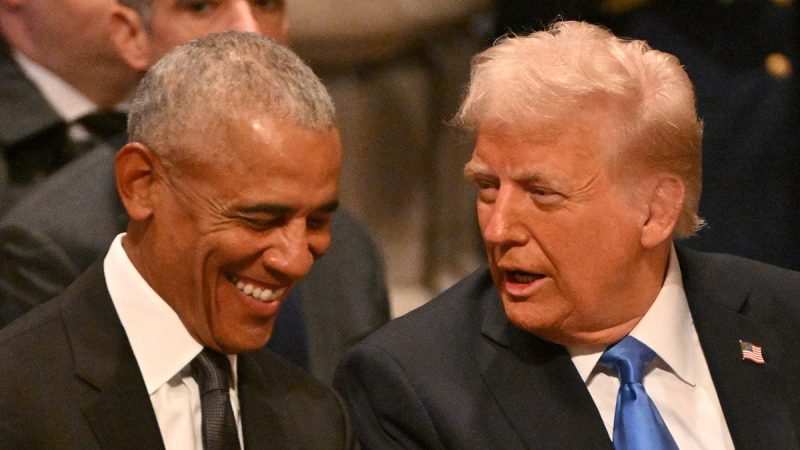
President Donald Trump and former President Barack Obama chatted about golf during a viral moment of bipartisanship during former President Jimmy Carter’s funeral in January, just days before Trump’s return to the Oval Office, a new book detailing the unprecedented 2024 election cycle reported. 

Trump and Obama were seen smiling and quietly chatting with one another in the pews of the Washington National Cathedral on Jan. 9, 2025, in a moment that spread like wildfire on social media as Americans sounded off with speculation over what the pair of presidents who had long traded political barbs were talking about. 

‘2024: How Trump Retook the White House and the Democrats Lost America,’ which was released Tuesday, said that Trump arrived in Washington for Carter’s funeral as a ‘conqueror’ following the November 2024 election and sat next to Obama for the funeral service. 

‘He’d attended Jimmy Carter’s funeral, walking into Washington not as a scourge but as a conqueror,’ the book reported of Trump. ‘He could ignore the speech on character by the outgoing president, and the cold shoulder from the vice president he’d defeated.’

‘Instead he sat next to Barack Obama and invited him to play golf, enticing him with descriptions of Trump’s courses around the world,’ the book continued of the pair’s conversation. ‘He was no longer an anomaly. He was being treated like an American president. He wanted to be remembered as a great one.’

Trump and Obama were seated near other high-profile former U.S. leaders, including former President George W. Bush, former Vice President Mike Pence, former President Bill Clinton, former first lady and Secretary of State Hillary Clinton, as well as then-President Joe Biden and then-Vice President Kamala Harris.

Social media commenters at the time remarked that footage and video clips of the pair were unexpected, and others joked that Obama may have voted for Trump despite years of the pair trading political barbs. 

‘Trump and Obama sitting next to each other was not on the 2025 bingo card,’ one social media user posted to X in January. 

‘Did Obama vote for Trump too?!’ Clay Travis, founder of sports and politics commentary platform OutKick, joked at the time. 

‘We need lip readers to see what Trump said to make Obama laugh,’ another person posted to X in January. 

Trump was asked about the viral moment ahead of his inauguration, remarking that he ‘didn’t realize how friendly it looked.’

‘I said, ‘Boy, they look like two people that like each other.’ And we probably do,’ Trump added at the time. ‘We have a little different philosophies, right? But we probably do. I don’t know. We just got along. But I got along with just about everybody.’

Fox News Digital’s Kristine Parks contributed to this report. 

This post appeared first on FOX NEWS

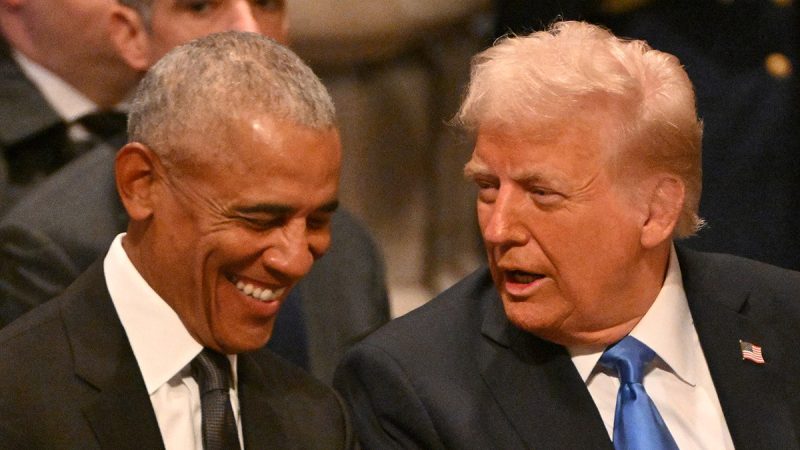
President Donald Trump and former President Barack Obama chatted about golf during a viral moment of bipartisanship during former President Jimmy Carter’s funeral in January, just days before Trump’s return to the Oval Office, a new book detailing the unprecedented 2024 election cycle reported. 

Trump and Obama were seen smiling and quietly chatting with one another in the pews of the Washington National Cathedral on Jan. 9, 2025, in a moment that spread like wildfire on social media as Americans sounded off with speculation over what the pair of presidents who had long traded political barbs were talking about. 

‘2024: How Trump Retook the White House and the Democrats Lost America,’ which was released Tuesday, said that Trump arrived in Washington for Carter’s funeral as a ‘conqueror’ following the November 2024 election and sat next to Obama for the funeral service. 

‘He’d attended Jimmy Carter’s funeral, walking into Washington not as a scourge but as a conqueror,’ the book reported of Trump. ‘He could ignore the speech on character by the outgoing president, and the cold shoulder from the vice president he’d defeated.’

‘Instead he sat next to Barack Obama and invited him to play golf, enticing him with descriptions of Trump’s courses around the world,’ the book continued of the pair’s conversation. ‘He was no longer an anomaly. He was being treated like an American president. He wanted to be remembered as a great one.’

Trump and Obama were seated near other high-profile former U.S. leaders, including former President George W. Bush, former Vice President Mike Pence, former President Bill Clinton, former first lady and Secretary of State Hillary Clinton, as well as then-President Joe Biden and then-Vice President Kamala Harris.

Social media commenters at the time remarked that footage and video clips of the pair were unexpected, and others joked that Obama may have voted for Trump despite years of the pair trading political barbs. 

‘Trump and Obama sitting next to each other was not on the 2025 bingo card,’ one social media user posted to X in January. 

‘Did Obama vote for Trump too?!’ Clay Travis, founder of sports and politics commentary platform OutKick, joked at the time. 

‘We need lip readers to see what Trump said to make Obama laugh,’ another person posted to X in January. 

Trump was asked about the viral moment ahead of his inauguration, remarking that he ‘didn’t realize how friendly it looked.’

‘I said, ‘Boy, they look like two people that like each other.’ And we probably do,’ Trump added at the time. ‘We have a little different philosophies, right? But we probably do. I don’t know. We just got along. But I got along with just about everybody.’

Fox News Digital’s Kristine Parks contributed to this report. 

This post appeared first on FOX NEWS

Senate Republicans are gearing up to claw back billions of dollars in foreign aid and public broadcasting funding, but dissent is brewing among some who could eat into President Donald Trump’s cut request.

A cohort of Senate Republicans are publicly and privately growing squeamish over the White House’s $9.4 billion rescissions package, which would slash $8.3 billion from the U.S. Agency for International Development (USAID) and over $1 billion from the Corporation for Public Broadcasting (CPB), the government-backed funding arm for NPR and PBS.

The cuts stem from Trump’s Department of Government Efficiency (DOGE), which was lauded by most Republicans for its mission to root out waste, fraud and abuse in the federal government.

Still, concerns and calls for changes are being made, in particular to proposed slashes to the President’s Emergency Plan for AIDS Relief (PEPFAR) and the public broadcasting fund.

Publicly, Sens. Susan Collins, R-Maine, Mike Rounds, R-S.D., and Lisa Murkowski, R-Alaska, have all aired their concerns about the House-passed bill and are eyeing changes that could see the cuts reduced.

‘I don’t like it as it is currently drafted,’ Murkowski said. ‘I’m a strong supporter of the Corporation for Public Broadcasting, and our health programs are important.’

Collins has raised issues with slashes to PEPFAR, an issue brought forth during a hearing with White House officials last month, while Rounds is worried about funding being slashed to rural radio stations, particularly for Native American populations in his state and others ‘and their ability to get good information during times of stress.’

Senate Republican leadership already has plans for an amendment process on the bill, which will likely culminate in another marathon vote-a-rama amendment session — roughly two weeks after the grueling amendment process for Trump’s ‘big, beautiful bill.’

Senate Majority Leader John Thune, R-S.D., said that he intended to put the package on the Senate floor next week, likely ahead of the Friday deadline for lawmakers to advance the clawbacks.

If the bill is amended, it would have to be sent back to the House before heading to Trump’s desk.

Sen. Markwayne Mullin, R-Okla., told Fox News Digital that he expected the vote-a-rama to begin Wednesday, and said the hope was that leadership would be able to address as many concerns among Republicans as possible before bringing the bill to the floor.

‘Whatever it takes, we’re having those conversations,’ he said. ‘The point is, once we get to the vote-a-rama, we want to have as much issues resolved so we know where we’re at on the floor without any surprises. And I think we can do that, maybe not, but I think we can. I think we got a good picture of where we’re at right now.’

Other lawmakers see the package in its current form as a no-brainer to pass.

Sen. John Kennedy, R-La., said that if amendments were offered to keep spending that he agreed with, he could find himself supporting tweaks to the package. But he challenged his colleagues to reject a spending cut package that ultimately amounted to less than half a percent of the nation’s entire budget.

‘This is gut check time for our Republican colleagues,’ he said. ‘They either believe in reducing spending or they don’t. They either believe in spending porn or they don’t, and I’ve listened to my colleagues, especially in the last 100 plus days, talk about how great DOGE was. Well, now is the chance to show it.’ 

This post appeared first on FOX NEWS

For Ekin Ober, bringing generative artificial intelligence (AI) to the critical metals sector through her work at Aethos Labs wasn’t just about technological innovation — it reshaped how she thinks about strategy and sustainability in mining.

Now a principal at Kinterra Capital, Ober applies that broad, cross-disciplinary lens to investment decisions, emphasizing the importance of digital fluency, stakeholder alignment and long-term viability.

Her experience helps her identify operational bottlenecks and social license challenges early — essential in guiding assets like nickel and copper projects from concept to production.

While mining has long been viewed as a slow adopter of new technologies, Ekin Ober sees the tide turning — especially when it comes to AI.

However one of the largest learning curves has been educating industry stakeholders about the value of generative AI.

“They don’t need to be tech experts,” she said, “but it’s our job to show them how the tools work, and how their concerns can be addressed.”

As AI gains traction across the sector, she noted that even conservative markets are beginning to host dedicated discussions on the technology — a sign that change is accelerating.

How AI is being deployed

In addition to benefiting project planning through better modeling and digital twin, AI is making mining more efficient, safe and environmentally responsible.

In exploration, startups like KoBold use machine learning to analyze geological data, drastically cutting the time and cost of identifying potential lithium, copper, nickel and cobalt deposits

Operationally, majors such as Rio Tinto (ASX:RIO,NYSE:RIO,LSE:RIO), BHP (ASX:BHP,NYSE:BHP,LSE:BHP) and Freeport-McMoRan (NYSE:FCX), deploy AI-powered autonomous haul trucks, drills and predictive maintenance systems that have slashed downtime and fuel use by up to 15 percent, while boosting throughput by 10 to 15 percent.

On the environmental front, AI tools optimize water management, monitor air quality and reduce waste, BHP’s Escondida mine reportedly saved over 3 gigaliters of water and 118 gigawatt hours of energy since 2022.

While AI isn’t without its own controversy, usually arising from its energy consumption, Ober explained that AI integration can help reduce a mining site’s overall energy intensity.

It is estimated that one billion daily AI prompts utilize 340 megawatt hours of electricity each day, while a mining site can use upwards of 1000 – 5000 megawatt hours. According to data from Natural Resources Canada, global mining operations consume 3 percent – 6 percent of the world’s electricity.

Together, AI can help the mining sector better target deposits and reduce the amount of energy deployed.

“Drill holes (alone) use 3000 liters of diesel. And when you look at grinding, grinding ore is 70 percent of the mine’s electricity (consumption),” said Ober.

She added: So if you’re using the technology for scans, you’re able to use computer vision and scan a core, or look at the geography to reduce the number of drills, or the grinding exercise that you’re going through, then it can actually save 1000s of hours of energy, conserving more than it consumes.”

From policy bottlenecks to permit approvals

This efficiency has made AI data sets appealing to governments as well. Through initiatives like DARPA’s CriticalMAAS and a collaboration with the US Geological Survey, AI models can now transform geologic map processing — from years to mere days — by automating georeferencing and mineral feature extraction.

These tools help rapidly assess hundreds of critical minerals across vast regions, accelerating decision-making and reducing exploration risk.

Meanwhile, the Pentagon’s AI-driven metals forecasting program, now managed by the Critical Minerals Forum, models supply, pricing and policy scenarios to bolster US sourcing strategies — especially for rare earths, nickel and cobalt.

For Ober, AI can also be integral to the often extended permitting process, while also implementing ESG goals and best practices. She explained that at Kinterra, AI is already playing a key role in streamlining permitting assessments, one of the most complex hurdles in mine development.

The firm has built a closed-loop system using large language models layered with its own criteria and values, including permitting stages, Indigenous engagement and community sentiment. The tool filters thousands of data points — from state filings to news releases and emails — extracting only what’s relevant.

Jurisdiction-specific updates are then summarized and delivered directly into Microsoft Teams, offering a real-time, digestible overview of key permitting signals.

“We need the company and the community to be engaged,” she said. “We take a very proactive approach. We engage very early on.”

Industry wide Ober sees AI improving the efficiency and transparency of mining permitting.

“One of the biggest concerns we hear is around security,” said Ober. “But we already trust companies like Google, Microsoft and Apple with sensitive data every day. If you’re using legitimate tools with strong policies in place, it’s manageable.”

Ober believes AI’s biggest value lies in its ability to accelerate slow, document-heavy government processes.

“Permitting can stall a project for years — not because of technical issues, but because no one has time to read the documents,” she said. “That’s where AI can help. Large language models can extract key information, layer in governance or environmental criteria and summarize it in a way that’s actionable.”

To address the risk of accuracy, Kinterra has designed its systems to generate traceable outputs.

“You can click a link and go straight to the original document and quote,” she explained, adding that this level of transparency is crucial for regulators and investors alike.

“It’s hard to commit capital when you don’t know if or when a permit will be granted,” she said. “AI won’t replace people, but it can get us to decision points faster — something the entire sector needs.”

Securities Disclosure: I, Georgia Williams, hold no direct investment interest in any company mentioned in this article.

This post appeared first on investingnews.com

Torex Gold (TSX:TXG,OTCQX:TORXF) is taking a step toward diversification with its planned acquisition of Reyna Silver (TSXV:RSLV,OYCQB:RSNVF), a junior explorer with early stage projects in Mexico and the US.

The US$26 million all-share deal, announced in late June, is set to close later this year and marks Torex’s first major move outside its flagship Mexico-based Morelos Complex.

The acquisition comes at a pivotal moment for Torex. The company is in the early ramp-up phase at its Media Luna project, part of the Morelos Complex southwest of Mexico City.

The site also includes the ELG underground and open-pit mines, which together produced 452,523 ounces of gold in 2024, meeting guidance for the sixth consecutive year at an all-in sustaining cost (AISC) of US$1,156 per ounce.

Looking ahead to 2025, Torex is forecasting production of 400,000 to 450,000 gold equivalent ounces, but expects a higher AISC range of US$1,400 to US$1,600 per ounce as development spending continues.

CEO Jody Kuzenko said the Reyna deal reflects Torex’s broader strategy to build out a pipeline of earlier-stage projects.

Reyna’s exploration-stage portfolio offers Torex low-cost entry into silver-rich terrain, while also signaling a shift in the producer’s long-term vision — one that includes earlier-stage risk and greater geographic flexibility.

Kuzenko stated that, with the company’s exploration team already having spent months conducting due diligence, Torex is ready to hit the ground running once the transaction is complete. She also noted the company had already developed conceptual programs and expects to commence work shortly after closing.

“We plan to leverage the same systematic approach to exploration employed at Morelos through which we effectively identify, rank, evaluate and prioritize targets with the success of the system demonstrated by the reserve and resource growth we have experienced at Morelos over the last several years,” Kuzenko said.

With the acquisition, Torex will gain immediate access to Reyna’s Mexican silver assets, including:

  • Guigui, a 4,750 hectare property covering a significant portion of the Santa Eulalia Mining District in Chihuahua. The area has a history of mining dating back to the 1700s and has recorded the production of 450 million ounces of silver.
  • Batopilas, a 1,183 hectare site that covers 94 percent of the Batopilas Mining District, which has significant deposits of native silver. Historic mining at the site produced an estimated 200 million to 300 million ounces of silver dating back to the mid-1600s.

Until now, Torex has primarily focused on operations in Mexico; however, with the takeover of Reyna, the company also has the option to acquire a 70 percent stake in the Griffin Summit project, located along the Carlin Trend in Nevada, US. The project covers an area of 10,300 hectares and is prospective for gold, silver and critical minerals.

Additionally, Torex will also have an option to acquire a 100 percent interest in the Medicine Springs project, also located in Nevada. The property spans 4,831 hectares south of Elko and is situated in a region with several large gold mines operated by major companies, including Newmont (TSX:NGT,NYSE:NEM) and Barrick Mining (TSX:ABX,NYSE:B).

Previous exploration at the site identified lead, zinc and silver mineralization.

“What attracted us to Reyna Silver is the immediate exposure to a portfolio of four properties in key mining regions of northern Mexico and Nevada,” Kuzenko said. She added that with the completion of Media Luna, Morelos is now positioned as the company’s flagship operation and serves as a foundation upon which it can build from.

Although shareholders won’t vote on the transaction until August, Kuzenko noted that the acquisition has the full support of management and the board of directors at Reyna Silver.

Securities Disclosure: I, Dean Belder, hold no direct investment interest in any company mentioned in this article.

This post appeared first on investingnews.com

China’s grip on the battery metals sector has drawn increasing scrutiny in recent years as nations confront growing concerns around supply chain risk and resource security.

Through a blend of domestic output and aggressive overseas investment, particularly in Africa and South America, Chinese companies now command a significant share of upstream supply.

The country is responsible for roughly 60 percent of global rare earths production and controls over 70 percent of cobalt supply through its stakes in mines across the Democratic Republic of Congo.

Meanwhile, its lithium footprint continues to grow through key assets in Chile, Argentina and Australia, reinforcing China’s strategic control across the entire battery metals value chain.

In addition to resource extraction China also firmly controls the global midstream of the battery metals supply chain, particularly in refining and processing. The country currently accounts for approximately 70 to 72 percent of lithium refining and 68 percent of cobalt refining, with similar dominance in graphite and rare earth processing.

China’s control of the battery metals supply chain was a dominant theme at the Fastmarkets Lithium Supply & Battery Raw Materials conference held at the end of June in Las Vegas.

During the “Building North America’s Sustainable EV and ESS Supply Chain” expert panelists explored complex forces shaping the battery supply chain, pointing to the intersection of commodities, geopolitics and evolving technologies as critical pressure points.

Chris Berry, founder and president of House Mountain Partners, stressed the importance of mastering midstream production amid shifting chemistries, and called for bold action, specifically, increased funding for refining and next-generation processing.

He also advocated for selective collaboration with China, highlighting the necessity of leveraging mutual strengths in a deeply interlinked global market.

For Berry, a convergence of high interest rates, volatile metal prices and deepening policy uncertainty is keeping critical investment sidelined at a time when it’s most needed.

Speaking to current market dynamics, Berry noted that while capital was readily available two years ago — when lithium traded around US$80,000 per tonne and other metals saw record highs — today’s environment is far less favorable.

“The cost of capital is much higher, and policy uncertainty is the biggest issue investors are grappling with,” he said, pointing to unpredictable tariff measures and export controls as key deterrents.

For institutional investors and private equity funds, that lack of clarity makes it nearly impossible to deploy capital into battery supply chains with confidence.

The timing couldn’t be worse, Berry added, as nations seek to reindustrialize and compete with China’s dominant position. “Any delay in getting money into the ground today means falling further behind tomorrow.”

Lithium’s boom/bust cycle

After 15 years in the lithium space and three boom-bust cycles, Berry sees the market once again caught between extremes.

“In each cycle, prices have overshot on the upside and overcorrected on the downside,” he said, noting that lithium peaked around US$85,000 per metric ton in late 2022 — well above sustainable levels.

Fast forward to mid-2025, and the price has tumbled to just over US$8,000, a level Berry also considers unsustainable given the strength of long-term demand.

Despite price volatility, he still expects lithium demand to grow by 20 percent annually through the end of the decade — requiring the industry to double in size by 2030. But with investor hesitation and incentive pricing far off, capital is slow to flow into new supply.

“How is it supposed to double when the economics aren’t there?” he asked, warning that delays today could set the stage for the next inevitable boom. For now, opaque pricing and limited market visibility continue to challenge investors and developers alike.

Western refining capacity

During his panel discussion Berry suggested that the west look to the midstream segment of the battery metals supply chain as an opportunity for growth.

“I would fund the refining portion of the supply chain, whether that’s refining raw materials, lithium, nickel, what have you, or magnets, next generation technology. That to me, is really the bottom line and where the government should focus,” he told the attendees.

Berry expanded on his answer explaining that mines can take over a decade to be fully permitted while refining and processing sites have a much shorter lead time.

For Berry, the buildout of western refining and processing is the logical step in wresting some of the supply chain control out of China’s hands.

“If we’re talking about how we can lessen dependence on China? That’s how you do it. You strike a deal with raw material providers or producers. Maybe they’re Canadian, maybe they’re Australian, maybe it’s Chilean. Maybe it’s a country in Africa. But, the process of capacity is absolutely critical. It’s much faster to production,” he said.

Partnership and collaboration

While Berry is adamant that more refining capacity outside of China is needed, he is not opposed to strategic partnerships and alliances with the nation.

“It’s a US$500 billion a year relationship. You think about trade between the US and China, and I don’t even know if it’s feasible to unwind that,” he said during the panel.

“I don’t think it’s wise to be honest with you, but with respect to the EV supply chain, I just think, why wouldn’t we try and find a way to selectively partner and leverage each other’s strengths?”

Securities Disclosure: I, Georgia Williams, hold no direct investment interest in any company mentioned in this article.

This post appeared first on investingnews.com