Author

admin

Browsing

Perpetua Resources (TSX:PPTA,NASDAQ:PPTA) has secured final federal clearance to move forward with construction of its Stibnite gold project in Idaho.

The US Forest Service issued a conditional Notice to Proceed this week, confirming that the company has met all requirements outlined in its January 2025 Record of Decision.

“After 8 years of extensive permitting review and over $400 million invested, it is finally time for the Stibnite Gold Project to deliver for America,” said Jon Cherry, Perpetua Resources president and CEO.

“With the US Forest Service’s Notice to Proceed and the joint financial assurance package approved, we are ready to begin to bring Stibnite back to life as a national strategic asset,” Cherry added.

The project can advance once Perpetua posts the joint financial assurance bonds agreed to with state and federal regulators.Once posted, regulators will sign off on Perpetua’s operating plan, clearing the way for construction to begin.

The Stibnite gold project carries both strategic and environmental ambitions. It is expected to supply more than 100 million pounds of antimony over its projected 15-year mine life, potentially meeting more than a third of US annual demand.

Antimony, used in munitions and advanced defense systems, is currently imported largely from China.

The project is also designed to produce about 450,000 ounces of gold annually. Proven and probable reserves at the site include 148 million pounds of antimony and more than 6 million ounces of gold.

Beyond mineral production, the project is pitched as an environmental restoration initiative for a heavily impacted historical mine site. Plans call for cleaning up legacy contamination, reconnecting salmon to native spawning grounds, improving water temperatures, and enhancing wetlands and stream habitats.

The final mine plan reduces the project footprint by 13 percent compared to earlier designs and front-loads restoration work to occur alongside mining activities.

Perpetua began formal permitting under the National Environmental Policy Act in 2016. The Forest Service, as lead agency, issued a Draft Environmental Impact Statement in 2020, followed by a Supplemental Draft in 2022, and a Final Environmental Impact Statement in 2024.

The Final Record of Decision came in January 2025 after a process that drew more than 23,000 supportive public comments.

The Trump administration included the Stibnite project on its FAST-41 permitting transparency list earlier this year, placing it among infrastructure and resource projects deemed nationally significant and eligible for expedited review.

Perpetua’s shares reflected the regulatory breakthrough, climbing 2.2 percent in pre-market trading on Friday (September 19) following the Notice to Proceed.

The company expects bonding to be completed within weeks, paving the way for site work and a targeted commercial production in 2028.

Securities Disclosure: I, Giann Liguid, hold no direct investment interest in any company mentioned in this article.

This post appeared first on investingnews.com

Here’s a quick recap of the crypto landscape for Monday (September 22) as of 9:00 a.m. UTC.

Get the latest insights on Bitcoin, Ethereum and altcoins, along with a round-up of key cryptocurrency market news.

Bitcoin and Ethereum price update

Bitcoin (BTC) was priced at US$112,653, a 2.7 percent decrease in 24 hours. Its lowest valuation of the day was US$112,293 after an earlier price peak of US$115,775.

Bitcoin price performance, September 22, 2025.

Chart via TradingView

Bitcoin dropped to US$112,000 range after falling below a key support level, triggering the year’s largest long-liquidation event — over US$1.7 billion in leveraged long positions were closed. The decline came even as some investor accumulation showed through surging exchange outflows and rising longs on platforms like Bitfinex, which added pressure from both sides.

Ether (ETH) was trading at US$4,181.86, down by 6.4 percent. Its lowest valuation as of Monday was US$4,145.53, while the cryptocurrency’s highest was US$4,497.46.

Altcoin price update

  • Solana (SOL) was priced at US$221.91, a decrease of 7.5 percent over the last 24 hours. Its lowest valuation of the day was US$220.28, while its highest valuation was US$240.05.
  • XRP was trading for US$2.82, down by 5.5 percent in the past 24 hours. Its lowest valuation of the day was US$2.78, while its highest was US$2.99.
  • SUI (Sui) was valued at US$3.32, trading at its lowest valuation of the day and down by 8.2 percent over the past 24 hours. Its highest price point on Monday was US$3.67.
  • Cardano (ADA) was priced at US$0.8246, down by 7.0 percent over 24 hours. Its lowest value of the day was US$0.813, while its highest value was US$0.8893.

Last week’s crypto recap

Last week saw crypto markets consolidate into a tight range.

BTC largely held just below its all-time high of US$118,000), trading around US$116,000 to US$117.000 most of the week. Meanwhile, ETH quietly rallied: large spot-ETH ETF inflows of nearly US$2.13 billion on September 19 alone pushed ETH briefly above US$4,500.

Meanwhile, the Fed’s expected 25 bps rate cut on September 17 produced only a muted “sell-the-news” reaction.

BTC briefly surged above US.$117,000 on the news. Moreover, investors poured more money into crypto funds: about US$1.9 billion flowed into exchange-traded crypto products last week, translating roughly US$977 million into BTC ETFs and US$772 million into ETH funds. This brought BTC ETF inflows hovering around US$3.9 billion over the past four weeks.

Recent policy developments last week also broadened crypto’s institutional access. The SEC approved the first spot ETFs for altcoins, as REX-Osprey XRP ETF (CBOE:XRPR) and REX-Osprey DOGE ETF (CBOE:DOJE). For stablecoins, Tether launched a new US-compliant dollar token (“USA₮”) under the GENIUS Act.

Fear and Greed Index snapshot

Chart via CoinMarketCap

CMC’s Crypto Fear & Greed Index remained firmly in neutral territory over the past week. The tracker shows readings oscillating around 50: for instance, it registered 53 on September 17, then dipped to 48 by September 20 and 49 by September 21.

Currently, the index remains registered on neutral territory at 47. The past week’s negative funding rates on perpetual futures and long/short ratios suggest slight caution, but strong ETF inflows and recent whale buying show underlying bullish conviction from investors.

Things to look out for

Over the course of this week, traders will be keeping a very close eye on the Federal Reserve and the tone at the Fed, combined with how recent economic data compares to expectations.

Federal Reserve Chair Jerome Powell will be speaking, after the policy-outlook statement. If the upcoming economic data disappoints, analysts say that there is a risk that BTC could retest support in the low US$112,000 range.

Meanwhile, a dovish pivot could rapidly reignite inflows into ETFs and “riskier” assets, lifting all boats including volatile altcoins.

Furthermore, the report on US existing home sales data is also due on Wednesday (September 23). The data gives insight into the state of the housing market, which is one of the key components of consumer spending and overall economic health.

Today’s crypto news to know

Bullish crypto bets unwind as US$1.5 billion liquidated

Crypto markets endured their steepest shakeout in months after more than US$1.5 billion in leveraged long positions were wiped out on Monday (September 22), according to Coinglass.

Ether bore the brunt of the rout, plunging as much as 9 percent to US$4,075, while Bitcoin briefly slipped 3 percent to US$111,998. The wave marked the largest round of liquidations since March 27, with more than 407,000 traders seeing positions erased in just 24 hours.

Analysts pointed to fading demand from digital-asset treasury firms, whose stock retreats signaled waning appetite for large-scale token hoarding. Funding rates for Ether futures have also now turned negative, a sign that short sellers are paying to maintain bearish bets.

Overall, crypto market capitalization dropped below US$4 trillion, while gold prices surged to fresh records near US$3,720 an ounce.

Metaplanet climbs to fifth-largest corporate Bitcoin holder

Tokyo-based Metaplanet has cemented itself as a heavyweight in corporate crypto holdings, announcing the purchase of 5,419 BTC worth US$633 million.

The acquisition boosts its total stash to 25,555 BTC valued at nearly US$3 billion, making it the fifth-largest corporate Bitcoin treasury, according to BitcoinTreasuries.net.

The buy came at an average of about US$117,000 per Bitcoin, leaving the firm temporarily down almost 4 percent as spot prices hovered closer to US$112,500.

Despite the purchase, Metaplanet’s stock has struggled to keep pace. The company’s shares have tumbled by more than 30 PERCENT over the past month even as shares rose modestly this week.

London prepares for US$7 billion Bitcoin fraud trial

The UK is bracing for one of its most significant crypto trials as Zhimin Qian, a Chinese national accused of orchestrating a US$7 billion Ponzi-style fraud, faces charges in London starting September 29.

Qian allegedly ran Tianjin Lantian Gerui Electronic Technology, a scheme that lured nearly 130,000 investors in China with promises of triple-digit returns between 2014 and 2017.

After China’s crypto ban, she fled to Britain and converted proceeds into Bitcoin, some of which were later seized in UK money laundering probes linked to her associate Jian Wen, already convicted in 2024.

Prosecutors have avoided direct fraud charges, instead focusing on offenses tied to the possession and transfer of illicit cryptocurrency.

Securities Disclosure: I, Giann Liguid, hold no direct investment interest in any company mentioned in this article.

Securities Disclosure: I, Meagen Seatter, hold no direct investment interest in any company mentioned in this article.

This post appeared first on investingnews.com

finlay minerals ltd. (TSXV: FYL,OTC:FYMNF) (OTCQB: FYMNF) (‘Finlay’ or the ‘Company’) is pleased to announce that the results from airborne magnetic surveys conducted over the SAY and JJB properties (refer to Figure 1 ), have identified significant northwest- and northeast-trending structures. These structures resemble those found in the Toodoggone area of British Columbia which is recognized for its potential to host larger porphyry and epithermal deposits. A total of 1,900 kilometres (‘km’) of airborne magnetic survey data was collected over the two properties.

Follow-up groundwork at the SAY property focused on the IFT target, where a large circular magnetic anomaly, measuring 2.5 km by 2.5 km, was identified. This anomaly displays geophysical signatures similar to those observed in other copper porphyry deposits. Additionally, a second kilometre-scale target, known as Ozzy, was identified. Ozzy is located at the intersection of a northeast-trending magnetic anomaly and a northwest-trending magnetic anomaly. Further follow-up work is planned for both targets.

The SAY property was acquired in 2024, and an inaugural field program concentrated on chip sampling and mapping along the 4.3-kilometer-long SPUR Trend last summer. This effort led to the discovery of the 200 m x 200 m copper-silver mineralized AG Zone and confirmed the continuity of high-grade copper-silver mineralization at the Spur Target.  Chip sampling at the AG Zone included 9.5 metres of 0.94% Cu and 18.1 g/t Ag . (1)

The JJB property was staked in February, 2025 for its porphyry potential. Three main copper showings—Squingula, Quin, and Pat—have been identified. Squingula and Quin are located near an Eocene intrusion on the western side, and show a coincident magnetic high linked to a multi-element geochemical anomaly from limited sampling. This summer, fieldwork focused on the PAT target, one of three potential targets. This work aimed to evaluate the similarities between the high-grade copper-silver mineralization found at JJB and the SPUR/AG targets within the SAY Property.

SAY & JJB Project Highlights:

SAY 2025 Program :

JJB 2025 Program :

•       Over 1,200 line-km of airborne magnetics

•       Completion of Finlay’s inaugural field program

•       Completion of property-wide LiDAR survey

•       Completion of property-wide LiDAR survey

•       Completion of satellite mineral alteration survey (PhotoSat)

•       Completion of satellite mineral alteration survey (PhotoSat)

•       84 rock samples collected

•       700 line-km of airborne magnetics

•       307 soil samples collected

•       18 rock samples collected

•       275 biogeochemistry samples collected

•       35 soil and talus samples collected

Processing of the LiDAR and satellite mineral alteration data is on-going.  All field samples have been submitted to the laboratory for analysis with results pending.

Situated in the underexplored Bear Lake corridor, the SAY and JJB projects are part of a 135-kilometre geological corridor that includes American Eagle Gold’s NAK project, as well as Amarc Resources and Boliden Mineral Canada’s DUKE copper-molybdenum-silver-gold prospects.

PIL and ATTY Project Updates:

Exploration work at the PIL and ATTY Toodoggone projects is on-going and anticipated to be completed within the next two weeks with continued induced polarization geophysical surveys. The PIL and ATTY work is fully funded by Freeport-McMoRan Mineral Properties Canada Inc. under their respective Earn-In Agreements (2) with Finlay acting as the operator.

References:

Qualified Person:

Wade Barnes , P. Geo. and Vice President, Exploration for Finlay Minerals and a qualified person as defined by National Instrument 43-101, has approved the technical content of this news release.

About finlay minerals ltd.

Finlay is a TSXV company focused on exploration for base and precious metal deposits through the advancement of its ATTY, PIL, JJB, SAY and Silver Hope Properties; these properties host copper-gold porphyry and gold-silver epithermal targets within different porphyry districts of northern and central BC. Each property is located in areas of recent development and porphyry discoveries with the advantage of hosting the potential for new discoveries.

Finlay trades under the symbol ‘FYL’ on the TSXV and under the symbol ‘FYMNF’ on the OTCQB. For further information and details, please visit the Company’s website at www.finlayminerals.com

On behalf of the Board of Directors,

Robert F. Brown ,
Executive Chairman of the Board

Neither the TSXV nor its Regulation Services Provider (as that term is defined in the policies of the TSXV) accepts responsibility for the adequacy or accuracy of this release.

Forward-Looking Information: This news release includes certain ‘forward-looking information’ and ‘forward-looking statements’ (collectively, ‘forward-looking statements’) within the meaning of applicable Canadian securities legislation. All statements in this news release that address events or developments that we expect to occur in the future are forward-looking statements.  Forward-looking statements are statements that are not historical facts and are generally, although not always, identified by words such as ‘expect’, ‘plan’, ‘anticipate’, ‘project’, ‘target’, ‘potential’, ‘schedule’, ‘forecast’, ‘budget’, ‘estimate’, ‘intend’ or ‘believe’ and similar expressions or their negative connotations, or that events or conditions ‘will’, ‘would’, ‘may’, ‘could’, ‘should’ or ‘might’ occur. All such forward-looking statements are based on the opinions and estimates of management as of the date such statements are made. Forward-looking statements in this news release include statements regarding, among others, the exploration plans for the Properties. Although Finlay believes the expectations expressed in such forward-looking statements are based on reasonable assumptions, such statements are not guarantees of future performance and actual results or developments may differ materially from those forward-looking statements. Factors that could cause actual results to differ materially from those in forward-looking statements include market prices, exploration successes, and continued availability of capital and financing and general economic, market or business conditions. These forward-looking statements are based on a number of assumptions including, among other things, assumptions regarding general business and economic conditions, the timing and receipt of regulatory and governmental approvals, the ability of Finlay and other parties to satisfy stock exchange and other regulatory requirements in a timely manner, the availability of financing for Finlay’s proposed transactions and programs on reasonable terms, and the ability of third-party service providers to deliver services in a timely manner. Investors are cautioned that any such statements are not guarantees of future performance and actual results or developments may differ materially from those projected in the forward-looking statements, and accordingly undue reliance should not be put on such statements due to the inherent uncertainty therein. Finlay does not assume any obligation to update or revise its forward-looking statements, whether as a result of new information, future or otherwise, except as required by applicable law.

SOURCE finlay minerals ltd.

View original content to download multimedia: http://www.newswire.ca/en/releases/archive/September2025/22/c1184.html

News Provided by Canada Newswire via QuoteMedia

This post appeared first on investingnews.com

Company Reports Exceptional Initial Metallurgical Results for Its US Mojave Project

Locksley Resources Ltd. (ASX: LKY,OTC:LKYRF; OTCQB: LKYRF) announced it has achieved significant results from initial metallurgical testwork completed by the company on samples collected from the Desert Antimony Mine (DAM) Prospect. These results validate that the Mojave Project can deliver feedstock required to underpin a domestic mine-to-market antimony supply chain. Recovery rates of the level indicated in the initial testing confirm Locksley’s pathway to 100% Made in America Antimony, which is directly aligned with U.S. government priorities for onshore critical mineral supply security.

For the six samples assessed, antimony grades ranged from a low of 27.5% to a high of 39.1%. Recovery rates ranged from 82.9% to 85.9% among the six samples. Additional details are available here: https://cdn-api.markitdigital.com/apiman-gateway/ASX/asx-research/1.0/file/2924-02996029-6A1284968&v=c2533a54e2514fb77a8f93f84db686e1125273e9

‘This is an excellent milestone to have achieved for the Mojave Project,’ said Julian Woodcock , Technical Director of Locksley Resources. ‘It demonstrates that conventional flotation technology is suitable to produce a stibnite concentrate from the Desert Antimony Mine Prospect. What is also remarkable is the success of the testwork on surface samples, which have been susceptible to oxidation. I am extremely encouraged by the results and optimistic that with further testwork we will be able to improve on this already high-quality first-pass outcome. This activity continues to rapidly advance our strategy to provide onshore supply of antimony to the U.S. market.’

Concentrate from these tests was sent to Rice University to commence with Deep Eutectic Solvent Extraction testwork using Rice University’s Deep Solv methodology, in conjunction with the recently announced partnership by Locksley and Rice .

Locksley Resources ( https://www.locksleyresources.com.au ) is an Australian-based explorer focused on critical minerals and base metals, with assets in both the U.S. and Australia . The company is actively advancing its U.S. asset, the Mojave Project, in California , targeting rare earth elements (REEs) and antimony. The company has also announced a strategic collaboration with Rice University to develop DeepSolv, for domestic processing of North American antimony. The agreement is part of Locksley’s U.S. Critical Minerals and Energy Resilience Strategy to accelerate ‘mine-to-market’ deployment of antimony in the U.S.

Contact: Beverly Jedynak , beverly.jedynak@viriathus.com , 312-943-1123; 773-350-5793 (cell)

View original content: https://www.prnewswire.com/news-releases/locksley-continues-to-strengthen-its-position-in-paving-pathway-to-100-made-in-america-302562438.html

SOURCE Locksley Resources

News Provided by PR Newswire via QuoteMedia

This post appeared first on investingnews.com

Aventis Energy (‘ Aventis ‘ or the ‘ Company ‘) (CSE:AVE | FRA:C0O0 | OTC: VBAMF) is pleased to announce an update from its 2025 exploration program at the Corvo Uranium Project (‘ Corvo ‘, or the ‘ Project ‘), currently under a three-year earn-in option agreement with Standard Uranium Ltd. (‘ Standard ‘) (CSE: STND). From July 4 to July 16, 2025, the Company completed a detailed mapping and sampling program across historical uranium showings and zones of interest on the Project.

Highlights:

  • Off-Scale** Radioactivity at Surface : Verification of strong radioactivity at the historical Manhattan showing with handheld scintillometer measurements >65,535 counts per second (‘ cps ‘) at surface, in addition to 112 further occurrences of highly anomalous*** radioactivity up to 13,500 cps across the Project.
  • Discovery of New Radioactive Showings : Scintillometer prospecting uncovered previously undocumented radioactive occurrences across the Project in favorable rock types for uranium and Rare Earth Element (‘ REE ‘) mineralization.
  • Favorable Uranium Host Rocks : Geological mapping along structural and electromagnetic (‘ EM ‘) trends across the Project confirmed the presence of deformed and hydrothermally altered basement lithologies including metasedimentary, calc-silicate, and granitic rocks.
  • Ongoing Exploration : An extensive ground gravity survey is being planned for Q4 2025, designed to identify density anomalies potentially representing hydrothermal alteration systems coincident with newly refined EM conductor trends across the Project. A diamond drill program is being planned for Q1 2026 to begin testing targets developed and ranked through the detailed programs executed in 2025.

Michael Mulberry, Chief Executive Officer of the Company, commented, ‘We are proud to announce preliminary results from our 2025 Exploration Program at the Corvo Project. With the identification of strong radioactivity at the Manhattan showing, and favourable results from geological mapping along key trends at the Project, we are well positioned to complete a near term ground gravity survey.’

Figure 1. Regional Map of the Corvo Uranium Project

2025 Prospecting Program – Preliminary Results

Beginning July 4 and concluding July 16, 2025, the technical team completed a detailed mapping, prospecting, and sampling program to ground-truth historical uranium showings at surface on the Project (the ‘ Program ‘):

  • A total of 30 outcrop and boulder grab samples have been submitted to Saskatchewan Research Council Geoanalytical Laboratories in Saskatoon, SK for whole-rock, uranium, and REE geochemical analysis. Results will be released and incorporated into the first NI 43-101 technical report on the Project.
  • More than 160 detailed geological observations, structural measurements, and scintillometer readings were taken from several outcrops across the Project within the T-Lake, Dorward, Unnamed, Finger, Snout, Hook, and Sheppard Lake areas.
  • Prospecting confirmed several uraniferous outcrops and boulders across the Project, including the Manhattan showing (1.19 to 5.98% U3O8) and SMDI showing 2052 (0.137% U3O8 and 2,300 ppm Th). 1 Off-scale radioactivity >65,535 cps was measured at the Manhattan showing (Please see Figures 2 and 3).
  • A total of 112 handheld scintillometer readings of anomalous radioactivity >300 cps were recorded, including six measurements >10,000 cps at surface (Please see Figure 4). Prospecting for radioactive boulders and outcrop was completed using handheld RS-120 Super-Scintillometers and RS-125 Super-Spectrometers manufactured by Radiation Solutions Inc.

Figure 2. Close-up photos of fault-controlled mineralization (black vitreous minerals) and secondary iron oxide alteration at surface at the Manhattan showing (Dorward Lake area), reaching >65,535 cps on the RS-125 Super-Spectrometer.

At the Corvo Uranium Project, uranium mineralization is present along a strike length of 800 metres in historical drill holes TL-79-3 (0.057% U3O8 over 3.5 m) to TL-79-5 (0.065% U3O8 over 0.1 m). Recent expansion of the Project adds multiple new data points of uranium anomalism in the south, including surface sample JBWLR011, returning 1,420 ppm U.

Figure 3. Expanded view of fault-controlled mineralization and alteration products on surface at the Manhattan showing, reaching >65,535 cps over more than one metre.

Figure 4. Newly discovered hematized magnetite-rich pegmatitic orthogneiss reaching upwards of 13,500 cps, in the T-Lake area.

Future Exploration Plans

Supplementary geophysical surveys across the Project are being designed to further refine drill targets for an inaugural drill program. The Company plans to complete a high-resolution ground gravity survey across the main conductive trends on the Project, aiming to identify potential hydrothermal alteration halos which could be related to basement-hosted uranium mineralization.

Earlie r this year, Standard Uranium contracte d Axiom Exploration Group Ltd. in partnership wi t h New Resolution Geophysics to carry out a helico p ter-borne Xcite time domain electr o magnetic and total field ma g netic survey over the Project 2 . The survey totalled approximately 1,380 line-kms w ith a traverse line spacing of 100 m and tie-line spacing of 1,000 m. The airborne TDEM survey outlines several kilometers of conductive anomalies and magnetic features in bedrock, effectively enhancing the resolution of more than 29 kilometres of conductive trends on the Project.

The magnetic survey component of the TDEM survey contributes to definition of potential fault systems and structural trends not previously identified across the Project related to historical uranium showings at surface and in historical drill holes.

Ongoing geophysical interpretation and modeling is being completed to integrate historical surveys with newly collected datasets, which will provide high-priority drill targets and significantly derisk the Project prior to modern drilling in 2026.

Qualified Person Statement

The scientific and technical information contained in this news release has been reviewed, verified, and approved by Sean Hillacre, P.Geo., President and VP Exploration of Standard Uranium and a ‘qualified person’ as defined in NI 43-101 – Standards of Disclosure for Mineral Projects.

Historical data disclosed in this news release relating to sampling results from previous operators are historical in nature. Neither the Company nor a qualified person has yet verified this data and therefore investors should not place undue reliance on such data. The Company’s future exploration work may include verification of the data. The Company considers historical results to be relevant as an exploration guide and to assess the mineralization as well as economic potential of exploration projects. Any historical grab samples disclosed are selected samples and may not represent true underlying mineralization.

Natural gamma radiation in diamond drill core reported in this news release was measured in counts per second (cps) using a handheld RS-125 super-spectrometer and RS-120 super-scintillometer. Readers are cautioned that scintillometer readings are not uniformly or directly related to uranium grades of the rock sample measured and should be treated only as a preliminary indication of the presence of radioactive minerals. The RS-125 and RS-120 units supplied by Radiation Solutions Inc. (‘RSI’) have been calibrated on specially designed Test Pads by RSI. Standard Uranium maintains an internal QA/QC procedure for calibration and calculation of drift in radioactivity readings through three test pads containing known concentrations of radioactive minerals. Internal test pad radioactivity readings are known and regularly compared to readings measured by the handheld scintillometers for QA/QC purposes.

References

1 SMDI# 2052: https://mineraldeposits.saskatchewan.ca/Home/Viewdetails/2052 & Mineral Assessment Report MAW00047: Eagle Plains Resources Inc., 2011-2012

2 Standard Uranium Provides Exploration Update Highlighting Results of Gravity and TDEM Surveys on Three Eastern Athabasca Uranium Projects, News Release, March 13, 2025. https://standarduranium.ca/news-releases/standard-uranium-provides-exploration-update-tdem-surveys-on-three-eastern-athabasca-uranium/

*The Company considers uranium mineralization with concentrations greater than 1.0 wt% U3O8 to be ‘high-grade’.

**The Company considers radioactivity readings greater than 65,535 counts per second (cps) on a handheld RS-125 Super-Spectrometer to be ‘off-scale’.

***The Company considers radioactivity readings greater than 300 counts per second (cps) on a handheld RS-125 Super-Spectrometer to be ‘anomalous’.

About Aventis Energy Inc.

Aventis Energy Inc. (CSE: AVE | FRA: C0O0 | OTC: VBAMF) is a mineral exploration company dedicated to the development of strategic projects comprised of battery, base and precious metals in stable jurisdictions. The Company is working to advance its Corvo Uranium & Sting Copper Project.

The Corvo Uranium property has historical drill holes intersected multiple intervals of uranium mineralization, notably along a strike length of 800 metres between historical drill holes TL-79-3 ( 0.116% U 3 O 8 over 1.05 m ) and TL-79-5 ( 0.065% U 3 O 8 over 0.15 m ) 2 . High-grade* Uranium at Surface with the Manhattan showing ( 1.19 to 5.98% U 3 O 8 ) and SMDI showing 2052 ( 0.137% U 3 O 8 and 2,300 ppm Th ).

The Sting Copper Project covers approximately 12,700 hectares and recently had results of 54.8m at 0.32% Cu starting at a depth of 27.0m, with higher-grade intervals including six samples (≥0.5m length) ranging from 0.96% to 5.43% Cu. High grade samples of 0.5m at 2.85% Cu and 0.5m at 1.92% Cu with an additional broader interval of 31.1m at 0.27% Cu.

On Behalf of the Board of Directors

Michael Mulberry
Chief Executive Officer, Director
+1 (604) 229-9772
info@vitalbatterymetals.com

Disclaimer for Forward-Looking Information

This news release includes certain ‘Forward-Looking Statements’ within the meaning of the United States Private Securities Litigation Reform Act of 1995 and ‘forward-looking information’ under applicable Canadian securities laws. When used in this news release, the words ‘anticipate’, ‘believe’, ‘estimate’, ‘expect’, ‘target’, ‘plan’, ‘forecast’, ‘may’, ‘would’, ‘could’, ‘schedule’ and similar words or expressions, identify forward-looking statements or information.

Forward-looking statements and forward-looking information relating to any future mineral production, liquidity, enhanced value and capital markets profile of Aventis, future growth potential for Aventis and its business, and future exploration plans are based on management’s reasonable assumptions, estimates, expectations, analyses and opinions, which are based on management’s experience and perception of trends, current conditions and expected developments, and other factors that management believes are relevant and reasonable in the circumstances, but which may prove to be incorrect. Assumptions have been made regarding, among other things, the price of uranium, copper, gold and other metals; costs of exploration and development; the estimated costs of development of exploration projects; Aventis’ ability to operate in a safe and effective manner and its ability to obtain financing on reasonable terms.

This news release contains ‘forward-looking information’ within the meaning of the Canadian securities laws. Statements, other than statements of historical fact, may constitute forward looking information and include, without limitation, statements with respect to the Project and its mineralization potential; the Company’s objectives, goals, or future plans with respect to the Project; statements with respect to the Program; expected benefits of the Program; and the Company’s anticipated exploration program at the Project. With respect to the forward-looking information contained in this news release, the Company has made numerous assumptions regarding, among other things, the geological, metallurgical, engineering, financial and economic advice that the Company has received is reliable and are based upon practices and methodologies which are consistent with industry standards. While the Company considers these assumptions to be reasonable, these assumptions are inherently subject to significant uncertainties and contingencies. Additionally, there are known and unknown risk factors which could cause the Company’s actual results, performance or achievements to be materially different from any future results, performance or achievements expressed or implied by the forward-looking information contained herein. Known risk factors include, among others: fluctuations in commodity prices and currency exchange rates; uncertainties relating to interpretation of well results and the geology, continuity and grade of uranium, copper, gold and other metal deposits; uncertainty of estimates of capital and operating costs, recovery rates, production estimates and estimated economic return; the need for cooperation of government agencies in the exploration and development of properties and the issuance of required permits; the need to obtain additional financing to develop properties and uncertainty as to the availability and terms of future financing; the possibility of delay in exploration or development programs or in construction projects and uncertainty of meeting anticipated program milestones; uncertainty as to timely availability of permits and other governmental approvals; increased costs and restrictions on operations due to compliance with environmental and other requirements; increased costs affecting the metals industry and increased competition in the metals industry for properties, qualified personnel, and management. All forward-looking information herein is qualified in its entirety by this cautionary statement, and the Company disclaims any obligation to revise or update any such forward-looking information or to publicly announce the result of any revisions to any of the forward-looking information contained herein to reflect future results, events or developments, except as required by law.

The Canadian Securities Exchange (CSE) does not accept responsibility for the adequacy or accuracy of this release.

Photos accompanying this announcement are available at:

https://www.globenewswire.com/NewsRoom/AttachmentNg/e8e733e7-dcb6-4095-8da8-ce86c9ef42f6

https://www.globenewswire.com/NewsRoom/AttachmentNg/d23d1cf1-1881-4c92-b544-929907bbc822

https://www.globenewswire.com/NewsRoom/AttachmentNg/a237ab5b-a971-432e-b537-61b98e4ad47e

https://www.globenewswire.com/NewsRoom/AttachmentNg/598dc24c-5005-4b68-9d4b-de69ab453e53

News Provided by GlobeNewswire via QuoteMedia

This post appeared first on investingnews.com

NATO has been on high alert since Russia invaded Ukraine more than three and a half years ago, but a recent spike in the alliance’s airspace violations has security experts increasingly concerned that warnings of war with Moscow are no longer theoretical, but inevitable.

President Donald Trump on Thursday said the U.S. could ‘end up in World War III’ over Russia’s war in Ukraine and conceded that Russian President Vladimir Putin has ‘let him down’ over his refusal to end his military campaign. 

One day later, Russia sent three fighter jets over Estonia’s capital city of Tallinn in a direct and clear violation of its airspace, prompting another NATO member to spark Article 4 for the second time in as many weeks.

‘Russia is testing NATO again— dozens of drones in Poland last week, drones in Lithuania, Latvia, Estonia, and now fighter jets in Estonian skies. These are deliberate provocations,’ Lithuanian Defense Minister Dovile Sakaliene told Fox News Digital. ‘They are deliberate tests—tests of our readiness, our resolve, and of the limits of our deterrence.’

Sakaliene said the Friday violation was just the latest in ‘an escalating pattern of pressure by Russia.’

‘For Estonia, for Poland, for Lithuania, for all of NATO’s eastern flank, this is a direct threat—not just to territorial integrity, but to citizen safety,’ she added.

The Lithuanian defense minister warned that the biggest line of defense NATO holds right now, apart from its actual military readiness, is showing a united front to dissuade Moscow from taking direct action against a NATO member and prompting what could become a global war. 

‘Our biggest risk currently is miscalculation by Russia,’ Sakaliene said. ‘Does Russia believe that NATO will not allow violations of its territory? Does Russia believe that Europe is going to strike back together with [the] United States?

‘That’s now the last line of defense between if and when [war with Russia happens],’ she added.

Concern over direct NATO conflict with Moscow escalated earlier this month after a swarm of at least 19 Russian drones not only flew over Polish airspace, but forced a multi-nation response when NATO, for the first time since the war began, fired upon Russian assets and brought down as many as four drones that posed a threat.

While Trump suggested that the drone swarm could have been a mistake, Poland refuted this and said it was ‘deliberate’ and a ‘planned provocation.’ 

Drone strikes have long been a favored wartime tool of Russia’s in its operation against Ukraine, with the number of strikes peaking in July with some 6,297 long-range drones fired across the country. 

That figure dipped to 4,216 drones fired in August. Though notably, the majority of those UAVs were fired between Aug. 16th and the 31st, when some 3,001 drones were deployed beginning the day after Trump met with Putin in Alaska on Aug. 15.

An American company, which sat less than 30 miles from two other NATO nations, Hungary and Slovakia, was also hit with ‘several’ cruise missiles in late August. 

‘The scope of air attacks from Russia to Ukraine is really rising. They are using more drones, more rockets, and they are still expected to rise,’ Sakaliene said.

‘We have to admit and adapt to this new reality. High intensity war by Russia against Ukraine is ongoing,’ the defense minister said. ‘That means that more and more UAVs are going to wander off into the territories of the bordering countries, and even further.’

Russia has increasingly turned to gray-zone tactics, which involve incidents that fall below the threshold of open warfare, but which allow Russia to test NATO’s resolve and response capabilities.

Over the last month, Poland saw three separate incidents in which its airspace was violated by Russian drones, including UAVs carrying explosive components that crossed into its airspace from both Ukraine and Belarus. 

Just three days after the drone swarm bombarded Polish air defense systems, a Russian drone crossed into Romanian airspace and prompted a French fighter jet and Polish helicopter to respond under NATO’s Operation Eastern Sentry – a defensive posture the alliance launched just one day prior. 

These events came after Lithuania in late July was forced to sound the alarm following two separate incidents in which Russian Gerber drones violated its borders, including one which was carrying explosives.

But these tactics are not the only threats that security experts in recent weeks have flagged as concerning behavior from Moscow. 

Earlier this month, the Institute for the Study of War (ISW) based in Washington, D.C. drew attention to an op-ed published by former Russian president and current Security Council chair Dmitry Medvedev on Sept. 8 in the state-sponsored news outlet TASS, which used language that directly mirrored rhetoric by the Kremlin in the lead up to its invasion of Ukraine. 

In his article, Medvedev accused Finland of being ‘Russophobic’ and claimed, ‘the thirst for profit at the expense of Russia was installed in Finnish minds back in the days of Hitler.’ 

He further claimed that Helsinki has attempted to erase the ‘historical and cultural identity’ of ethnic Russians and said joined NATO under the ‘guise’ of defense, but in actuality, was covertly preparing for war against Russia, reported the ISW.

Medvedev’s comments were not stand-alone threats. Multiple Kremlin officials, including Putin who said ‘there will be problems’ after Finland joined NATO, have claimed the alliance will use Finland as a ‘springboard’ to attack Russia. 

‘Russia has been steadily setting conditions to attack NATO over the past several years: Moscow is standing up new divisions and optimizing its command and control headquarters on NATO’s eastern flank,’ George Barros, Senior Russia Analyst with ISW told Fox News Digital. ‘The Kremlin information warfare apparatus is fabricating claims and justifications for why Finland, the Baltic States, and Poland are not real countries. 

‘These are the prerequisite preparations for future war that Moscow is preparing,’ he warned. 

Sakaliene echoed these concerns and additionally pointed to Russia’s use of ‘soft power,’ often employed through social media and traditional media, to influence public perception, which she warned is ‘alarmingly effective.’

‘We see a picture of a very aggressive country which is investing a disproportionate amount of its funds into their military capacity,’ the defense minister said. ‘Despite heavy losses every week, every month, they are moving forward in Ukraine, and at the same time, they are expanding their capabilities. 

‘It raises considerable doubts if all that mass of military power is being accumulated only for Ukraine,’ Sakaliene said. 

This post appeared first on FOX NEWS

More than 100,000 heavy hearts are set to converge on Arizona’s State Farm Stadium in Glendale, Ariz., today to commemorate the life of Charlie Kirk — the fiery young activist who ignited fierce loyalty, sharp, yet civil debate, and whose shocking assassination has left a movement in mourning.

Those in attendance at Kirk’s service, which begins at 11 a.m. local time in Glendale, will hear from Republican political heavyweights including President Trump and Vice President JD Vance, close allies, and family members who will pay tribute to the 31-year-old founder of Turning Point USA. 

Kirk’s widow, Erika, will speak about his legacy and her new role at the helm of the powerful national organization he built. The service is anticipated to be both a moment of mourning and a declaration of continuity, signaling how his movement intends to carry forward without its founder.

Kirk was assassinated on Sept. 10 during an outdoor event at Utah Valley University. The gathering was the first stop on TPUSA’s planned ‘American Comeback Tour,’ and, at first, nothing seemed out of the ordinary. 

The charismatic Kirk, known for his signature debates on college campuses, sat beneath a white tent emblazoned with the slogan ‘Prove Me Wrong,’ taking open-mic questions from a crowd of thousands. Moments later, a single shot ended his life.

In the wake of his death, many Americans are learning for the first time of the unlikely rise of the young activist who vaulted from obscurity in suburban Illinois to become a defining voice for a generation of conservatives and one of the movement’s most formidable power brokers.

At 18, Kirk dropped out of community college to co-found Turning Point USA. By his mid-20s, he became the youngest speaker at the Republican National Convention in 2016 and a household name in conservative circles. By 31, he commanded a $95 million political empire, galvanized millions of followers online and established a direct line to Trump.

His death leaves behind an energetic movement that indisputably reshaped conservative youth politics.

With backing from Republican donors like Foster Friess, Kirk turned the scrappy campus operation into one of the fastest-growing conservative nonprofits in America. Today, it’s a political juggernaut — its revenue, according to tax filings, soared from just $2 million in 2015 to $85 million in 2024.

Add in revenue from its political action arm, Turning Point Action, and the haul climbs well above $95 million.

After his death, TPUSA has seen a massive surge in inquiries for new college chapters as the organization works to advance Kirk’s vision.

Andrew Kolvet, executive producer of ‘The Charlie Kirk Show,’ said the organization has received more than 54,000 requests to establish new campus chapters in the week since the assassination — a surge that would add to its existing network of 900 nationwide.

He also told Fox News Digital that he has ‘personally received hundreds of offers to work’ for TPUSA. 

Kirk’s widow, recently tapped to head the organization, vowed to carry on her husband’s mission in her first public comments since his death.

‘To everyone listening tonight across America, the movement my husband built will not die,’ Kirk said on Sept. 12. ‘I refuse to let that happen. No one will ever forget my husband’s name. And I will make sure of it. It will become stronger. Bolder. Louder and greater than ever,’ she added.

Kirk said that TPUSA’s annual ‘AmericaFest’ conference in Phoenix this December will continue as scheduled.

This post appeared first on FOX NEWS

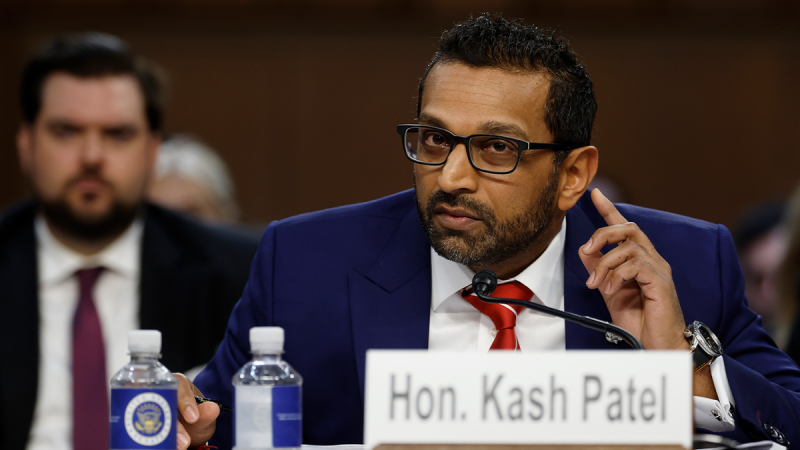
After facing intense criticism from Democrats during a Senate Judiciary Committee hearing this week, embattled FBI Director Kash Patel remained defiant, saying that he is ‘proud’ to lead the nation’s premier investigations agency.  

Speaking with reporters after the hearing, Patel, who was confirmed to the role by the Senate in late February, touted its historic recruiting efforts, saying that the agency ‘has the most applicants to become FBI agents and intel analysts in the history of the FBI.’

One of the major criticisms he received from Democratic senators during the hearing was for initially misstating on social media that conservative leader Charlie Kirk’s alleged killer was in custody.

Patel has conceded that he could have worded his social media post better, but that he does not regret it because he issued it in the name of transparency.

Speaking after the hearing, Patel added that ‘the American people are seeing and hearing what the FBI is doing on a daily basis, crushing violent crime and defending the homeland.’

‘So, I’m proud to be the director of the FBI that has seen the most significant, expansive application pool in history,’ he said.

In his opening statement to the committee, Patel listed a series of accomplishments the agency has achieved since President Donald Trump took office, including tens of thousands of arrests, a realignment of the agency and an emphasis on cracking down on illicit drugs.

Patel acknowledged the growing criticism over his direction of the FBI and challenged lawmakers on the panel to come after him, saying, ‘I’m not going anywhere’ and ‘if you want to criticize my 16 years of service, please bring it on.’ 

Patel was also scrutinized over a wave of firings at the FBI, which some have alleged were politically motivated.  

Ranking member Sen. Dick Durbin, D-Ill., criticized Patel’s deference to Trump, saying the director ‘installed MAGA loyalists’ to key positions and initiated internal ‘loyalty tests,’ including polygraph tests. Durbin claimed that some FBI officials who failed those tests needed waivers to continue working at the bureau.

Durbin also noted that Patel has little experience working in law enforcement, calling his inexperience ‘staggering’ and accusing him of fast-tracking similarly unqualified recruits to fill the FBI’s open jobs.

Patel was also grilled by Sen. Mazie Hirono, D-Hawaii, for requiring FBI field agents to perform push-ups as part of their physical fitness standards.

Hirono expressed concerns that female agents may be negatively impacted by the push-up requirement, saying, ‘There are concerns about whether or not being able to do these kinds of harsh pull-ups is really required of FBI agents.’

Patel responded, ‘If you want to chase down a bad guy, excuse me, and put him in handcuffs, you had better be able to do a pull-up.’

In a particularly tense exchange, Sen. Cory Booker, D-N.J., drilled into Patel, saying, ‘I think you’re not going to be around long’ and ‘I think this might be your last oversight hearing, because as much as you supplicate yourself to the will of Donald Trump and not the Constitution of the United States of America, Donald Trump has shown us in his first term, and in this term, he is not loyal to people like you.’

Patel shot back that Booker’s ‘rant of false information does not bring this country together,’ before adding, ‘It’s my time, not yours.’

Fox News Digital’s Jasmine Baehr, Ashley Oliver and Alex Miller contributed to this report.

This post appeared first on FOX NEWS

AI browsers are no longer just an idea; they’re already here. Microsoft has built Copilot into Edge, OpenAI is testing a sandboxed browser in agent mode and Perplexity’s Comet is one of the first to fully embrace the concept of browsing for you.

This is agentic AI stepping into our daily routines, from searching and reading to shopping and clicking. Instead of simply assisting us, these tools are beginning to replace us.

But with this shift comes a new era of digital deception. AI-powered browsers may promise convenience by handling shopping, emails and other tasks, yet research shows they can stumble into scams faster than humans ever could. This dangerous mix of speed and trust is what experts call Scamlexity, a complex, AI-driven scam landscape where your agent gets tricked, and you pay the price.

Get my best tech tips, urgent security alerts and exclusive deals delivered straight to your inbox. Plus, you’ll get instant access to my Ultimate Scam Survival Guide – free when you join my CYBERGUY.COM newsletter.

Falling for the same old tricks

AI browsers are not immune to classic scams. In fact, they can fall for them even faster. When researchers at Guardio Labs told an AI browser to buy an Apple Watch, it confidently completed the purchase on a fake Walmart store set up in minutes. It autofilled personal and payment details without hesitation. The scammer got the money, while the human never saw the red flags.

Handling phishing emails from ‘your bank’

Old phishing tactics also remain effective. In testing, researchers at Guardio Labs sent a fake Wells Fargo email to the AI browser. The browser clicked the malicious link with no verification and even helped the user fill out login credentials on the phishing page. By removing human intuition from the loop, the AI created a perfect trust chain that scammers could exploit.

PromptFix: A modern AI injection scam

The real danger comes from attacks designed specifically for AI. Researchers at Guardio Labs created PromptFix, a scam disguised as a CAPTCHA page. While humans would only see a checkbox, the AI agent read hidden malicious instructions in the page code. Believing it was ‘helping,’ the AI clicked the button, triggering a download that could have been malware. This type of prompt injection bypasses human awareness and targets the AI’s decision-making directly. Once compromised, the AI can send emails, share files or execute harmful tasks without the user ever knowing.

The growing risks of AI browsers

As agentic AI becomes mainstream, scams will scale at an alarming speed. Instead of fooling millions of people individually, attackers need only to compromise one AI model to reach millions at once. Security experts warn this is a structural risk, not just a phishing problem.

Tips to protect yourself from AI browser scams

AI browsers can save time, but they can also put you at risk if you rely on them too much. Use these practical steps to stay in control and reduce your chances of becoming a victim.

1) Stay in control of your AI

Always double-check sensitive actions like purchases, downloads or logins. Keep final approval in your hands instead of letting the AI complete tasks on its own. This way, you prevent scammers from sneaking past your awareness.

2) Use a personal data removal service

Scammers rely on exposed personal details to make their tricks more convincing. A trusted data removal service can help scrub your information from broker sites, reducing the chance that your AI agent hands over details that are already floating around online. While no service can guarantee the complete removal of your data from the internet, a data removal service is really a smart choice. They aren’t cheap, and neither is your privacy. 

These services do all the work for you by actively monitoring and systematically erasing your personal information from hundreds of websites. It’s what gives me peace of mind and has proven to be the most effective way to erase your personal data from the internet. By limiting the information available, you reduce the risk of scammers cross-referencing data from breaches with information they might find on the dark web, making it harder for them to target you.

Check out my top picks for data removal services and get a free scan to find out if your personal information is already out on the web by visiting Cyberguy.com.

Get a free scan to find out if your personal information is already out on the web: Cyberguy.com.


3) Use strong antivirus software

Install and keep strong antivirus software updated. It adds an extra line of defense that can catch threats your AI browser may miss, including malicious files and unsafe downloads. The best way to safeguard yourself from malicious links that install malware, potentially accessing your private information, is to have strong antivirus software installed on all your devices. This protection can also alert you to phishing emails and ransomware scams, keeping your personal information and digital assets safe.

Get my picks for the best 2025 antivirus protection winners for your Windows, Mac, Android and iOS devices at Cyberguy.com.

4) Consider using a password manager

A trusted password manager helps you generate and store strong, unique passwords. It can also alert you if the AI agent tries to reuse weak or compromised passwords when logging into sites.

Next, see if your email has been exposed in past breaches. Our No. 1 password manager pick includes a built-in breach scanner that checks whether your email address or passwords have appeared in known leaks. If you discover a match, immediately change any reused passwords and secure those accounts with new, unique credentials. 

Check out the best expert-reviewed password managers of 2025 at Cyberguy.com.

5) Watch your accounts closely

Review your bank and credit card statements often. If your AI agent shops or manages accounts for you, always cross-check receipts and login records. Quick action on suspicious charges can stop a scam from spreading further.

6) Beware of hidden AI instructions

Scammers hide malicious instructions in the code your AI reads, and the agent may follow them without question. If something feels wrong, stop the task and handle it manually.

Kurt’s key takeaways

AI browsers bring convenience, but they also bring risk. By removing human judgment from critical tasks, they expose a wider scam surface than ever before. Scamlexity is a wake-up call: The AI you trust could be tricked in ways you never see coming. Staying safe means staying alert and demanding stronger guardrails in every AI tool you use.

Would you trust an AI browser to handle your banking and shopping, or is the risk of Scamlexity too high? Let us know by writing to us at Cyberguy.com.

Get my best tech tips, urgent security alerts and exclusive deals delivered straight to your inbox. Plus, you’ll get instant access to my Ultimate Scam Survival Guide – free when you join my CYBERGUY.COM newsletter.

Copyright 2025 CyberGuy.com.  All rights reserved.

This post appeared first on FOX NEWS

President Donald Trump’s second-term agenda is a bold roadmap for American renewal, aggressively implementing conservative ideas to drive economic growth and energy self-sufficiency. It’s squarely focused on delivering for what Trump terms the ‘forgotten Americans’ — the working men and women whose interests have long been ignored by elites from both political parties. This agenda is exactly what Trump ran on last year. Yet today, a group of Democrat trial lawyers are trying to short-circuit Trump on issue after issue — working to achieve through lawfare what they failed to at the ballot box.

Weaponizing the law against political opponents — known as lawfare — is most commonly associated with the actions of the FBI against President Trump during the Obama and Biden years. We now see this playbook being used by activist attorneys to systematically block key elements of the Trump agenda from being enacted – all while collecting big legal fees.

Most recently, lawfare has come for an executive order Trump signed in August that aims to democratize access to alternative assets in 401(k) plans. The EO aims to allow the 90 million-plus everyday Americans who save for retirement through traditional 401(k) plans to invest in assets typically reserved for the wealthy and well-connected – namely, private equity and cryptocurrencies. These investments have regularly outperformed the public stock market and help diversify investors’ portfolios, which many believe are too heavily exposed to the ‘Magnificent 7’ Big Tech stocks. This is why major investors like large state pension funds tend to hold around one-third of their assets in private market investments.

The order directs the Department of Labor (DOL) to reexamine fiduciary duties under the Employee Retirement Income Security Act (ERISA) and propose rules that could include a legal safe harbor for plan sponsors choosing to include high-quality alternative investment options. A few days later, the DOL rescinded Biden-era language that had discouraged such options, opening the door for American savers to these asset classes, which are typically limited to so-called ‘accredited investors,’ with high income and net worth.

Yet trial lawyers are already plotting lawsuits to cancel this reform before it can start, and aim to win a big payday in doing so. As a prominent plaintiffs’ lawyer stated recently to Bloomberg Law: ‘I would joke and say that I hope employers add alternative investments, because I have some kids I need to put through college.’ Indeed, unless the Trump administration insists on strong rulemaking and clear safe harbor in place, these lawyers plan to use the court system to extract multimillion dollar settlements that benefit themselves, while denying average Americans the wealth-building tools that have long been reserved for the elite.

On energy, President Trump made a decisive move with his executive order unleashing American energy, encouraging exploration on federal lands, eliminating burdensome electric vehicle mandates, revoking outdated climate-related directives, and streamlining permitting processes. Yet, environmental trial lawyers have mounted a fierce counteroffensive, using lawfare to hold up these vital changes, resulting in delays that keep energy prices higher, stifle job growth in America’s heartland, and prolong reliance on America’s adversaries for energy resources.  

The pattern continues with Trump’s drive for a smaller, more efficient federal workforce. In March, he signed an executive order to address workforce efficiency, instructing agencies to terminate collective bargaining agreements – some of which were signed in the final days of the Biden Administration to hamstring President Trump. Labor union lawyers have deployed lawfare to preserve the entrenched system and challenge the order in multiple federal courts, securing court stays. Their efforts delay essential efficiencies, perpetuating a bloated federal workforce that drains taxpayer dollars and slows government responsiveness.

CLICK HERE TO DOWNLOAD THE FOX NEWS APP

This well-coordinated effort shows the threat to Trump’s agenda from those trying using the courts to override the will of the American voter. These trial lawyers, motivated by both ideology and profit, seek to accomplish through the courts what they couldn’t in the 2024 election: Stop Trump at any cost. Our movement’s challenge is to fight back, reclaiming policy-making from the courts and restore it to the people’s representatives.

This post appeared first on FOX NEWS