Author

admin

Browsing

East Star Resources (LSE:EST) and Endeavour Exploration announced they have entered into a binding earn-in and joint venture (JV) agreement to advance gold exploration in Kazakhstan.

Endeavour Exploration, a subsidiary of top gold producer Endeavour Mining (LSE:EDV,TSX:EDV,OTCQX:EDVMF), will have the right to earn up to an 80 percent interest in a new JV company via staged investments.

Stage 1 includes a US$5 million payment within two years, equivalent to a 51 percent interest. If an additional US$20 million is given over three years, its interest will increase to 70 percent.

The last 10 percent will be given to Endeavour if it funds and completes a prefeasibility study.

During the initial phase, East Star will act as manager of the JV.

The area of interest for the partnership includes two proven, underexplored mineral belts.

‘This agreement with Endeavour is a transformational milestone for East Star that validates the quality of our exploration programme and provides a clear pathway to unlock the full potential of our gold exploration strategy,” said East Star Resources CEO Alex Walker in a November 13 press release.

While the JV will focus on gold, East Star is also pursuing copper in Kazakhstan.

Its assets include a volcanogenic massive sulfide deposit with a JORC-compliant resource estimate of 20.3 million metric tons at 1.16 percent copper, 1.54 percent zinc and 0.27 percent lead.

An investor webcast is scheduled for Tuesday (November 18) to discuss the terms of the JV.

Both parties will fund the JV company in proportion to their ownership share after the earn-in period.

Securities Disclosure: I, Gabrielle de la Cruz, hold no direct investment interest in any company mentioned in this article.

This post appeared first on investingnews.com

VVC Exploration Corporation, dba VVC Resources (‘VVC’ or the ‘Company’) (TSX-V: VVC; OTC: VVCVF) announces that, after a project review, it is strategically restructured its mining projects in Mexico.

This project review encompassed multiple considerations, including ongoing maintenance costs, permitting authorizations, political climate, safety, upside potential and financeability of each project and probability of achieving the projects potential.

After this review, the Company has decided to:

  • Exit the Gloria Copper Project located near Samalayuca, State of Chihuahua, Mexico. This long-standing project of the Company is expensive to maintain and is in an area that has become more politically volatile with uncertain safety. The geological potential of the project is not in question, but the ability to achieve that potential is unclear.
  • Focus all mining exploration activity on the Cumeral Gold Project. Cumeral is the Company’s highly prospective gold project in north central Sonora Mexico. This project, while not as advanced as the Gloria Copper Project, has a huge upside potential. It is in an area where there is strong local support for the project and a higher likelihood of permitting and implementation success. The Cumeral Gold Project is a 1,665-hectare property in northern Sonora near Imuris which exhibits quartz-vein–hosted gold in a detachment-fault/orogenic setting with a documented NNW–SSE mineralized trend of ~4 km. Historical work reported that ~36% of 407 grab/chip samples assayed 0.1–10 g/t Au; soil surveys outlined additional anomalies (47 samples >0.020 ppm Au); and air-track drilling intersected broad, near-surface intervals of 0.21–0.44 g/t Au over 6–26 m in key target areas. The Company will continue activities on the Cumeral Gold Project.

Rationale and Next Steps
The Company’s decision reflects consideration of cost discipline, safety and risk management. The exit from the Gloria Copper Project will reduce future cash outlays for care, maintenance, and permitting at amid uncertainty over permit viability and broader political conditions in Chihuahua State. Capital and management resources will be reallocated to the Cumeral Gold Project exploration, and to development of the Company’s helium/natural gas project in the Central Kansas Uplift (CKU) Project where existing infrastructure and near-term activities offer a clearer path to execution.

« There are opportunity costs in every project, » said Jim Culver, CEO. « Exiting the Gloria Copper Project will allow the Company to concentrate resources on projects with an obvious direct and timely route to advancing development while maintaining discipline on risk and spending. »

About VVC Resources
VVC engages in the exploration, development, and management of natural resources – specializing in scarce and increasingly valuable materials needed to meet the growing, high-tech demands of industries such as manufacturing, technology, medicine, space travel, and the expanding green economy. Our portfolio includes a diverse set of multi-asset high-growth projects, comprising: Helium & industrial gas production in western U.S.; Gold & associated metals operations in northern Mexico; and Strategic investments in carbon sequestration and other green energy technologies. VVC is a Canada-based, publicly-traded company on the TSXV (TSX-V:VVC). To learn more, visit our website at: www.vvcresources.com .

On behalf of the Board of Directors
Michel J. Lafrance, Secretary-Treasurer
For further information, please contact:
Emily Bigelow – (615) 504-4621 Patrick Fernet – (514) 631-2727 (French)
E-mail: emily@vvcresources.com E-mail: pfernet@vvcexploration.com


Neither TSX Venture Exchange nor its Regulation Services Provider (as that term is defined in policies of the TSX Venture Exchange) accepts responsibility for the adequacy or accuracy of this release.

2369 Kingston Road, PO Box 28059 Terry Town, Scarborough, ON M1N 4E7 Tel: 416-619-5304

Forward-Looking Statements

This news release contains ‘forward-looking information’ (within the meaning of applicable Canadian securities laws) and ‘forward-looking statements’ (within the meaning of the U.S. Private Securities Litigation Reform Act of 1995). Such statements are generally identified by words such as ‘anticipate’, ‘believe’, ‘expect’, ‘plan’, ‘intend’, ‘potential’, ‘estimate’, ‘propose’, ‘project’, ‘outlook’, ‘foresee’, ‘strategy’, ‘success’ or similar words suggesting future outcomes or statements regarding an outlook. Such statements include, among others: « Exit the Gloria Copper Project ; Focus all mining exploration activity on the Cumeral Gold Project.; The Company will continue activities on the Cumeral Gold Project.; The exit from Gloria will reduce future cash outlay ; resources will be reallocated to Cumeral ; to concentrate resources to advancing development ».

Such forward-looking information or statements are based on several risks, uncertainties, and assumptions which may cause actual results or other expectations to differ materially from those anticipated and which may prove to be incorrect. Assumptions have been made regarding, among other things, management’s expectations regarding future project development and growth, timing and completion of asset divestitures, market conditions for copper, gold, helium, or gas, availability of capital, and the necessity to incur capital and other expenditures. Actual results could differ materially due to a number of factors, without limitation, operational risks in completing anticipated transactions, delays or changes in plans with respect to the development or divestiture of projects, risks affecting the ability to obtain regulatory or governmental approvals, political or permitting risks in Mexico or the United States, the ability to attract key personnel, and fluctuations in commodity prices. No assurances can be given that the efforts by the Company will be successful.

Although the Company believes that the expectations reflected in the forward-looking information or statements are reasonable, prospective investors in the Company’s securities should not place undue reliance on forward-looking statements because the Company can provide no assurance that such expectations will prove to be correct. Forward-looking information and statements contained in this news release are as of the date of this news release, and the Company assumes no obligation to update or revise this forward-looking information and statements, except as required by law. Investors are cautioned that notwithstanding the expectations described herein, there can be no assurance that the plans described herein will be completed as proposed. Trading in the securities of VVC should be considered highly speculative. All forward-looking statements contained in this press release are expressly qualified in their entirety by these cautionary statements and by those made in our filings with SEDAR+ in Canada (available at www.sedarplus.ca ).

News Provided by GlobeNewswire via QuoteMedia

This post appeared first on investingnews.com

Cartier Resources Inc. (″ Cartier ″ or the ″ Company ″) (TSXV: ECR,OTC:ECRFF; FSE: 6CA) is pleased to announce that metallurgical testwork program is underway on samples of the Main Sector from its Cadillac Project, located in Val-d’Or (Abitibi, Quebec). This work will be supervised by Soutex, a firm specializing in mineral processing and metallurgy, located in Quebec City (Quebec).

Methodology of the Metallurgical Testwork Program

A total of 388.7 kg of representative NZ-size half-drill core samples, which 92% of the samples come from holes drilled by Cartier between 2017 and 2023, has been collected from three gold deposits (Chimo, East Chimo and West Nordeau) of the Main Sector (Figure 1) and shipped to ALS Canada Ltd – Metallurgy Services in Kamloops, British Columbia; the details and process of which are provided below:

  • Chimo Deposit: 126.1 kg (composites 1 & 2).
  • East Chimo Deposit: 132.6 kg (composites 3 & 4).
  • West Nordeau Deposit: 130.0 kg (composites 5 & 6).

Figure 1 : Geographic Location of the Composites

The preparation and testing process of the composites of the three deposits will be subject to cyanidation tests at three different grind sizes. After these tests, gravimetric concentration separation followed by a cyanide destruction tests of the gravity tails will be done at the grind size showing the best results. In addition to the metallurgical program, comminution test, as well as chemical and mineralogical characterization, will also be performed to define the grindability of the mineralized material and predict his behaviour in the process (Figure 2).

Figure 2 : Material Preparation and Testing Flowchart of the Composites

Key Objectives of the Program

  • Defining expected gold recovery rates and improving upon historical results from the Chimo deposit.
  • Establishing first-time metallurgical recovery data for the East Chimo and West Nordeau satellite deposits, where no previous data exists.
  • Supporting the development of an integrated process flowsheet .
  • Providing critical data for future trade-off studies to guide project development.

Results from the metallurgical testwork program are expected in Q1 2026 (Figure 3).

Figure 3 : Planned Test Schedule

Milestones of 2025-2027 Exploration Program

100,000 m Drilling Program (Q3 2025 to Q2 2027)

The ambitious 600-hole drilling program will both expand known gold zones and test new shallow surface high-potential targets. The objective is to unlock the camp-scale, high-grade gold potential along the 15 km Cadillac Fault Zone. It is important to note that Cartier’s recent consolidation of this large land holding offers the unique opportunity in over 90 years for unrestricted exploration.

Environmental Baseline Studies & Economic Evaluation of Chimo mine tailings (Q3 2025 to Q3 2026)

The baseline studies will be divided into two distinct parts which include 1) environmental baseline desktop study and 2) preliminary environmental geochemical characterization. The initial baseline studies will provide a comprehensive understanding of the current environmental conditions and implement operations that minimize environmental impact while optimizing the economic potential of the project. These studies will be supplemented by an initial assessment of the economic potential of the past-producing Chimo mine tailings to determine whether a quantity of gold can be extracted economically.

Qualified Person

The scientific and technical content of this press release has been prepared, reviewed and approved by Mr. Ronan Déroff, P.Geo., M.Sc., Vice President Exploration, who is a ″Qualified Person″ as defined by National Instrument 43-101 – Standards of Disclosure for Mineral Projects (″NI 43-101″).

About Soutex

Soutex is a consulting firm in mineral processing and metallurgy that offers specialized services, from the initial stages of development on paper to the daily operations of the processing plant. Their designs stem from their solid experience in providing plant operations support. This support is based on their knowledge of fundamental ore processing principles and their in-plant experience. Founded in 2000 and having offices in Canada (Quebec and Longueuil) and Germany (Munich), Soutex comprises more than 40 metallurgists, process engineers, and technicians, making it one of the largest groupings of specialists in the field in Canada. Services have been offered to clients located across Canada and abroad (West Africa, United States, Finland, New Caledonia, Suriname, and Madagascar).

About Cadillac Project

The Cadillac Project, covering 14,000 hectares along a 15-kilometre stretch of the Cadillac Fault, is one of the largest consolidated land packages in the Val-d’Or mining camp. Cartier’s flagship asset integrates the historic Chimo Mine and East Cadillac projects, creating a dominant position in a world class gold mining district. With excellent road access, year-round infrastructure and nearby milling capacity, the project is ideally positioned for rapid advancement and value creation.

Using a gold price of US$1,750/oz, a Preliminary Economic Assessment demonstrated the economic viability of a 2-km segment, compared to the 15 km that will be the subject of the 100,000 m drilling program, with an average annual gold production of 116,900 oz over a 9.7-year mine life. Indicated resources are estimated at 720,000 ounces (7.1 million tonnes at 3.1 g/t Au) and inferred resources at 1,633,000 ounces (18.5 million tonnes at 2.8 g/t Au). Please see the NI 43-101 ″Technical Report and Preliminary Economic Assessment for Chimo Mine and West Nordeau Gold Deposits, Chimo Mine and East Cadillac Properties, Quebec, Canada, Marc R. Beauvais, P.Eng., of InnovExplo Inc., Mr. Florent Baril of Bumigeme and Mr. Eric Sellars, P.Eng. of Responsible Mining Solutions″ effective May 29, 2023.

About Cartier Resources Inc.

Cartier Resources Inc., founded in 2006 and headquartered in Val-d’Or (Quebec) is a gold exploration company focused on building shareholder value through discovery and development in one of Canada’s most prolific mining camps. The Company combines strong technical expertise, a track record of successful exploration, and a fully funded program to advance its flagship Cadillac Project. Cartier’s strategy is clear: unlock the full potential of one of the largest undeveloped gold landholdings in Quebec.

For further information, contact:
Philippe Cloutier, P. Geo.
President and CEO
Telephone: 819-856-0512
philippe.cloutier@ressourcescartier.com
www.ressourcescartier.com

Neither TSX Venture Exchange nor its Regulation Services Provider (as that term is defined in policies of the TSX Venture Exchange) accepts responsibility for the adequacy or accuracy of this release.

Photos accompanying this announcement are available at:

https://www.globenewswire.com/NewsRoom/AttachmentNg/1858495b-72ed-4b77-a5bf-e47428aed8da

https://www.globenewswire.com/NewsRoom/AttachmentNg/a9b5fdb0-cf7f-4d4e-8362-bb70e1e27572

https://www.globenewswire.com/NewsRoom/AttachmentNg/ae6cbada-64f4-4610-ad98-fa90ea5bb903

News Provided by GlobeNewswire via QuoteMedia

This post appeared first on investingnews.com

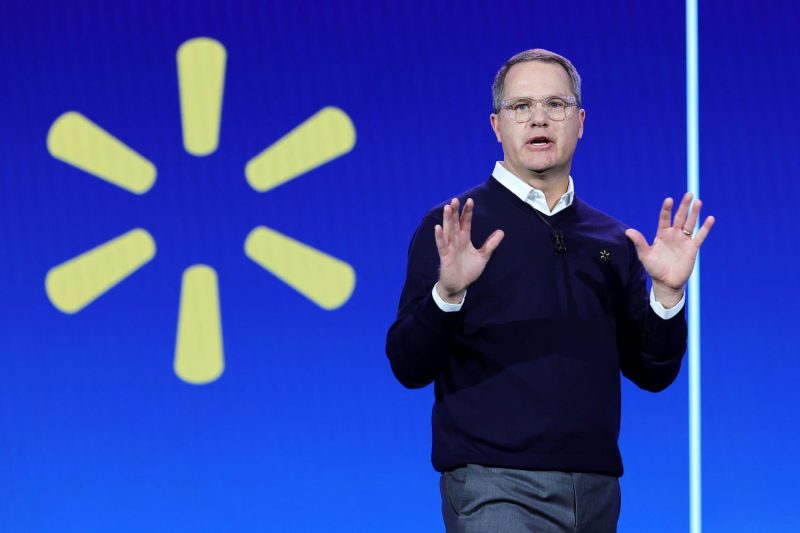
Walmart announced Friday that longtime CEO Doug McMillon will retire at the end of January — which came as a surprise to some given the company’s success in a rapidly evolving retail landscape.

John Furner, Walmart’s U.S. CEO, will assume the role of overall CEO on Feb. 1, the company said. McMillon will continue to serve in an executive and advisory role through January 2027. Furner, 51, began his career at Walmart as an hourly associate.

McMillon, 59, has held the top job since 2014 and is only the fifth person to lead the storied company in its 63-year history.

McMillon has overseen a radical transformation of Walmart’s image in a little over a decade.

In 2014, Walmart had a reputation as a budget retail option and was accused of underpaying its associates. Today, it draws more well-to-do shoppers and has earned credit for adopting innovative personnel policies.

McMillon also built up Walmart’s e-commerce operation into the country’s second-largest, behind only Amazon. Over the course of McMillon’s tenure, the value of Walmart’s shares has increased some 300%.

“Serving as Walmart’s CEO has been a great honor and I’m thankful to our Board and the Walton family for the opportunity,” McMillon said in a statement. “I’ve worked with John for more than 20 years. … He’s uniquely capable of leading the company through this next AI-driven transformation.”

America’s retail landscape continues to rapidly evolve, as consumer spending habits increasingly bifurcate between wealthier households and everyone else.

However, Walmart’s quarterly results have held steady — and the company has been justly rewarded by investors. Just this year, Walmart shares have climbed around 13%. Over the course of McMillon’s tenure, the retailer’s stock price is up some 300%.

On Walmart’s most recent earnings call in August, McMillon indicated the company has been able to withstand the broader pressures facing consumers. Its shoppers’ “behavior has been generally consistent,” he said. “We aren’t seeing dramatic shifts.”

Other retailers have not been so fortunate.

Target’s shares have lost about one-third of their value this year, as the chain works to regain its footing in a more value-conscious environment. In August, longtime CEO Brian Cornell announced plans to step down.

Amazon, meanwhile, has fared slightly better as consumers continue to prioritize the convenience of online shopping. But it recently announced thousands of layoffs affecting corporate employees. Amazon’s share price has climbed about 8% this year.

McMillon has also steered Walmart through a volatile period in U.S. politics, during which elected officials have engaged directly with companies and consumers have proven willing to boycott corporate giants over social issues.

Walmart found itself in President Donald Trump’s crosshairs in May, after it signaled plans to increase some prices in response to his tariffs.

“Walmart should STOP trying to blame Tariffs as the reason for raising prices throughout the chain,” Trump wrote on his Truth Social platform. “Between Walmart and China they should, as is said, ‘EAT THE TARIFFS,’ and not charge valued customers ANYTHING. I’ll be watching, and so will your customers!!!”

While subsequent reports indicated that Walmart had indeed increased prices on some items, McMillon said in August that the changes were gradual enough that consumer habits shifted only modestly.

Six months after Trump singled Walmart out over tariffs, he did so again — but for a very different reason.

In recent weeks, the Trump White House has repeatedly touted Walmart’s 2025 Thanksgiving menu package — which costs less overall than the retailer’s similar menu did last year — as a sign that the president’s economic policies have helped drive down grocery prices for consumers.

But there is a flaw in that rationale. This year’s Walmart Thanksgiving menu contains fewer items than last year’s menu did.

This post appeared first on NBC NEWS

Oversight Committee Republicans are accusing their Democratic counterparts of using the House’s ongoing investigation into Jeffrey Epstein to attack President Donald Trump rather than find closure for the late pedophile’s victims.

Fox News Digital obtained a 10-page internal memo written by GOP committee staff for lawmakers on the panel that argued Democrats intentionally misrepresented information obtained by Republicans to create a narrative that was not there.

‘Unfortunately, during this investigation, Oversight Committee Democrats, led by Ranking Member Robert Garcia (D-Calif.), have intentionally mischaracterized witness testimony and selectively released information with targeted redactions in an effort to create another hoax involving President Trump,’ the memo said.

‘When the Majority released the full set of documents, Democrats claimed that this transparency was meant to ‘disorient’ and ‘distract’ from the false narrative they had been attempting to construct about President Trump.’

The committee’s months-long investigation was launched by a bipartisan push for transparency but has since devolved into partisan fighting as both sides blame the other for focusing on the wrong things.

Democrats have accused Republicans of using the probe to cover for Trump, who was known to have been an associate of Epstein’s but never tied to any wrongdoing.

But the committee’s GOP majority, which has released thousands of pages of documents obtained from both the Department of Justice (DOJ) and Epstein’s own estate, has contended that it is dedicated to transparency for the victims and has accused Democrats of politicizing the probe.

‘The Democrats have uncovered nothing new, have released no document not provided at the request of Republicans, and have only succeeded in reinforcing what the American people already knew: President Trump knew Jeffrey Epstein decades ago, President Trump ended the relationship with Epstein, and President Trump did not participate or know about the nature of Epstein’s evil,’ the memo said.

‘Committee Democrats have overpromised and underdelivered, and now they paw through every new document production looking for a single term: Trump.’

Documents released by the committee so far appear to neither concretely prove nor disprove that Trump was aware of Epstein’s crimes, but the president himself has consistently denied any improper links.

In their memo, Republicans pointed to former Attorney General Bill Barr’s deposition where he appeared to clear Trump of wrongdoing, at least in his knowledge of the probe.

But they accuse Garcia of intentionally twisting the facts by claiming Barr had ‘limited knowledge’ of the case.

The memo also accused Democrats of having ‘selectively leaked’ three emails earlier this month out of roughly 23,000 documents handed over by the Epstein estate in a bid to portray Trump in a negative light.

The GOP memo accused Democrats of having ‘made their own redactions to deceive the media and American people,’ including the name of late Epstein accuser Virginia Giuffre, ‘who stated that she never witnessed wrongdoing by President Trump,’ the memo said.

‘Democrats also redacted ‘she was the one that accused prince andrew’ [sic] in another Epstein email. By making this redaction, Democrats took away important context in the email that named Virginia Guiffre [sic], who worked at Mar-a-Lago, made allegations against Prince Andrew, and was recruited by Ghislaine Maxwell in the parking lot,’ the memo said.

‘This changes the meaning in Epstein’s email where he states, ‘of course he knew about the girls as he asked Ghislaine to stop.’’

The GOP memo also pointed out that Democrats leaked pages of Epstein’s infamous ‘birthday book’ that included Trump but did not publish a message purportedly written by former President Bill Clinton.

It also accused Democrats of failing to help the committee bring in the Clintons for questioning, despite both being issued subpoenas earlier this year. The only figures who have testified so far have been tied to Trump.

‘Democrats are not concerned with transparency or justice,’ the memo said. ‘The evidence the Oversight Committee has gathered does not implicate President Trump in any way. Democrats must stop playing games in this investigation.’

The memo is dated Sunday, two days before the House is expected to vote on a bipartisan bill demanding the DOJ release all of its files related to Epstein.

House GOP leaders had previously been against the effort, arguing the bill as written could lead to the release of information that could harm Epstein’s victims, while also claiming it was unnecessary given the Oversight Committee’s investigation.

But a mechanism known as a discharge petition, led by Reps. Thomas Massie, R-Ky., and Ro Khanna, D-Calif., is allowing the majority of House lawmakers to override leadership’s wishes and force a vote on the bill.

Trump encouraged Republicans to vote in favor of it in a Truth Social post Sunday night, telling the GOP, ‘We have nothing to hide, and it’s time to move on from this Democrat Hoax.’

Fox News Digital reached out to the committee’s Democratic minority for a response.

This post appeared first on FOX NEWS
A majority of Democrats, Independents and Republicans agree that ‘extremist political rhetoric’ contributed to the assassination of conservative activist Charlie Kirk, according to a new poll.

The survey from NBC News found that 54% of Democrats agree that extreme rhetoric from ‘some in the media and by political leaders’ was a major factor in Kirk’s killing. An overwhelming majority of Republicans, 73%, expressed the same sentiment, while 53% of Independents agreed.

Across all respondents, 61% of Americans said they believe rhetoric contributed to Kirk’s death.

Meanwhile, 28% said they believed Kirk’s killing was caused more by the lone actions of a disturbed individual than the broader political climate. Another 4% said it was a combination of the two.

The poll marks the first time in 15 years of NBC News polling that majorities of all major American political groups agree that extreme rhetoric was a major factor in causing a violent incident.

Polls going back to the 2011 shooting of former Rep. Gabrielle Giffords, D-Ariz., show a steady rise in Americans blaming political rhetoric for violence, rather than just a lone individual.

In Giffords’ case, 71% of respondents blamed the lone attacker, while 24% blamed rhetoric. By the time of President Donald Trump’s second assassination attempt, however, 37% blamed the attacker and 54% blamed rhetoric.

Kirk’s alleged killer, Tyler Robinson, faces a capital punishment trial in Utah. Members of his family say he became politically extreme and moved further and further to the left in the year leading up to Kirk’s assassination.

Robinson faces a slew of charges, including aggravated murder, which carries the potential the death penalty. He has not yet entered a plea.

Judge Tony Graf granted a defense motion to allow Robinson to wear civilian clothes in court, citing his constitutional presumption of innocence, but denied a motion to allow him to appear without shackles.

Robinson’s next hearing is scheduled for Jan. 16, 2026, when he is expected to make his first in-person appearance.

Fox News’ Michael Ruiz contributed to this report.

This post appeared first on FOX NEWS

President Donald Trump is set to host Saudi Arabia’s ambitious and influential Crown Prince Mohammed bin Salman at the White House this week for high-level talks aimed at deepening economic and defense ties.

‘We’re more than meeting,’ Trump said on Friday en route to Florida for the weekend. ‘We’re honoring Saudi Arabia, the crown prince.’

While not formally a state visit, the plans include a welcome ceremony with military bands, a bilateral meeting in the Oval Office and a black-tie dinner in the evening.

Prince Mohammed bin Salman serves as the kingdom’s powerful understudy to his 89-year-old father, King Salman. Widely regarded as Saudi Arabia’s de facto ruler, he manages nearly all daily affairs of state and frequently represents the kingdom in international summits and diplomatic meetings.

Tuesday’s meetings will mark Prince Mohammed bin Salman’s first visit to the White House in more than seven years. Trump said last week that he plans to discuss strengthening ties with the Saudi leader and hopes the kingdom will move toward formally recognizing Israel.

‘The Abraham Accords will be a part we’re going to be discussing,’ Trump told reporters Friday. ‘I hope that Saudi Arabia will be joining the Abraham Accords fairly soon.’

Such a move would build on Trump’s signature foreign-policy initiative, the Abraham Accords, which normalized relations between Israel and several Arab nations during his presidency.

The crown prince last visited the White House in 2018, just months before Jamal Khashoggi, a dissident journalist and critic of the kingdom, was murdered at a Saudi consulate in Turkey. 

A subsequent CIA assessment concluded the prince had likely ordered the killing, though he has consistently denied involvement. Even so, Trump’s relationship with the crown prince appeared largely undeterred during his first term.

Trump last met the crown prince during his first state visit of his second term to Riyadh in May, where he was welcomed with a fighter jet escort, an honor guard wielding golden swords and a parade of Arabian horses flanking his limousine.

The Trump administration is also expected to finalize an agreement with bin Salman to allow Riyadh to purchase F-35 stealth fighter jets, Bloomberg reported Friday, citing a White House official.

The two leaders are expected to sign several other economic and defense agreements during the crown prince’s visit to the White House on Tuesday, the report added.

This post appeared first on FOX NEWS

Americans have delivered the same message in the last two elections: make life affordable again. 

They are tired of working harder for less, while the cost of everything — from housing to education to insurance — keeps rising. The affordability crisis touches every household, and its biggest driver is the one Washington refuses to tackle seriously: healthcare. 

Healthcare now consumes nearly one-fifth of our economy. It is the largest single cost for employers, the fastest-growing burden on families, and the quietest drain on national growth. Every dollar businesses spend on bloated health costs is a dollar not available for higher wages, new jobs or investment. Every dollar families spend on premiums or out-of-pocket costs is a dollar they can’t use for savings, housing or opportunity. Until we fix healthcare, we can’t fix affordability. 

It’s not that Washington ignores healthcare — it’s that it thinks about it too narrowly. Politicians obsess over temporary subsidies, tax credits and program expansions that make insurance more expensive to subsidize but never make care itself more affordable. The current fight over extending COVID-era insurance subsidies is a perfect example. Even supporters of Obamacare now admit that the ‘Affordable’ Care Act turned out to be unaffordable. Their answer is to borrow more money to prop up a system that keeps getting worse. That is not reform — it’s surrender.

There are three truths both parties must face. 

First, the system is already too expensive and locked in a pattern that guarantees it will grow more unaffordable every year. 

Second, 60 years of bureaucratic control — public and private — have utterly failed to contain costs.

Third, we must build a new model that relies on patients, doctors and employers — not massive government and insurance-company bureaucracies — to achieve the change Americans want. 

That model is not theoretical — it already works in the rest of our economy. When people have access to clear prices and quality information before making decisions, competition drives innovation, choice and lower costs. Technology has made this possible in every industry, from travel to retail to manufacturing. If the same principles applied to healthcare, we could unleash that same power to lower costs and improve quality. 

Instead, our opaque, bureaucratic system hides prices and multiplies middlemen. The average family of four now spends roughly $27,000 a year on health insurance — about the cost of a new Chevrolet or Toyota every 12 months. Most families don’t see the full bill because their employer or the government pays much of it, but that just means their wages are smaller. Paying the equivalent of a new car every year just for coverage is why Americans list affordability as their top economic concern.

Worse, nobody knows what anything costs — not patients, not families, not even the self-funded employers who pay the claims for their plan members. Bills arrive months after care, after passing through a maze of third-party administrators, repricers and billing vendors. That secrecy fuels waste, fraud and frustration. It’s estimated that 30% to 50% of all healthcare spending is administrative rather than medical. In short, America’s healthcare system has more middlemen than medicine. 

And who benefits? Powerful interest groups, insurers, consultants and bureaucracies that profit from complexity and confusion. As Tom Cruise shouted in ‘Jerry Maguire’: ‘Show me the money.’ Behind the speeches and lobbyists defending this broken system are people determined to protect their share of a bankrupting status quo. 

Second, 60 years of bureaucratic control — public and private — have utterly failed to contain costs.

Politicians can’t fight every entrenched interest group — but millions of patients and doctors armed with real price and quality information can. Transparency gives power back to those who actually deliver and receive care. When they can see what things cost, they can make smarter choices, reward efficiency and hold wasteful players accountable. Transparency doesn’t just lower prices — it changes who holds the power.

That’s why President Donald Trump’s price-transparency executive order in his first administration was a genuine breakthrough. It required hospitals and insurers to publish negotiated prices and, through the No Surprises Act, directed officials to create Advance Explanations of Benefits (AEOBs) so Americans could know their costs before receiving care. Trump started the transparency revolution. Under the Biden administration, enforcement stalled, and patients never saw the full benefit. 

Now Trump has the chance to finish what he began — and make transparency permanent. 

The administration has the authority to act right now under his ‘radical transparency’ executive order issued earlier this year, the No Surprises Act, and existing Employee Retirement Income Security Act authority. The Centers for Medicare & Medicaid Services should immediately issue and enforce AEOB rules. The Department of Labor should guarantee employers access to complete claims and pricing data while protecting patient privacy. If the administration moves quickly, Americans could begin receiving AEOBs in 2026 — and Trump could rightfully claim a historic victory for transparency, competition and higher wages before the midterms. 

Congress should reinforce this effort by passing the bipartisan Patients Deserve Price Tags Act, led by Kansas Republican Sen. Roger Marshall and Colorado Democrat Sen. John Hickenlooper. The bill secures employer access to data and ensures no third-party administrator can hide prices from the people who pay the bills. The executive branch can act today; Congress should make it permanent.

When every patient and employer can see prices, markets will clean out waste on their own. Transparency gives employers the power to negotiate directly with providers and patients the ability to choose wisely. Prices in the open create competition that middlemen can’t survive and costs they can’t hide. The ripple effect — lower costs, higher wages, more investment — will strengthen every part of the economy. 

If America truly wants to make life affordable again, healthcare transparency is where we start.

It’s bold. It’s achievable. And it’s the single biggest step we can take to restore prosperity for working families.   

Disclaimer: Gingrich 360 has consulting clients in the healthcare industry which may be impacted by changes to healthcare laws. 

This post appeared first on FOX NEWS
The War Department is narrowing its research and development strategy to six ‘Critical Technology Areas’ officials say will speed up innovation and strengthen America’s military edge.

Under Secretary of War for Research and Engineering Emil Michael said the plan will deliver faster, more focused results to the warfighter by merging overlapping programs and steering funding toward technologies that will shape future conflicts.

‘As the Department of War’s Chief Technology Officer, I am statutorily charged with the mission of advancing technology and innovation for the armed forces,’ Michael wrote in a Nov. 13 memorandum to senior Pentagon and combatant command leadership. ‘The previous list of fourteen CTAs did not provide the focus that the threat environment of today requires.’

The six areas — Applied Artificial Intelligence, Biomanufacturing, Contested Logistics Technologies, Quantum and Battlefield Information Dominance, Scaled Directed Energy and Scaled Hypersonics — will be advanced through rapid ‘sprints’ designed to move emerging technologies from prototype to production.

Secretary of War Pete Hegseth said the streamlined approach will keep the United States ahead of its rivals.

‘Our nation’s military has always been the tip of the spear,’ Hegseth said. ‘Under Secretary Emil Michael’s six Critical Technology Areas will ensure that our warriors never enter a fair fight and have the best systems in their hands for maximum lethality.’

The initiative also aligns with President Donald Trump’s Artificial Intelligence Action Plan, which directs the War Department to become an ‘AI-First’ organization.

Officials say the shift will reshape how intelligence is processed, how logistics are managed and how weapons systems are deployed.

‘In alignment with President Trump’s Artificial Intelligence (AI) Action Plan, the Department of War must become an ‘AI-First’ organization,’ Michael wrote. ‘When adopted rapidly, AI will fundamentally transform the Department from the enterprise-level, to intelligence synthesis and to warfighting.’

Michael’s plan emphasizes resilience and self-sufficiency on the battlefield. Biomanufacturing will create bio-based materials to reduce reliance on foreign suppliers, while Contested Logistics Technologies will help U.S. forces sustain operations in contested or denied environments.

The goal, he said, is to ensure troops can fight and resupply even when traditional lines are cut. Each new technology area is meant to reinforce that capability.

‘Future warfare will likely be characterized by contested environments in which the Joint Force is challenged to surge, operate into and within the operational theater, and resupply, reconstitute, and recover forces,’ Michael wrote. ‘This CTA will enable the demonstration, validation, and scaling of novel approaches and technologies.’

Other priorities include quantum computing for secure battlefield communications, scaled directed energy systems such as high-energy lasers and high-power microwave weapons, and the expansion of hypersonic capabilities for both offensive and defensive missions.

Each effort depends on close coordination between the Pentagon, private industry and allied militaries to ensure the technologies reach the field quickly.

‘Executing these sprints will require unprecedented coordination between the Office of the Under Secretary of War for Research and Engineering, military departments, combatant commands and other Office of the Secretary of War components,’ Michael said. ‘I am committed to working with you and our partners inside and outside of the Department on these efforts.’

This post appeared first on FOX NEWS
Locksley Resources, Ltd. (ASX: LKY,OTC:LKYRF; OTCQX: LKYRF) announced the company has formalized a research collaboration with Columbia University, one of the United States’ premier institutions in sustainable mineral processing, to advance next-generation recovery and separation of REEs and other energy and technology critical metals from geologic resources in the Mountain Pass region, California.

The research program will be led by Professor Greeshma Gadikota, Director of the Lenfest Center for Sustainable Energy at Columbia University and a leading researcher in electrochemical and CO assisted mineral processing technologies.

The collaboration will work to develop an integrated technology platform for the advanced characterization, recovery and separation of REEs and transition metals from carbonatite, monazite, and silicate ores within the Clark Mountain District, the geological district that hosts both the El Campo Prospect and the adjacent Mountain Pass Mine. More information is available here: https://cdn-api.markitdigital.com/apiman-gateway/ASX/asx-research/1.0/file/2924-03023756-6A1297315&v=undefined.

‘This collaboration with Columbia University expands our U.S. research partnerships into rare earths, complementing our DeepSolv DES work with Rice University on antimony,’ said Kerrie Matthews, chief executive officer of Locksley. ‘Together, these programs significantly strengthen the technical foundation of our U.S. Mine-to-Market strategy and broaden our exposure to emerging American developed processing technologies.

‘The Columbia and Rice University programs together underpin Locksley’s advanced processing strategy in the U.S. Rice University’s work on green hydrometallurgical extraction of antimony and advanced energy storage materials directly complements Columbia’s electrochemical recovery of rare earths, creating a unified, dual-pathway platform for American-controlled critical mineral processing,’ explained Matthews.

Locksley Resources (https://www.locksleyresources.com.au) is focused on critical minerals in the U.S. The company is actively advancing the Mojave Project in California, targeting rare earth elements (REEs) and antimony. Locksley is executing a mine-to-market strategy for antimony, aimed at reestablishing domestic supply chains for critical materials, underpinned by strategic downstream technology partnerships with leading U.S. research institutions and industry partners. This integrated approach, combined with resource development with innovative processing and separation technologies, positions Locksley to play a key role in advancing U.S. critical minerals independence.

Contact: Beverly Jedynak, beverly.jedynak@viriathus.com, 312-943-1123; 773-350-5793.

View original content:https://www.prnewswire.com/news-releases/locksley-enters-into-sponsored-research-agreement-with-columbia-university-to-develop-advanced-sustainable-processing-technologies-for-rare-earth-elements-ree-and-critical-metal-recovery-302616514.html

SOURCE Locksley Resources

News Provided by PR Newswire via QuoteMedia

This post appeared first on investingnews.com