
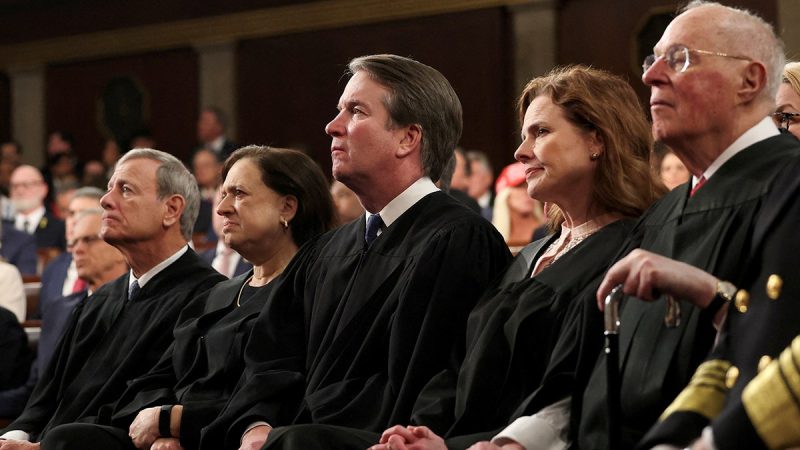
It goes against the very instincts of some of the most powerful officials in the U.S.: get all dressed up, appear before a national TV audience, but sit there like statues without betraying any words or emotion.
For members of the Supreme Court, enduring the annual State of the Union address is a civic exercise in poker-faced discretion. As recent history has shown, that has not always been easy.
Tuesday’s speech by President Donald Trump will be watched closely not only for what is said, but also for who will be there in person to hear it — especially an undetermined number of justices with front-row seats.
This year’s appearances are especially of interest, coming four days after a 6-3 majority of the court struck down the president’s sweeping tariffs, in a sweeping setback to his economic agenda.
Trump lashed out sharply at the court, especially the six members who voted against him, including two he appointed to the bench — Justices Neil Gorsuch and Amy Coney Barrett.
The president said he was ‘ashamed of certain members of the court, absolutely ashamed for not having the courage to do what’s right for the country.’
At least one member of the bench, Justice Samuel Alito, has previously stated he will likely no longer go — after lingering, dramatic criticism leveled at a court ruling by Obama in his 2010 address.
But one or more justices have almost always attended the annual speech to Congress and the nation in recent decades. Court members are not required by law to be there, but custom has dictated their appearance, mostly for show. They are a key, if low-key, part of the pageantry, and are compelled to sit politely and stoically, amid the often high-spirited partisan rhetoric and response of the event.
There is no word yet from the high court on who will appear. Invitations are sent to each chamber, and the justices have individual discretion over whether to go.
Those who do traditionally wear their judicial robes, are escorted into the House as a group, and take prominent seats up front.
Retired justices usually get asked as well, minus the robes. They are joined by other officers of the court, such as the marshal and clerk.
Chief Justice John Roberts and Justice Elana Kagan, along with former Justices Stephen Breyer and Anthony Kennedy, have been regular attendees over the years.
But the ceremony put the justices in a highly uncomfortable position in 2010.
Democrats cheered President Barack Obama when he dressed down high court conservatives for its ruling in Citizens United v. Federal Election Commission, issued a week earlier, which removed legal barriers preventing corporations and unions from spending unlimited sums on federal elections.
‘With all due deference to the separation of powers,’ Obama said, ‘the Supreme Court reversed a century of law to open the floodgates for special interests — including foreign corporations — to spend without limit in our elections.’
Alito, sitting just feet away in the audience, shook his head and mouthed words interpreted as ‘not true,’ referring to the line about ‘foreign corporations,’ court sources later confirmed.
Alito’s five fellow justices in attendance showed no emotion.
He had been a regular at previous addresses, but months after the incident, Alito told an audience in New York that he felt ‘like the proverbial potted plant’ and would not be attending in the near future. In fact, the year after the presidential dress-down, Alito was in Hawaii at a law school symposium.
The now 75-year-old justice also, with a smile, noted that his colleagues ‘who are more disciplined, refrain from manifesting any emotion or opinion whatsoever.’
Roberts labeled the political atmosphere at the 2010 address ‘very troubling.’
The head of the federal judiciary has said partisan rhetoric and gestures aimed at the court left him questioning whether his colleagues should continue to attend.
During that 2010 address, members of Congress sat just behind the justices, many applauding loudly when Obama made his remarks about the court’s election spending case, especially Sen. Charles Schumer, D-N.Y.
‘It does cause me to think whether or not it makes sense for us to be there’ Roberts said weeks after the controversy. ‘To the extent the State of the Union has degenerated into a political pep rally, I’m not sure why we’re there.’
Then-White House press secretary Robert Gibbs responded quickly at the time with an indirect attack on Roberts, saying ‘the only thing troubling’ was the Citizens United ruling itself.
Regardless, Roberts has never missed a State of the Union as chief justice.
That included 2021 with President Joe Biden’s address to a joint session of Congress that was limited in attendance because of the pandemic. The sparse, widely-separated crowd included Roberts, a few Cabinet officers and a smattering of congressional members, all wearing masks.
Some justices were regular no-shows at the State of the Union, including John Paul Stevens, who stepped down from the court months after the 2010 State of the Union.
Roberts’ predecessor, Chief Justice William Rehnquist, also rarely appeared in person, once because he considered a painting class more preferable.
Justice Clarence Thomas called it ‘very uncomfortable for a judge to sit there.’ He went to Obama’s first annual address in 2009, but has not been back since.
‘There’s a lot that you don’t hear on TV,’ he once said, ‘the catcalls, the whooping, hollering and under-the breath comments.’
Another more vocal no-go was the late Justice Antonin Scalia, who compared the televised State of the Union to ‘cheerleading sessions.’
‘I don’t know at what point that happened, but it has happened, and now you go and sit there like bumps on a log while applause lines cause one half of the Congress to leap up while [another line] causes the other half to leap up,’ he once said. ‘It is a juvenile spectacle. And I resent being called upon to give it dignity.’
He last attended the event in 1997, but did attend a special joint session of Congress after the 9/11 terror attacks in 2001, with four other justices.
Scalia, a generally verbose and animated jurist, said bluntly: ‘You just sit there, looking stupid.’
Even remarks touching on supposedly nonpartisan topics like patriotism, war veterans and puppy dogs leave the justices in a quandary: should they applaud, should they stand and applaud or do neither? The protocols are never clear, and the public might view the court members as aloof or uncaring if they offer no reaction during, say, a salute to Martin Luther King Jr.’s memory, when everyone else is shown engaging in bipartisan applause in the chamber.
One ‘extra-court-ricular’ event that is a must-attend for the Supreme Court is the presidential inauguration. All nine members were at last year’s public swearing-in for Trump to a second four-year term. Roberts and Kavanaugh had official duties to administer the oaths of office to the president and vice president, respectively, but the other seven justices only had to sit there, again quietly, in the Capitol Rotunda.
Breyer is the one justice who might be called a ‘regular’ at the State of the Union, going to nearly all of them since joining the court in 1994, including one in his retirement.
He missed President Bill Clinton’s last annual address in 2000 because of the flu. That year, no justices were in attendance.
Many believe the justices have to go to such events, that it is just another unwanted chore of office. Not so, Breyer told us in 2005. ‘People attend if they wish to attend. I do wish to attend, so I go.’
Here’s a list of Supreme Court members attending recent State of the Union or equivalent Joint Session of Congress addresses in recent years, based on Fox News research and congressional records. Names are listed by seniority:
– 2025: John Roberts, Elena Kagan, Brett Kavanaugh, Amy Coney Barrett, Anthony Kennedy (retired)
– 2024: Roberts, Sonia Sotomayor, Kagan, Neil Gorsuch, Kavanaugh, Ketanji Brown Jackson, Kennedy (retired)
– 2023: Roberts, Kagan, Kavanaugh, Barrett, Jackson, Kennedy, Stephen Breyer (retired)
– 2022: Roberts, Breyer, Kagan, Kavanaugh, Barrett
– 2021: Roberts (limited speech attendance because of pandemic)
– 2020: Roberts, Kagan, Gorsuch, Kavanaugh
– 2019: Roberts, Kagan, Gorsuch, Kavanaugh
– 2018: Roberts, Breyer, Kagan, Gorsuch
– 2017: Roberts, Kennedy, Breyer, Sotomayor, Kagan
– 2016: Roberts, Kennedy, Ruth Bader Ginsburg, Breyer, Sotomayor, Kagan
– 2015: Roberts, Kennedy, Ginsburg, Breyer, Sotomayor, Kagan
– 2014: Roberts, Kennedy, Ginsburg, Breyer, Kagan
– 2013: Roberts, Kennedy, Ginsburg, Breyer, Sotomayor, Kagan
– 2012: Roberts, Kennedy, Ginsburg, Breyer, Kagan
– 2011: Roberts, Kennedy, Ginsburg, Breyer, Sotomayor, Kagan
– 2010: Roberts, Kennedy, Ginsburg, Breyer, Samuel Alito, Sotomayor
– 2009: Roberts, Kennedy, Clarence Thomas, Ginsburg, Breyer, Alito
– 2008: Roberts, Kennedy, Breyer, Alito
– 2007: Roberts, Kennedy, Breyer, Alito
– 2006: Roberts, Thomas, Breyer, Alito
– 2005: Breyer
– 2004: Breyer
– 2003: Breyer
– 2002: Kennedy, Breyer
– 2001: Breyer
– 2000: None
– 1999: Sandra Day O’Connor, Kennedy, David Souter, Thomas, Ginsburg, Breyer
– 1998: William Rehnquist, O’Connor, Souter, Thomas, Breyer
– 1997: Antonin Scalia, Kennedy, Souter, Thomas, Ginsburg, Breyer, Byron White (retired)
– 1996: Rehnquist, O’Connor, Kennedy, Thomas, Ginsburg, Breyer
– 1995: Rehnquist, O’Connor, Scalia, Ginsburg, Breyer, Harry Blackmun (retired)